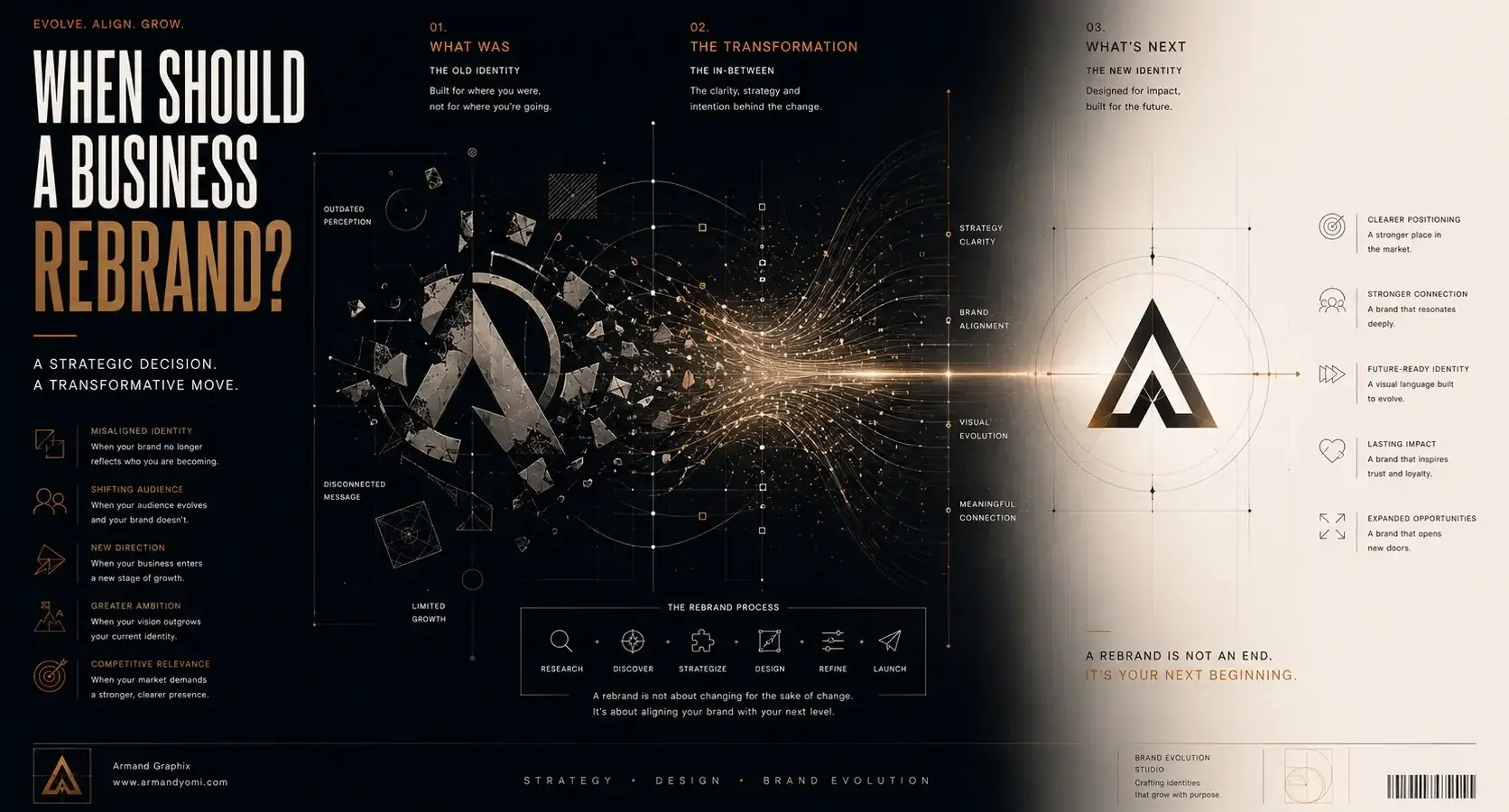
A business rarely wakes up one morning and suddenly needs a rebrand. More often, the signs have been building for months – or years. The website feels dated, the logo no longer reflects the quality of the offer, marketing looks inconsistent across channels, or the business has simply outgrown the identity it launched with. If you’re asking when should a business rebrand, the real question is usually this: does your current brand still match who you are, who you serve, and where you’re going?
That distinction matters. A rebrand is not just a design update. It is a strategic decision that affects perception, positioning, trust, and growth. Done well, it creates clarity and momentum. Done too early, too late, or for the wrong reasons, it can create confusion and dilute recognition.
“Is Your Brand Ready for Its Next Chapter ?”
Discover the key signs that your business has outgrown its current identity and learn when a strategic rebrand can create new opportunities.
Evaluate Your Brand →When should a business rebrand for strategic reasons?
The strongest reason to rebrand is misalignment. Your brand should tell a coherent story about your value. When the story customers see no longer matches the experience you deliver, the gap starts costing you.
Sometimes that gap shows up visually. Your identity may look generic, amateur, or inconsistent compared with the caliber of your work. In other cases, the problem is deeper. The market may have changed, your audience may have shifted, or your services may have evolved far beyond what your original messaging can hold.
A business should consider rebranding when its current brand creates friction instead of confidence. That friction can show up in sales conversations, low conversion rates, weak recall, pricing resistance, or the sense that you’re attracting the wrong clients. If the business has matured but the brand still looks like version one, people notice.
The clearest signs your brand no longer fits
One common trigger is growth. A startup identity often works well in the early stages because speed matters more than polish. But once the business gains traction, expands its offer, or moves into a more competitive market, that early brand can start to feel too small for the next chapter.
Another sign is a major shift in positioning. If you started with one audience and now serve another, your visual language and messaging may no longer resonate. A company that once spoke to budget-conscious buyers may now be targeting premium clients. A founder-led personal brand may be transitioning into a studio, agency, or multi-service business. In both cases, the old brand can limit perceived value.
Rebranding also makes sense after a merger, acquisition, or structural change. If the business model has changed, the brand architecture needs to support that reality. Otherwise, customers are left trying to connect dots they should not have to connect.
Then there is the practical issue of inconsistency. Many businesses have a logo, a few colors, and a website, but not a true brand system. Over time, that lack of structure leads to fragmented presentations across social media, print materials, packaging, advertising, and digital campaigns. The result is not just messy design. It weakens credibility.
When should a business rebrand versus refresh?
Not every brand problem calls for a full rebrand. This is where many businesses overspend or overcorrect.
If your core positioning is still right, your audience still connects with your message, and your brand has meaningful recognition, a refresh may be enough. That might involve refining the logo, updating typography, improving your website, tightening your messaging, or building a more consistent visual system. The foundation stays intact, but the execution gets sharper.
A full rebrand is more appropriate when the foundation itself is no longer serving the business. That means your name, brand story, positioning, visual identity, voice, or market perception needs significant change. In that case, polishing the surface will not solve the real issue.
The difference comes down to depth. A refresh improves how the brand looks and functions. A rebrand redefines what the brand means.
Bad reasons to rebrand
Some businesses rebrand because they are bored. Others do it because a competitor launched something new and suddenly their own identity feels less exciting. Neither reason is strong enough.
Branding is not seasonal fashion. Recognition has value. If customers know you, trust you, and associate your brand with a clear promise, changing it casually can do more harm than good.
Another weak reason is following trends too closely. Trend-aware design has its place, but trend-dependent branding ages fast. A rebrand should create a stronger long-term position, not just a more current look for the next six months.
There is also a common internal trap: using rebranding to solve operational problems. If customer service is poor, the offer is unclear, or the product-market fit is weak, a new visual identity will not fix the underlying issue. Design can amplify a strong business. It cannot disguise a broken one for long.
Timing matters more than most businesses think
Even when a rebrand is justified, timing can make or break the rollout.
The best time to rebrand is often just before a major growth phase, not in the middle of one. If you are preparing to launch a new service, enter a new market, raise your prices, improve your digital presence, or scale your marketing, that is usually a smart window. It gives the new brand context and momentum.
Rebranding in the middle of chaos is harder. If your team is overwhelmed, your systems are unstable, or your business model is still changing weekly, you may not yet have the clarity needed to build the right brand. In that situation, it can be smarter to stabilize first, then rebrand from a more strategic place.
That said, waiting too long also has a cost. A weak brand can quietly reduce marketing performance, limit referrals, and make every sales conversation harder than it needs to be. If your current identity is actively undermining trust, delay becomes expensive.
What a good rebrand should actually accomplish
A successful rebrand should do more than make the business look better. It should create alignment between perception and reality.
That means your visual identity reflects your level of quality. Your messaging communicates a sharper value proposition. Your brand voice speaks to the right audience. Your website supports credibility and conversion. Your marketing becomes easier to execute because the strategy and design are finally working together.
For businesses trying to grow, this is where the real value lives. A stronger brand can justify better pricing, improve consistency across channels, and make your audience understand you faster. It becomes easier to present your business with confidence because the brand is carrying its share of the conversation.
This is especially true for founder-led businesses and growing small brands. When the identity is underdeveloped, the founder often has to overexplain everything. A strategic brand reduces that burden. It signals positioning before a pitch even begins.
How to know you’re ready
Readiness is not about having a perfect plan. It is about having enough clarity to make meaningful decisions.
You are likely ready to rebrand if you can clearly define your audience, articulate your offer, explain how you are different, and identify what is not working in the current brand. You do not need every answer, but you do need direction.
It also helps to know what success looks like. Are you trying to attract a higher-value client base? Improve market perception? Support a product launch? Create consistency across touchpoints? Strengthen digital performance? The more specific the objective, the more effective the rebrand will be.
This is one reason the strongest rebrands combine storytelling, design, and marketing strategy. A brand is not just seen. It is experienced across platforms, campaigns, and customer decisions. That broader view is what turns a rebrand from an aesthetic project into a growth asset.
When should a business rebrand if customers already know the old brand?
This is where nuance matters. Familiarity is valuable, but only if it is helping. If your existing recognition is tied to outdated perception, unclear positioning, or a lower-value version of the business, protecting it at all costs can hold you back.
The key is not to erase equity without purpose. The best rebrands preserve what people trust while evolving what no longer serves the business. Sometimes that means keeping the name and changing the system around it. Other times it means making a bigger shift, but doing so with careful messaging and rollout.
A thoughtful transition gives people a bridge from the old identity to the new one. It respects recognition while making the future clearer.
For businesses investing in better design, sharper messaging, and stronger market visibility, the question is rarely whether branding matters. It does. The real question is whether your current brand is helping you grow or quietly holding you in place. When the answer becomes obvious, the timing usually is too.
The right rebrand does not make your business feel different for the sake of change. It makes your business look, sound, and perform more like what it has already become.
“A Strong Brand Evolves With Your Business”
Learn how thoughtful rebranding can refresh your positioning, strengthen customer perception, and align your identity with your future goals.
Start Your Rebrand Journey →- WordPress Versus Custom Websites for Growing Brands
 WordPress versus custom websites: compare cost, speed, control, SEO, and growth to choose a site that supports your brand and business goals clearly.
 - What Does Brand Strategy Include for Growth?
 What does brand strategy include? Learn the research, positioning, identity, messaging, and marketing choices that turn a business into a distinct brand.
 - Packaging Design Guide for Retail Brands
 A packaging design guide for retail brands: build shelf impact, meet production realities, and turn a first glance into a confident purchase decision.
 - Multicultural Branding Trends 2026 for Modern Brands
 Multicultural branding trends 2026 will reward brands that pair cultural intelligence, inclusive design, and local relevance with measurable, real growth.
 - Custom Logo vs Template: What Fits Your Brand?
 Custom logo vs template: compare cost, speed, ownership, and brand impact to choose an identity that builds your launch, growth, and reputation today.
 - What Is a Visual Identity? Design That Builds Trust
 What is a visual identity? Learn how logos, color, typography, and systems create recognition, trust, and stronger brand growth for ambitious businesses.