A customer picks up your product for the first time. Before they read a single word, the packaging has already said something about your brand. It has signaled quality, price point, personality, and attention to detail. That is why the question of custom packaging vs stock packaging is not just about boxes or labels. It is a brand decision with real commercial consequences.
For some businesses, stock packaging is the smartest move. For others, custom packaging creates the kind of shelf presence and recall that generic solutions simply cannot match. The right choice depends on where your brand is now, what your customers expect, and how much performance you need from the packaging itself.
“Your Packaging Should Be More Than a Container”
Discover how custom packaging can strengthen brand identity, improve customer perception, and create memorable product experiences.
Create Custom Packaging →Custom packaging vs stock packaging: what is the difference?
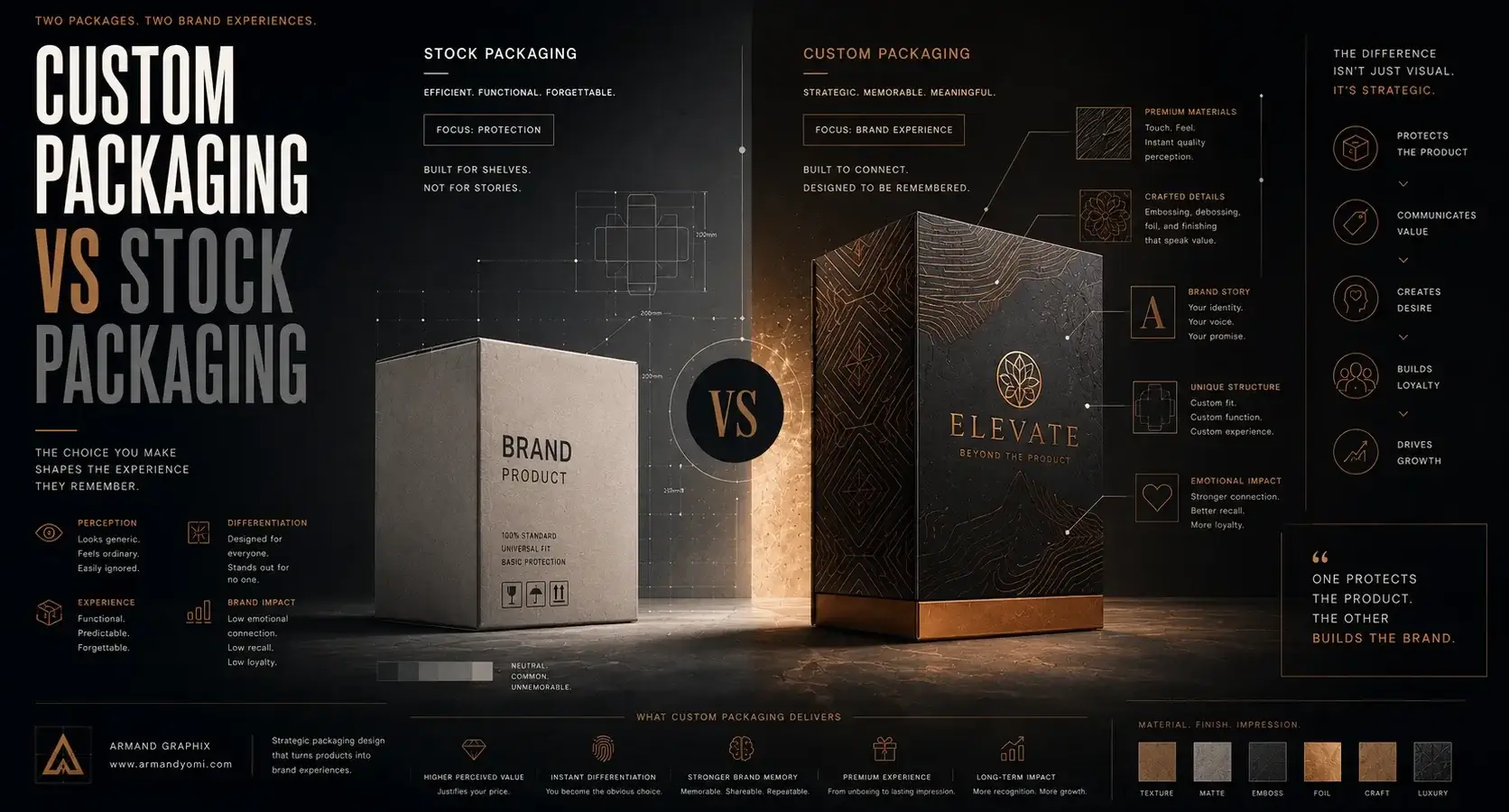
Stock packaging is pre-made packaging available in standard sizes, formats, and finishes. Think plain mailer boxes, standard pouches, generic bottle shapes, or simple cartons that can be ordered quickly and used with minimal customization. In many cases, the only branded element is a sticker, sleeve, stamp, or label.
Custom packaging is designed around your specific product and brand. That can mean a fully tailored box structure, custom dimensions, original graphics, premium finishes, inserts, unusual opening experiences, or packaging systems created to support retail display, shipping performance, and storytelling all at once.
The distinction matters because packaging does more than protect a product. It influences perception, affects logistics, supports compliance, shapes unboxing, and often determines whether a brand looks established or forgettable.
When stock packaging makes more sense
Stock packaging is often the better choice for newer brands, lean product launches, seasonal tests, or operationally simple businesses. If you are validating demand, watching cash flow closely, or selling a product where packaging plays a limited emotional role, standard packaging can be a strong strategic decision.
Its biggest advantage is speed. Stock options are usually faster to source and easier to reorder. That matters when timelines are tight or inventory needs change quickly. If you are launching a small batch, preparing for a local market, or testing an ecommerce offer, you may not want to wait through a full custom development process.
Cost is the other clear benefit. Custom packaging usually requires design time, prototyping, tooling, and larger production commitments. Stock packaging lowers that barrier. You can put a product in market without tying up too much budget in structural development.
There is also a practical side that many founders appreciate. Standard packaging is simpler to manage. Sizing is predictable, replacement is easier, and the operational learning curve is lower. For a startup still building systems, that simplicity can be worth more than a polished unboxing moment.
That said, stock packaging has limits. It may fit awkwardly, waste space, increase filler use, or make your product look interchangeable with competitors. If the market is crowded, generic packaging can quietly weaken your positioning.
When custom packaging earns its cost
Custom packaging starts to make sense when packaging is part of the brand experience, not just a container. If your product is giftable, premium, design-led, highly visual, or sold in a competitive retail environment, custom packaging can do real strategic work.
First, it improves fit. Packaging designed around the product can reduce movement, improve protection, and create a more refined presentation. That can lower damage rates in shipping and reduce the need for excessive void fill.
Second, it strengthens brand recognition. Distinct color systems, typography, structure, and finishing create consistency across touchpoints. Customers begin to recognize your brand before they even see the logo clearly. That kind of recall is hard to build with standard packaging and a label slapped on top.
Third, it supports pricing power. People do not only buy products. They buy confidence, emotion, and perceived value. Well-designed packaging can help a product feel more premium, more intentional, and more trustworthy. In many categories, that translates directly into stronger margins.
Custom packaging also gives you more control over storytelling. You can guide how the customer opens the product, what message they encounter first, what details reinforce your positioning, and how the experience extends into social sharing or repeat purchase. That is where design starts acting like marketing.
The real trade-off: efficiency vs distinction
Most decisions around custom packaging vs stock packaging come down to one tension: efficiency versus distinction.
Stock packaging favors operational ease. It helps you move fast, spend less upfront, and keep production simpler. Custom packaging favors differentiation. It helps you shape perception, sharpen market position, and build a stronger experience around the product.
Neither is automatically better. A practical skincare startup with five products and limited capital may do well with elegant stock cartons and excellent labels. A premium candle brand entering boutiques may need custom structures and finishes to justify its price point. The right answer depends on what the packaging needs to achieve.
If your packaging only needs to protect the product and look clean, stock may be enough. If it needs to persuade, elevate, and create memorability, custom often becomes a better investment.
Cost is not just the invoice
It is easy to compare the unit cost of custom and stock packaging and stop there. That is rarely the full picture.
Stock packaging may be cheaper per unit upfront, but it can create hidden costs. Oversized boxes may increase shipping fees. Poor fit may increase breakage. Generic presentation may weaken conversions, reduce shelf appeal, or make your product harder to remember.
Custom packaging may cost more initially, but it can reduce waste, improve handling, support stronger pricing, and create better customer perception. In some cases, it becomes part of the reason people choose your product at all.
This is where strategic design matters. Good packaging is not decoration. It is a performance asset. It should solve functional problems while reinforcing the story your brand wants customers to believe.
How to decide what your brand actually needs
A better packaging decision starts with sharper questions.
Ask how your product is sold. Ecommerce packaging has very different demands than retail packaging. Online, durability and unboxing matter more. On shelf, visibility and differentiation become more critical.
Ask what role perception plays in the purchase. If customers compare products quickly and visually, packaging carries more weight. If your product is highly commoditized, stronger design may be one of the few ways to create separation.
Ask how stable your product line is. If sizes, formulas, or formats are still changing, heavy investment in custom structures may be premature. If your brand has a stable lineup and clear growth plans, custom packaging becomes easier to justify.
Ask what your audience expects. Budget-conscious buyers may not need elaborate presentation. Premium buyers usually do. If your packaging does not match the promise your marketing makes, trust erodes fast.
And ask whether your current packaging helps or hurts growth. If it creates friction, feels forgettable, or undercuts your positioning, that is a signal. The cheapest option is not always the most affordable in the long run.
A hybrid approach often works best
For many brands, the smartest answer is not purely stock or purely custom. It is a thoughtful mix.
You might use stock structures with custom labels, branded inserts, and a refined color system. You might begin with standard mailers for ecommerce while investing in custom retail packaging for top-selling SKUs. You might reserve premium custom packaging for gift sets, launches, or wholesale accounts where presentation has a bigger sales impact.
This hybrid model gives growing businesses flexibility. It protects budget while still creating moments of distinction where they matter most. It also allows packaging to evolve with the brand instead of forcing a major investment too early.
That approach is especially useful for founders who care deeply about design but also need packaging decisions to support margins and scalability. Strong branding is not about spending more. It is about spending with intention.
Custom packaging vs stock packaging for growing brands
As your business grows, your packaging should grow with it. What works for a first production run may not support wholesale expansion, better shelf placement, or a more premium market position six months later.
That is why packaging should be reviewed as part of a broader brand system, not treated as an isolated production task. Visual identity, messaging, customer expectations, photography, and product marketing all intersect here. When those elements align, packaging feels credible. When they do not, even expensive packaging can miss the mark.
At Armand Graphix, that is often the real conversation behind packaging design. Not simply what looks good, but what expresses the brand clearly and performs in the market.
The best packaging choice is the one that fits your current stage while leaving room for the brand you are building next. If stock packaging gives you speed and breathing room, use it well. If custom packaging helps your product earn attention and trust, invest in it with purpose. Packaging is never just the wrap. It is part of the story customers decide to believe.
“Choose Packaging That Supports Your Brand Vision”
Understand the difference between stock and custom packaging and discover which approach creates stronger long-term brand value.
Explore Packaging Options →- WordPress Versus Custom Websites for Growing Brands
 WordPress versus custom websites: compare cost, speed, control, SEO, and growth to choose a site that supports your brand and business goals clearly.
 - What Does Brand Strategy Include for Growth?
 What does brand strategy include? Learn the research, positioning, identity, messaging, and marketing choices that turn a business into a distinct brand.
 - Packaging Design Guide for Retail Brands
 A packaging design guide for retail brands: build shelf impact, meet production realities, and turn a first glance into a confident purchase decision.
 - Multicultural Branding Trends 2026 for Modern Brands
 Multicultural branding trends 2026 will reward brands that pair cultural intelligence, inclusive design, and local relevance with measurable, real growth.
 - Custom Logo vs Template: What Fits Your Brand?
 Custom logo vs template: compare cost, speed, ownership, and brand impact to choose an identity that builds your launch, growth, and reputation today.
 - What Is a Visual Identity? Design That Builds Trust
 What is a visual identity? Learn how logos, color, typography, and systems create recognition, trust, and stronger brand growth for ambitious businesses.