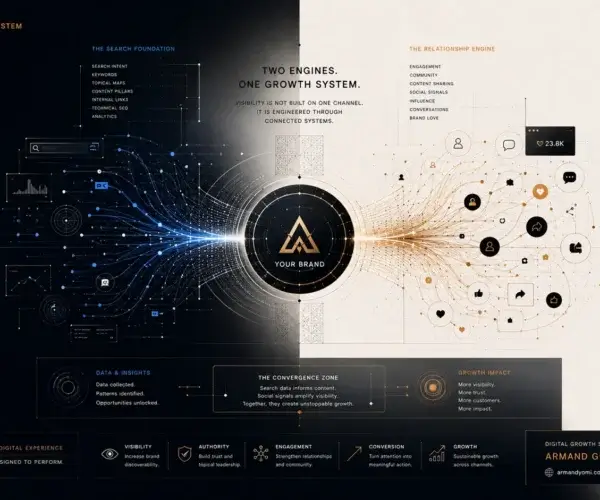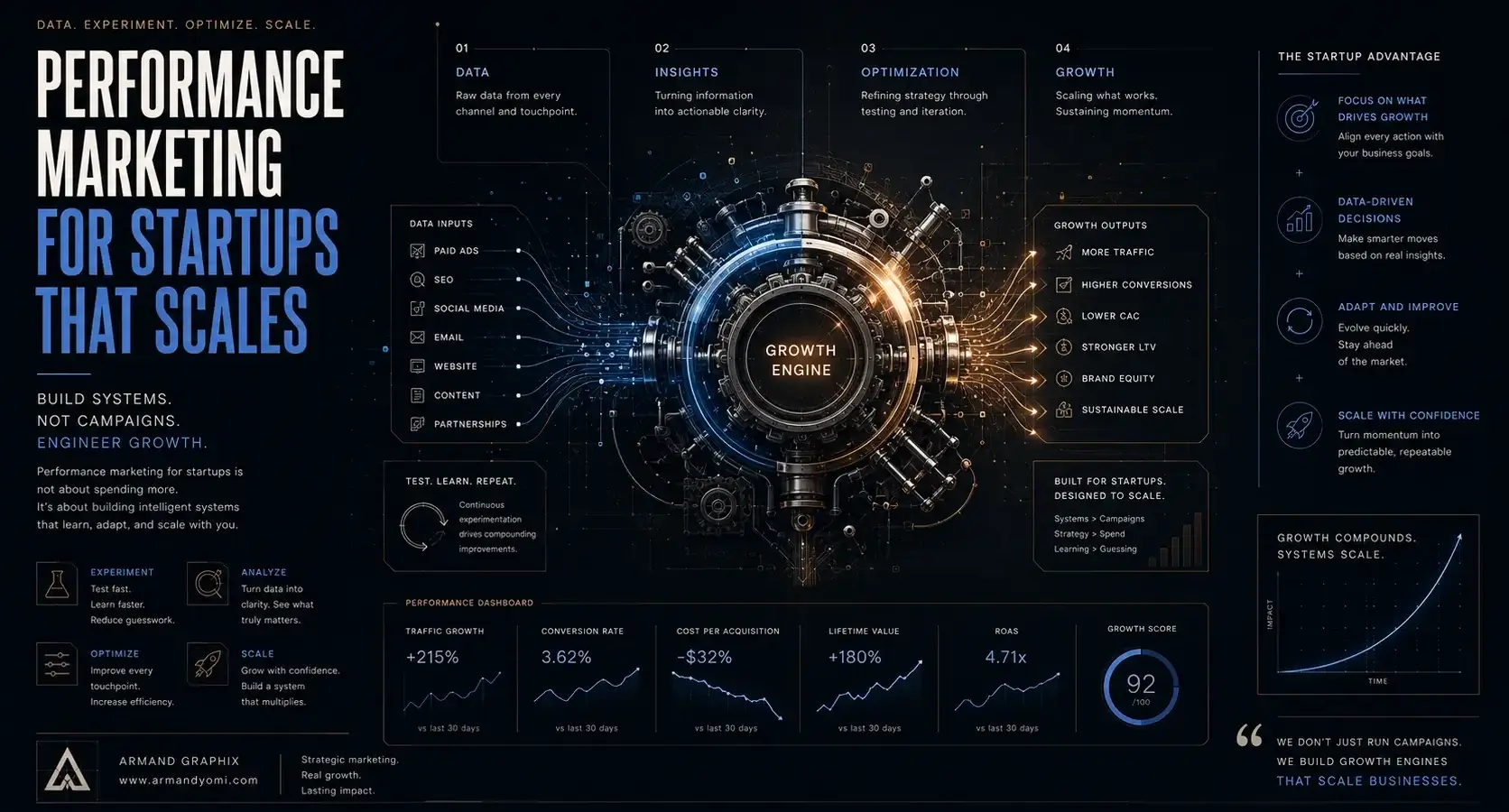
A lot of startups make the same expensive mistake early – they treat growth like a traffic problem when it is really a clarity problem. If your offer is fuzzy, your positioning is forgettable, or your landing page feels generic, no amount of media spend will save the campaign. That is why performance marketing for startups starts before the first ad goes live.
The strongest startup growth systems are not built on hacks. They are built on alignment between message, audience, creative, and measurement. When those pieces work together, paid search, social ads, SEO, and retargeting become more than channels. They become a repeatable engine for customer acquisition.
“Build a Marketing System That Scales With Your Startup”
Discover how performance marketing helps startups test faster, optimize smarter, and build predictable growth engines.
Scale Your Growth Strategy →What performance marketing for startups actually means
Performance marketing for startups is a results-driven approach to promotion where spend is tied to measurable actions such as clicks, leads, demos, purchases, or subscriptions. The appeal is obvious. Startups cannot afford vague awareness campaigns with no line of sight to revenue.
But the term gets oversimplified. Performance marketing is not just running ads and checking cost per click. For early-stage companies, it is the discipline of finding where demand lives, shaping a message people respond to, and improving the full path from first impression to conversion.
That path includes your brand. A startup with a strong visual identity and a clear story often outperforms a cheaper, noisier competitor because trust compounds. People judge credibility quickly. They notice design, language, consistency, and whether the experience feels intentional.
Start with the foundation, not the platform
Founders often ask which channel they should use first. Google Ads. Meta. LinkedIn. TikTok. SEO. The honest answer is that the best first move depends on your audience, sales cycle, and offer maturity. The wrong answer is choosing a platform before tightening your fundamentals.
Before you spend, get clear on three things. First, who are you trying to reach, specifically? Not just “small businesses” or “busy professionals.” You need a sharper picture of buyer pain, urgency, objections, and intent. Second, what makes your offer different in a way the market can understand quickly? Third, what action do you want people to take now?
If those answers are weak, campaign performance will be weak too. Creative can attract attention, but it cannot fix confusion.
The best channels depend on buying intent
Not all startup channels work the same way, and not all traffic has the same temperature. Search marketing usually captures existing intent. Social often creates or shapes intent. SEO builds long-term visibility but takes patience. Retargeting helps recover interest that did not convert the first time.
For a startup selling a high-intent solution, paid search can be powerful because it reaches people actively looking for an answer. If someone searches for a software category, a service type, or a specific problem, the path to conversion can be relatively direct. The trade-off is cost. Competitive keywords can be expensive, and weak landing pages waste that spend fast.
Social media advertising works differently. It is stronger when your product needs explanation, your brand has visual appeal, or your audience responds to storytelling. This is where creative strategy matters. Strong design, clear hooks, and audience-aware messaging can create momentum even when people were not searching for you. The trade-off is that conversion paths are often longer, so measurement needs more nuance.
SEO is attractive because it compounds. For startups with limited cash but strong expertise, it can become a durable acquisition asset. The challenge is timing. SEO rarely solves an immediate revenue gap. It rewards consistency, quality, and a site architecture built to support discoverability.
Email and retargeting deserve more respect than they often get. Most startups focus too hard on acquiring cold traffic and forget to nurture interest already earned. If a prospect visits, signs up, or engages once, that is not the end of the story. It is the beginning of a better conversation.
Why brand matters more than most growth advice admits
There is a persistent myth that early-stage companies should ignore brand and focus only on performance. In practice, the best results usually come from combining both. Brand gives your marketing memory. Performance gives it momentum.
When a startup looks inconsistent, sounds generic, or feels visually interchangeable, every click becomes harder to convert. People hesitate. They compare. They leave. On the other hand, when the experience feels polished and distinct, acquisition gets more efficient because trust shows up earlier in the journey.
This is especially true in crowded categories. If several competitors offer similar features, your identity becomes part of the product. Design that tells your story is not decorative. It shapes perception, and perception affects conversion.
That is one reason brand-led startups often scale more cleanly. Their campaigns are not just optimized for response. They are built around a recognizable narrative, making every touchpoint stronger.
Metrics that matter early on
Startup teams often track too much or the wrong things. Impressions and clicks can be useful signals, but they are not proof of progress on their own. What matters most depends on your model.
If you are validating demand, focus on conversion rate, cost per lead, and the quality of those leads. If you are selling directly online, customer acquisition cost and return on ad spend matter more. If your deal cycle is longer, look beyond the first conversion and track what actually turns into pipeline or revenue.
There is also a timing issue. A campaign can look inefficient in the first week and become profitable after retargeting, email follow-up, or sales outreach. That does not mean you should tolerate bad performance. It means you need a realistic view of attribution and buying behavior.
The goal is not to collect more dashboards. The goal is to understand which messages, audiences, and channels create valuable action.
How startups should test without burning budget
Testing is essential, but random testing is just expensive guessing. Startups need a tighter method. Begin with one core audience, one strong offer, and a small set of creative variations based on a real hypothesis.
Maybe you test a credibility-led message against a pain-point-led message. Maybe you compare a product demo visual with a founder-led story. Maybe you test a short-form landing page against a more detailed version. Each test should answer one question.
This is where many campaigns go off track. Teams change too many variables at once, then cannot tell what caused the result. Good testing is controlled. It respects volume, timing, and context.
Budget discipline matters too. A startup does not need to be everywhere. It needs to be effective somewhere first. One profitable channel with a clear message is more valuable than five scattered campaigns producing noisy data.
Common mistakes that slow growth
The first mistake is chasing channels because competitors use them. Your startup may not have the same economics, audience behavior, or sales process. What works for a funded SaaS brand may fail for a service startup or a product-led ecommerce launch.
The second mistake is underinvesting in the destination. Founders obsess over ad creative while sending traffic to pages that are slow, cluttered, or vague. The click is only half the job.
The third mistake is treating creative as an afterthought. In performance marketing, creative is not decoration. It is a conversion variable. The headline, image system, typography, page structure, and call to action all influence response.
The fourth mistake is expecting instant scale. Early wins are often fragile. A message that works for one audience segment may stall when expanded. Costs can rise. fatigue can set in. Scaling requires fresh creative, tighter segmentation, and a willingness to refine the offer itself.
A smarter model for sustainable startup growth
The most resilient approach is simple in structure, even if the execution takes skill. Build a brand people remember. Create a website that communicates value fast. Choose one or two channels that match buying intent. Measure what leads to revenue. Test deliberately. Improve the whole journey, not just the ad.
That is where the creative and strategic sides of marketing should meet. A startup does not need empty polish, but it also does not need sterile campaigns that ignore emotion and trust. The best work lives in the middle – sharp design, clear positioning, and performance systems that are accountable.
For founders who want growth that feels sustainable, that balance matters. Strategy that grows your brand should not come at the expense of identity. It should sharpen it.
If you are building from zero, keep this in mind: the campaigns that scale best are usually the ones that know exactly who they are talking to, why they matter, and what the next step should feel like. Everything else is just spend.
“Stop Guessing. Start Growing With Data.”
Learn how startups use performance marketing strategies to measure results, improve campaigns, and accelerate customer acquisition.
Explore Growth Strategies →- WordPress Versus Custom Websites for Growing Brands
 WordPress versus custom websites: compare cost, speed, control, SEO, and growth to choose a site that supports your brand and business goals clearly.
 - What Does Brand Strategy Include for Growth?
 What does brand strategy include? Learn the research, positioning, identity, messaging, and marketing choices that turn a business into a distinct brand.
 - Packaging Design Guide for Retail Brands
 A packaging design guide for retail brands: build shelf impact, meet production realities, and turn a first glance into a confident purchase decision.
 - Multicultural Branding Trends 2026 for Modern Brands
 Multicultural branding trends 2026 will reward brands that pair cultural intelligence, inclusive design, and local relevance with measurable, real growth.
 - Custom Logo vs Template: What Fits Your Brand?
 Custom logo vs template: compare cost, speed, ownership, and brand impact to choose an identity that builds your launch, growth, and reputation today.
 - What Is a Visual Identity? Design That Builds Trust
 What is a visual identity? Learn how logos, color, typography, and systems create recognition, trust, and stronger brand growth for ambitious businesses.