A brand can look polished, modern, and expensive – and still miss the people it wants to reach.
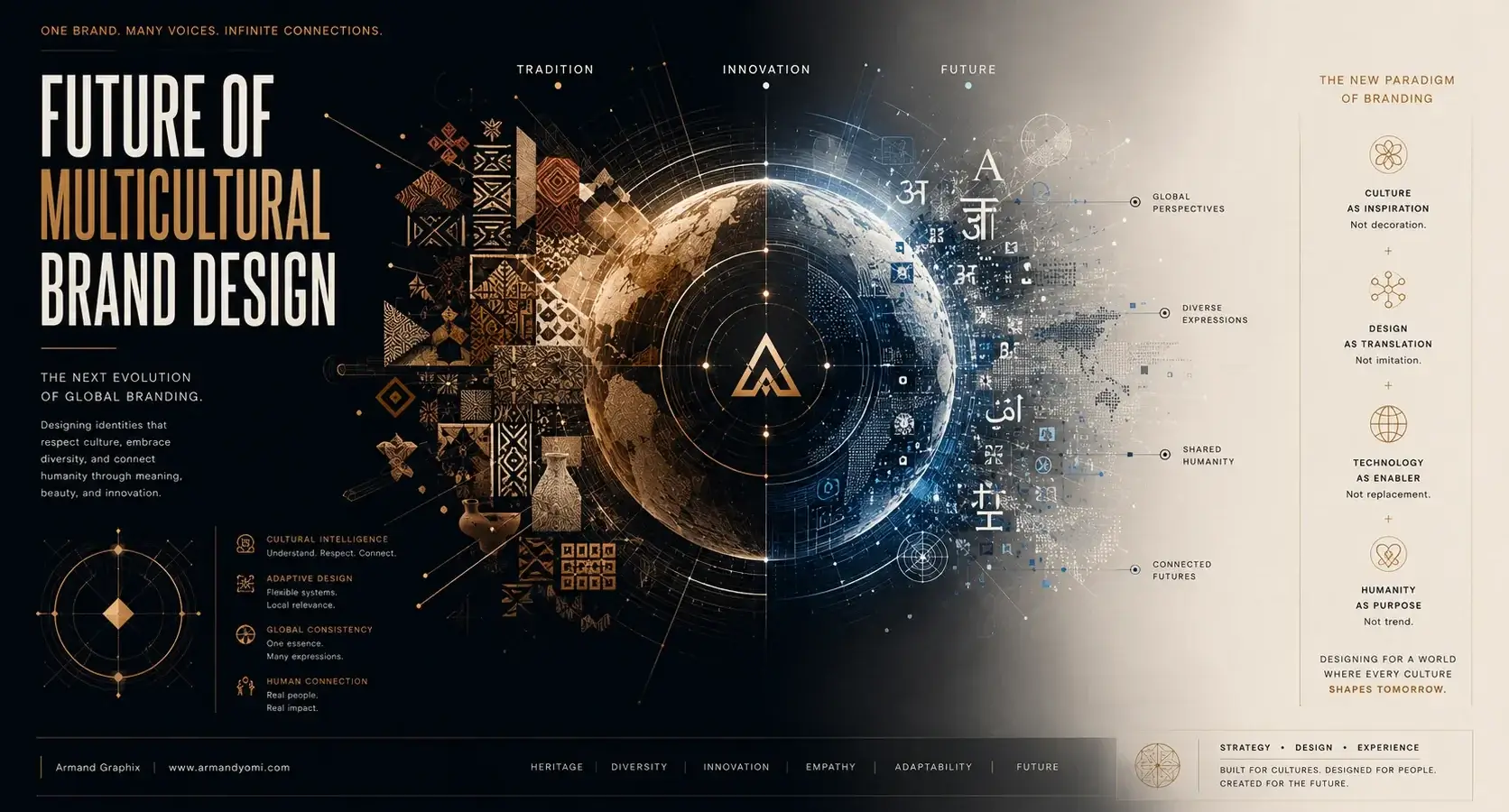
That tension sits at the heart of the future of multicultural brand design. For growing brands, the challenge is no longer whether to reflect cultural diversity. It is whether that reflection feels informed, intentional, and commercially smart. Audiences are more visually literate, more globally connected, and quicker to spot branding that treats culture like decoration instead of meaning.
For founders, marketers, and creative teams, this changes the brief. Multicultural design is not a trend layer added after the logo is approved. It is becoming a core brand decision that shapes identity, packaging, messaging, digital experience, and market expansion.
The best decision is rarely about freelancer versus agency as a fixed rule. It is about fit, trust, and whether the person or team in front of you can turn your vision into a brand people remember and a business people choose.
“The Future of Branding Is Culturally Intelligent”
Discover how multicultural design is transforming the way brands connect with global audiences through authenticity, creativity, and meaningful experiences.
Explore the Future of Branding →Why the future of multicultural brand design is changing now
Brands used to think about multicultural communication mainly in campaign terms. A seasonal ad might feature broader representation. A social post might nod to a cultural moment. That approach feels thin now because audiences experience brands as systems, not isolated assets.
They see the typography, the photography, the website flow, the product naming, the packaging hierarchy, and the tone of voice together. If one part signals inclusion while the rest of the brand stays generic or culturally tone-deaf, the disconnect is obvious.
The shift is also being driven by business reality. Many startups and growing companies serve mixed audiences from day one. A beauty brand might speak to first-generation customers, trend-conscious Gen Z shoppers, and mainstream retail buyers at the same time. A food brand may need to preserve cultural authenticity while also appealing to new consumers who are unfamiliar with the category. Design has to carry both clarity and cultural intelligence.
That is why the future belongs to brands that can balance emotional resonance with strategic precision.
Multicultural design will move from representation to interpretation
Representation still matters. People want to see themselves reflected in the brands they buy from. But representation alone is no longer enough to make a brand feel credible.
The next phase is interpretation. That means understanding how culture influences visual preference, symbolism, rhythm, language, and trust. It asks harder questions. Which colors carry pride in one context and caution in another? Which type styles feel premium to one audience but distant to another? Which images signal belonging, and which feel like stock-photo diversity with no real point of view?
Good multicultural brand design interprets cultural cues without flattening them. It does not reduce identity to flags, patterns, or predictable palettes. It studies behavior, context, and perception.
This is where many brands will face trade-offs. If you make the identity too broad, it becomes generic. If you make it too coded, it may alienate adjacent audiences or limit scale. The right answer depends on the product, the market, and the brand story. A culturally specific restaurant should not look like a global fintech startup. A mass-market personal care brand should not borrow niche cultural codes it cannot authentically support.
Visual systems will matter more than one-off assets
In the future of multicultural brand design, flexible systems will outperform static identities.
Why? Because brands increasingly show up across multiple cultural and digital contexts at once. A logo alone cannot do that work. What matters is the system around it – the type hierarchy, image direction, color logic, icon style, motion language, and content templates that allow the brand to adapt without losing itself.
A well-built system gives a brand room to speak differently to different communities while staying recognizable. That might mean adjusting photography styles for regional campaigns, shifting language emphasis on packaging, or creating motion graphics that feel native to different social audiences. The identity stays coherent, but not rigid.
This is especially important for small businesses and challenger brands. They may not have the budget for constant reinvention, so the design foundation has to be both distinctive and adaptable. Strategy that grows your brand starts with an identity that can travel.
Typography and language will become stronger cultural signals
Typography is often treated as a formal choice, but it carries cultural meaning. The same brand message can feel institutional, intimate, youthful, heritage-led, or globally premium depending on typographic execution.
As multicultural branding evolves, typography will become a sharper strategic tool. Designers will need to consider multilingual environments, accent marks, script compatibility, and readability across platforms. But the bigger issue is tone. Fonts help signal who the brand respects, who it understands, and who it expects to reach.
Language will matter just as much. Not every multicultural brand needs multiple languages, but every brand needs linguistic awareness. Literal translation rarely solves the problem. Certain phrases, naming structures, and calls to action land differently across communities. A direct, sales-heavy tone may work in one context and feel untrustworthy in another.
The brands that stand out will treat verbal identity and visual identity as one conversation.
AI will speed production, but not cultural judgment
AI tools are already changing how design concepts, content variations, and visual assets are produced. That will continue. Faster iteration is useful. It helps teams test more ideas, localize content more efficiently, and move campaigns into market with less friction.
But AI does not remove the need for taste, context, or judgment. In fact, it raises the stakes.
Multicultural branding depends on nuance, and nuance is where automated outputs often fail. AI can remix visual references without understanding their meaning. It can generate images that appear diverse while reinforcing tired stereotypes. It can suggest copy that is grammatically clean but culturally flat.
The smart move is to use AI for speed, not authority. Let it support production, variation, and exploration. Do not let it make final calls on identity, symbolism, or cultural positioning. Those decisions still require human perspective, research, and accountability.
The strongest brands will design for layered identities
People do not move through the market with one simple identity. They are local and global, traditional and trend-aware, culturally rooted and digitally fluid. Brands that understand this will build stronger emotional connection.
This has practical implications. A fashion brand may need to speak to heritage without looking nostalgic. A wellness brand may need to respect ritual without turning it into vague lifestyle branding. A consumer packaged goods brand may need to feel familiar to one audience and accessible to another at the same time.
That complexity is not a problem. It is a creative advantage if the strategy is clear.
Design that tells your story has to account for layered audiences, not imaginary averages. The goal is not to please everyone equally. The goal is to be specific enough to matter and clear enough to grow.
What brands should do next
For founders and business owners, the next step is not to add more visual references from more cultures and hope the brand feels inclusive. The better move is to audit the brand from the ground up.
Look at your identity, packaging, website, and campaign materials as one ecosystem. Ask whether your visuals are carrying real meaning or just aesthetic trend signals. Review your photography, your typography, your tone of voice, and your customer journey. See where the brand feels authentic, and where it starts to generalize.
Then test your assumptions. Talk to actual customers. Study how different audiences interpret the same brand elements. What feels premium to them? What feels familiar? What creates trust? What creates distance? These answers are often more valuable than broad demographic labels.
This is also where an integrated creative approach becomes useful. When branding, design, and digital marketing are developed together, the result is more coherent. You are not just creating a better visual identity. You are building a brand that performs better because it communicates with more clarity.
For a studio like Armand Graphix, that means treating multicultural design not as a niche add-on, but as a serious business tool – one that can strengthen recognition, relevance, and conversion when handled with care.
The future of multicultural brand design will reward depth
The brands that win next will not be the ones that look the most globally inspired at a glance. They will be the ones that understand people more deeply and express that understanding with craft.
That requires restraint as much as creativity. Not every culture cue belongs in the logo. Not every audience needs a different identity. Not every expansion strategy should start with visual change. Sometimes the right move is a subtle adjustment in tone, a more thoughtful packaging hierarchy, or a stronger photography direction that reflects real lives instead of generic aspiration.
Multicultural brand design is heading toward something more mature, more strategic, and more demanding. That is good news for brands willing to do the work.
If your brand is growing across audiences, the design question is no longer, “How do we look inclusive?” It is, “How do we become recognizable, trusted, and relevant to the people we want to serve?” That is where better design starts – and where better growth usually follows.
“Build Brands That Speak Across Cultures”
Learn how modern brands can balance global consistency with cultural relevance to create stronger emotional connections worldwide.
Create a Global Brand Strategy →- WordPress Versus Custom Websites for Growing Brands
 WordPress versus custom websites: compare cost, speed, control, SEO, and growth to choose a site that supports your brand and business goals clearly.
 - What Does Brand Strategy Include for Growth?
 What does brand strategy include? Learn the research, positioning, identity, messaging, and marketing choices that turn a business into a distinct brand.
 - Packaging Design Guide for Retail Brands
 A packaging design guide for retail brands: build shelf impact, meet production realities, and turn a first glance into a confident purchase decision.
 - Multicultural Branding Trends 2026 for Modern Brands
 Multicultural branding trends 2026 will reward brands that pair cultural intelligence, inclusive design, and local relevance with measurable, real growth.
 - Custom Logo vs Template: What Fits Your Brand?
 Custom logo vs template: compare cost, speed, ownership, and brand impact to choose an identity that builds your launch, growth, and reputation today.
 - What Is a Visual Identity? Design That Builds Trust
 What is a visual identity? Learn how logos, color, typography, and systems create recognition, trust, and stronger brand growth for ambitious businesses.