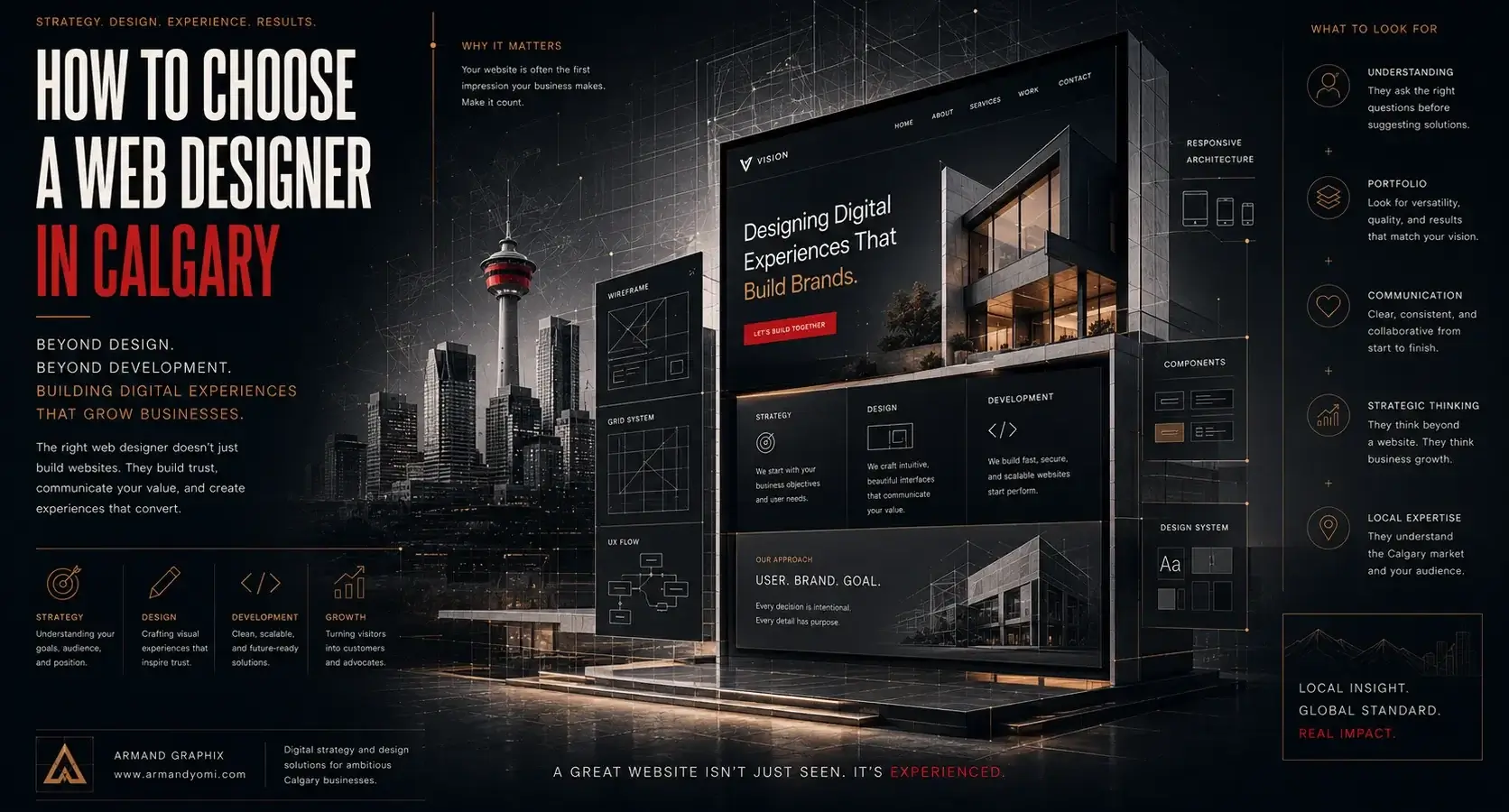
A website can look polished and still miss the point. That is usually the problem when businesses start searching for a web designer Calgary clients recommend – they are not only buying a layout, they are choosing how their brand will be understood in seconds.
For a startup, that first impression can shape investor confidence. For a service business, it can decide whether a visitor calls or leaves. For a product brand, it can influence trust before anyone reads a word. Good web design is not decoration. It is positioning, clarity, and momentum.
The best decision is rarely about freelancer versus agency as a fixed rule. It is about fit, trust, and whether the person or team in front of you can turn your vision into a brand people remember and a business people choose.
“Choose a Web Designer Who Understands Your Business”
Discover the key factors to evaluate before hiring a web designer and creating a website that truly supports your brand goals.
Find the Right Designer →What a web designer in Calgary should actually deliver
A strong website should do more than sit online and look current. It should express your brand clearly, guide the visitor naturally, and support a business goal. Sometimes that goal is lead generation. Sometimes it is booking calls, selling products, building authority, or helping a new brand look established from day one.
That is why design alone is never the full conversation. A skilled designer should think about messaging hierarchy, user behavior, mobile responsiveness, page speed, search visibility, and the emotional tone of the brand. If those pieces are disconnected, the site may feel attractive but underperform.
This is where many businesses make an expensive mistake. They hire for visuals, then realize later they still need help with branding, SEO, content structure, or conversion strategy. The result is a site that needs revision before it ever starts working properly.
Why hiring a web designer Calgary businesses trust is not just a visual decision
Your website is often the first serious interaction someone has with your business. Before a meeting, before a proposal, before a purchase, people are scanning your site for signals. They want to know if you are credible, relevant, and worth their time.
Design communicates that faster than copy. Typography, spacing, image direction, color balance, and page structure all shape perception. A law firm should not feel like a lifestyle brand. A boutique product company should not look like a generic corporate template. A founder-led business should not sound like it was written for everyone.
The right designer understands this. They build around the character of the business, not just around trends. They ask better questions upfront, because design quality depends on strategic clarity.
The difference between a template site and a strategic website
Not every business needs a custom build from the ground up. In some cases, a well-handled template is the smart move. It is faster, more affordable, and enough for businesses that need a clean presence with clear information. That trade-off makes sense when the brand is simple and the website has a narrow job.
But there are limits. Templates often flatten brand personality. They can make businesses look interchangeable, especially in crowded markets. If your company depends on trust, differentiation, or a strong visual story, a template may save money upfront while costing you attention later.
A strategic website starts from brand intent. It considers what the audience needs to feel, understand, and do. It is less about adding visual effects and more about shaping a coherent experience. That can mean a minimalist design, or it can mean something bold. It depends on the business, the audience, and the market position.
What to look for before you hire
The best way to evaluate a designer is not by asking whether they can make something look good. Most can. The better question is whether they can design a website that aligns with your business goals.
Look closely at their portfolio. Not just the final screens, but the thinking behind them. Do the sites feel distinct from one another, or do they all follow the same formula? Can you see evidence of brand sensitivity, industry awareness, and clarity of purpose? A strong portfolio should show range without losing quality.
Pay attention to how they talk about process. A serious designer should be able to explain how they approach discovery, messaging, structure, visual direction, revisions, and launch. If the process sounds vague, the outcome often is too.
It also helps to understand whether they can support adjacent needs. Many websites fail because no one considered SEO, brand consistency, or post-launch performance. A designer with a broader strategic view is often more valuable than someone focused only on mockups.
Red flags that get overlooked
One red flag is an obsession with trends that have nothing to do with business results. If every recommendation is about what looks modern, but there is no discussion of audience behavior or brand positioning, that is a problem.
Another is weak communication. Website projects involve decisions, feedback, and refinement. If the designer is unclear before the project begins, that usually does not improve later.
There is also the issue of generic messaging. Some sites are designed beautifully but sound empty. They rely on broad phrases, stock visuals, and headlines that could belong to any company in any city. That kind of site does not build distinction. It erases it.
How branding changes the quality of web design
A website is strongest when it grows from a clear brand foundation. Without that, the designer is often guessing at tone, personality, and differentiation. The result may look professional, but it rarely feels memorable.
Branding gives the website its internal logic. It defines the voice, visual language, emotional direction, and market position. Once those are clear, web design becomes sharper. The layout has purpose. The visuals feel consistent. The calls to action make sense.
This is especially important for founders and small businesses competing against larger companies. You may not have the biggest budget, but you can still create a stronger impression if your brand is coherent and your website expresses it with precision.
That is one reason some clients choose a partner who understands both design and marketing. At Armand Graphix, that intersection matters because the website is not treated as an isolated asset. It is part of a larger brand story and a larger growth strategy.
A web designer Calgary brands choose should understand performance too
A beautiful site that no one finds is incomplete. A site that gets traffic but fails to convert is incomplete too. This is where web design and digital marketing need to work together.
Search visibility matters. So does user flow. So does the clarity of the offer on the page. If a visitor cannot quickly understand what you do, who it is for, and what to do next, design has not done its job.
That does not mean every website needs aggressive optimization or a complex funnel. A local service business has different needs than an e-commerce brand or a creative portfolio. The point is that design decisions should support how the business grows.
Sometimes that means building service pages with cleaner keyword structure. Sometimes it means simplifying navigation to reduce friction. Sometimes it means improving mobile design because that is where most visitors are arriving. The right answer depends on context, which is exactly why strategy matters.
Questions worth asking before the project starts
Before hiring, ask how the designer approaches brand discovery, content planning, mobile experience, and SEO basics. Ask what they need from you and what they handle themselves. Ask how revisions are structured and what happens after launch.
You should also ask what success looks like for the project. More inquiries, better positioning, stronger credibility, improved search performance, cleaner storytelling – these are not interchangeable goals. The clearer the objective, the stronger the design decisions will be.
A good designer will not rush past these questions. They will use them to shape the work.
The best choice is not always the cheapest or the flashiest
Price matters, especially for small businesses. But a lower quote can become expensive if the website needs rebuilding, lacks direction, or fails to support growth. At the same time, the highest price does not guarantee strategic depth.
The best fit is usually the designer who understands how to translate your business into a digital experience that feels credible, distinctive, and useful. Someone who can balance story with structure. Aesthetic quality with commercial intent. Vision with execution.
That is what makes the difference between a site you simply launch and a site that starts working for you.
If you are looking for a web designer in Calgary, do not just ask who can build a website. Ask who can shape how your brand is seen, understood, and chosen. That is where real value begins.
“Your Website Is More Than a Digital Brochure”
Learn how the right web designer can transform your website into a strategic tool for credibility, engagement, and growth.
Build Your Digital Presence →- WordPress Versus Custom Websites for Growing Brands
 WordPress versus custom websites: compare cost, speed, control, SEO, and growth to choose a site that supports your brand and business goals clearly.
 - What Does Brand Strategy Include for Growth?
 What does brand strategy include? Learn the research, positioning, identity, messaging, and marketing choices that turn a business into a distinct brand.
 - Packaging Design Guide for Retail Brands
 A packaging design guide for retail brands: build shelf impact, meet production realities, and turn a first glance into a confident purchase decision.
 - Multicultural Branding Trends 2026 for Modern Brands
 Multicultural branding trends 2026 will reward brands that pair cultural intelligence, inclusive design, and local relevance with measurable, real growth.
 - Custom Logo vs Template: What Fits Your Brand?
 Custom logo vs template: compare cost, speed, ownership, and brand impact to choose an identity that builds your launch, growth, and reputation today.
 - What Is a Visual Identity? Design That Builds Trust
 What is a visual identity? Learn how logos, color, typography, and systems create recognition, trust, and stronger brand growth for ambitious businesses.