Why Your Branding
Isn’t Converting —
And How to Fix It
Your business has a strong product, but clients don’t understand your value? Your image lacks impact or consistency? The problem may not be your marketing, it may be your branding.
In this three-part series on strategic branding, we’ll dismantle common misconceptions, name the real problems, and give you a concrete framework for action. Let’s start at the foundation: understanding what branding actually is, and why yours may not be producing the results it should.
What Branding Actually Is
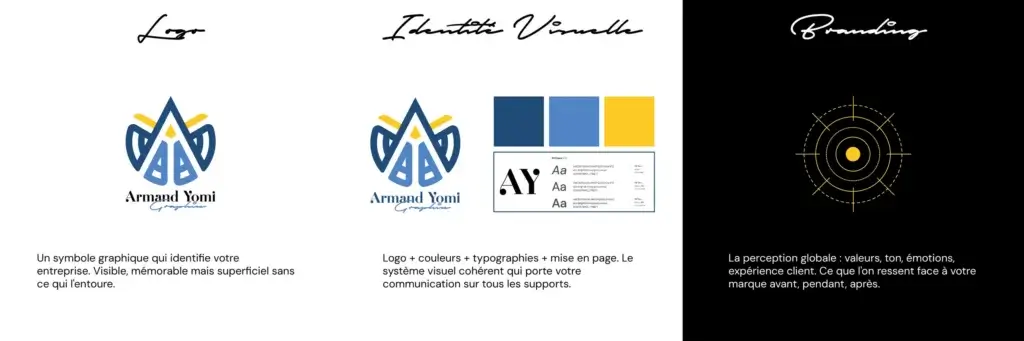
Let’s dismantle the most widespread myth first: your branding is not your logo. The logo is merely a visible symbol, equivalent to a first name. Branding, on the other hand, is the full personality, reputation, and emotional associations connected to that name.
“A brand isn’t what you say it is. It’s what they say it is.”
— Marty Neumeier · Author of “The Brand Gap” (2003), brand strategy consultant for Apple, Adobe & Procter & GambleThis definition from Marty Neumeier, one of the most influential brand strategists of the past three decades,captures the essential point: branding is a perception, not a production. You don’t control your brand, you influence the conditions under which your clients construct it in their minds.
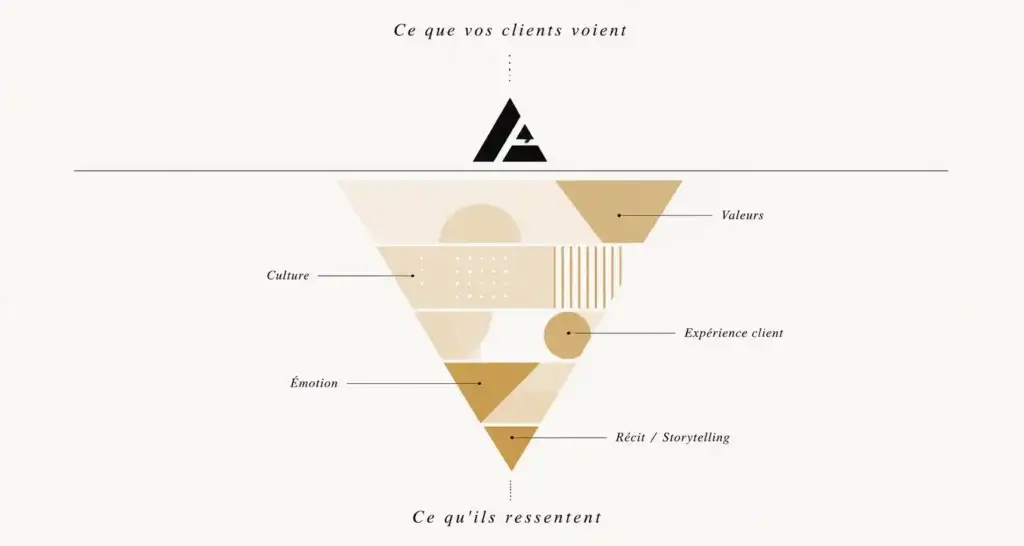
Carefully crafted graphic design can build your visual identity but without a brand strategy behind it, it remains a beautiful, purposeless facade. This confusion between the wrapper and the content costs companies clients every single day.
Does your current image truly reflect your value?
We analyze your existing branding and identify the specific barriers to your growth, no commitment, no jargon.
Request my free branding audit →Why Branding Directly Drives Your Revenue
Design is too often treated as an expense something to sort out “once business picks up.” The measurable reality is the exact opposite. According to the Design Management Institute (DMI), design-driven companies outperformed the S&P 500 by 219% over a ten-year period (DMI Design Value Index, 2015). That’s not a marginal advantage, it’s a structural growth lever.
Trust, emotion, credibility — the three pillars
David Aaker, professor emeritus at UC Berkeley’s Haas School of Business and one of the founding fathers of modern brand equity theory, demonstrated that brand value rests on four dimensions: brand awareness, perceived quality, brand associations, and customer loyalty, all directly shaped by design and visual consistency, well before the product itself enters the picture.
“People don’t buy what you do. They buy why you do it.”
— Simon Sinek · Author of “Start With Why” (2009) — TED Talk with over 60 million views, one of the five most-watched in the platform’s historyThis principle from Simon Sinek, one I apply to every branding project, explains why two companies with equivalent products achieve fundamentally different results. The one that communicates its “why” with visual clarity and consistency converts more, retains clients more easily, and resists pricing pressure more effectively.
| Criteria | ✦ Strong Brand | Weak Brand |
|---|---|---|
| First impression | Immediate trust | Doubt, hesitation |
| Conversion rate | High, short sales cycles | Low, constant objections |
| Client retention | Strong, active word-of-mouth | Low, volatile clients |
| Pricing power | Premium rates — defensible | Constant downward pressure on fees |
| Talent recruitment | Attractive, strong employer brand | Difficulty attracting key profiles |
“Branding transforms a product into an experience, a purchase into a sense of belonging — and a client into an advocate.”
— Armand Yomi · Founder, Armand GraphixThe Warning Signs That Your Branding Isn’t Working
Before correcting, you need to diagnose honestly. Here are the most common red flags — some obvious, others far more subtle. I encounter them in the vast majority of the audits I conduct.
- ✕Your conversion rate stagnates despite decent traffic — visitors arrive but don’t take action.
- ✕You frequently have to explain what you do, even to qualified prospects. Your positioning isn’t clear enough.
- ✕Your visuals vary across touchpoints — your website, social media, and presentations look like three different companies.
- ✕Your competitors look a lot like you — there’s no obvious visual reason to choose you over them.
- ✕Clients consistently negotiate your prices down — your image doesn’t justify your perceived value.
- ✕Your identity is more than 5 years old and hasn’t evolved with your business reality.
The 5 Most Common Branding Mistakes
After years of working with startups, SMEs, and white-label agency partners, I’ve identified five structural mistakes that sabotage most brands. They’re not about budget. They’re about strategy.
Inconsistent Cross-Channel Branding
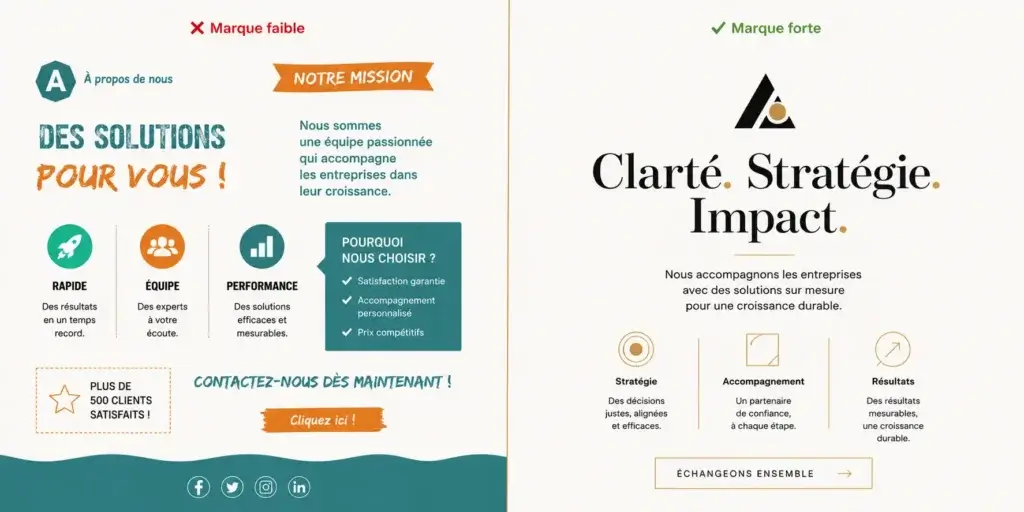
Different colors on every touchpoint, tone shifting by channel. Without consistency, there’s no memorization. Without memorization, there’s no trust — and no conversion.
Design Without Strategy
A quickly assembled logo with no positioning, no intention behind it. Visually appealing but unanchored — therefore producing no measurable impact on revenue.
Complete Absence of Emotion
A cold brand that lists features without telling a story. Yet according to research by Gerald Zaltman at Harvard Business School, 95% of purchasing decisions are unconscious and emotional in nature.
Copying Industry Visual Codes
Adopting sector-standard visuals to “look professional” turns you into a commodity. Resemblance destroys differentiation — and differentiation is your primary defense against a price war.
No Clear, Owned Positioning
Trying to speak to everyone means speaking to no one. Marty Neumeier calls this “brand blur.” Without a defined niche and a precise promise, your branding cannot convert: it’s too unfocused to leave a memorable impression. Precision is the first strength of any powerful brand.
How to Build Effective Branding — In 6 Steps
Branding that converts isn’t born from inspiration — it’s the result of a rigorous strategic process, from positioning through UX execution. Here is the framework I apply to every project at Armand Graphix.
Brand Strategy — The Invisible Foundation
Mission, vision, values, unique positioning. This strategic foundation — shaped by David Aaker’s brand equity model — determines the relevance of everything that follows. Without it, everything else is decorative.
Visual Identity — The Graphic Translation of Your Strategy
Logo, colors, typography, iconography, layout systems. Every graphic choice is justified by strategy. Our approach to strategic graphic design guarantees this foundational consistency.
Visual Storytelling — The Narrative That Creates Emotional Connection
The brands that endure tell a story. What is your “why” in Simon Sinek’s sense? This narrative must be visible at every brand touchpoint — not just your website.
User Experience — Branding in Motion
Your branding also lives in how visitors navigate your site, receive your emails, and interact with your content. UX is branding in lived experience — aligned with your digital marketing strategy.
Cross-Channel Consistency — Branding as a Living System
The same tone, the same visual codes, the same promise — across your website, LinkedIn, presentations, and business cards. Consistency creates memorization, memorization creates trust, trust creates conversion.
Measurement & Iteration — Branding as Lasting Competitive Advantage
Effective branding is measurable: conversion rates, spontaneous awareness, client NPS, perceived position vs. competitors. Branding is not a one-time project — it’s a strategic asset that requires ongoing stewardship.
Branding That Works — What Our Projects Demonstrate
The strongest argument for strategic branding is never theoretical — it’s concrete transformations with measurable outcomes. Explore the full body of our work in our project portfolio.
A SaaS publisher with a strong product but a generic image that couldn’t justify its price point. After a complete overhaul of visual identity and strategic positioning, demo page conversion improved by 38% within 3 months. View project →
An artisan SME trapped in generic visual codes, unable to justify its premium pricing. A packaging redesign built around strong visual storytelling enabled a 22% increase in accepted selling price with no volume loss. View project →
Want similar results for your brand?
View all our projects & case studies →When Should You Consider a Rebrand?
Rebranding must be a strategic decision driven by precise business indicators — not an aesthetic whim. Well timed, it unlocks significant new growth. Poorly timed, it destabilizes an existing community.
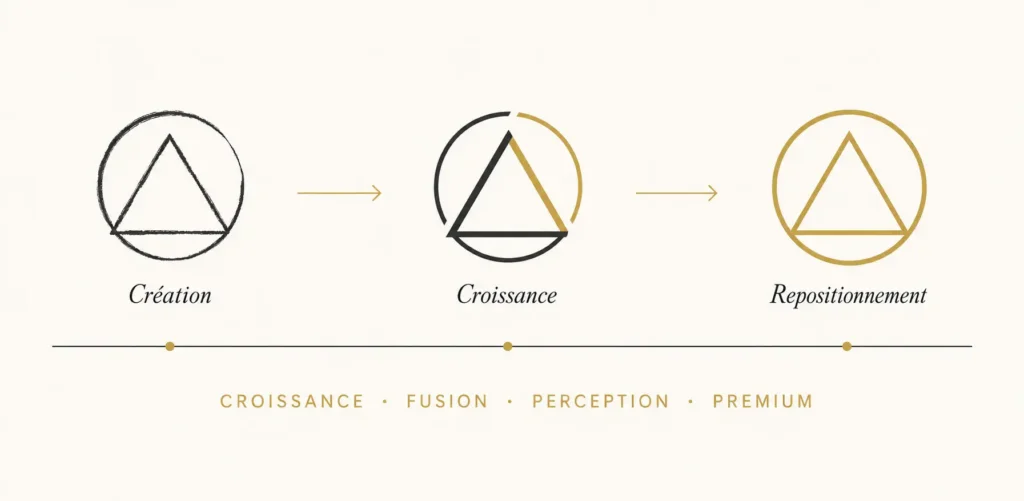
| Situation | Rebrand Recommended? | Type of Intervention |
|---|---|---|
| Rapid growth, new target market segment | YES | Full strategic rebrand |
| Image perceived as outdated or amateur | YES | Visual identity modernization |
| Merger, acquisition, or name change | YES | Full rebrand with managed transition |
| Premium repositioning — moving upmarket | YES | Positioning + identity overhaul |
| Reputation damage requiring recovery | YES | Strategic rebrand + communications |
| Pure aesthetic preference, no underlying issue | NO | Light graphic refresh if needed |
| Recent identity (< 2 years), conversion issue only | NO | Strategic audit of message & UX first |
Our services cover the full spectrum, from initial positioning to complete rebranding. The next article in this series gives you the precise tools to diagnose where your credibility gap lies.
Ready to turn your branding into a growth engine?
At Armand Graphix, we don’t create logos. We build brands that inspire trust, create emotional connection, and convert. Every project begins with a no-commitment branding audit.
Book a free discovery call →