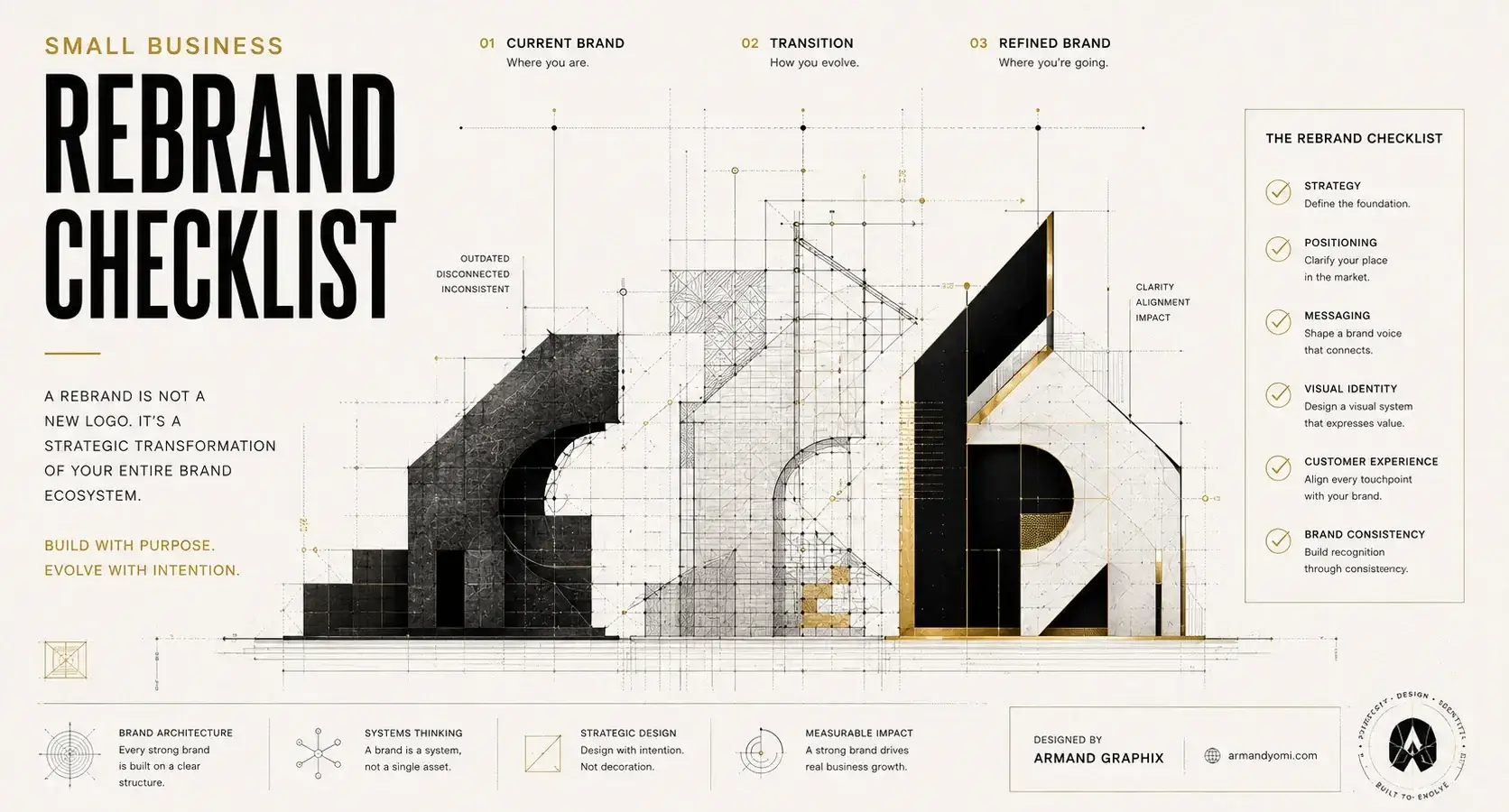
A rebrand usually starts with a feeling before it becomes a project. Your business looks dated. Your visuals no longer match your quality. Or your brand grew faster than your identity could keep up. A strong small business rebrand checklist helps you slow that instinct down and turn it into smart decisions – because changing your logo without changing the story, structure, and customer experience rarely gets the result you want.
Rebranding is not decoration. It is repositioning. For a small business, that makes the stakes higher. You are often working with limited time, limited budget, and a customer base that already knows you in a certain way. Done well, a rebrand sharpens recognition, improves trust, and creates better alignment between what you offer and how the market sees you. Done poorly, it creates confusion and burns momentum.
A logo matters. It gives your business a recognizable mark and creates a first impression. But a logo alone cannot define your positioning, shape your voice, clarify your offer, or tell people why they should trust you over the next option. Strategy does that work. Design makes it visible.
“Thinking About Rebranding Your Business?”
Follow a proven checklist to avoid costly mistakes and build a stronger brand with confidence.
Get Your Rebrand Checklist →Start with the reason behind the rebrand
Before colors, type, or a new website layout, define the business case. What exactly is no longer working? Sometimes the issue is visual inconsistency. Sometimes it is deeper – the audience changed, the offer evolved, the brand outgrew its original positioning, or the market became more competitive.
This step matters because not every business needs a full rebrand. Some need a brand refresh. That is a meaningful difference. A refresh updates selected elements while keeping recognizable brand equity intact. A full rebrand changes the strategic foundation, visual system, messaging, and often the customer-facing experience.
Ask a few direct questions. Has your ideal customer changed? Has your pricing moved upmarket? Are you introducing new services or products that your current brand cannot carry well? Do prospects misunderstand what you do? If the answers point to strategic misalignment, a rebrand makes sense. If the problem is simply inconsistent design execution, a lighter update may be the better investment.
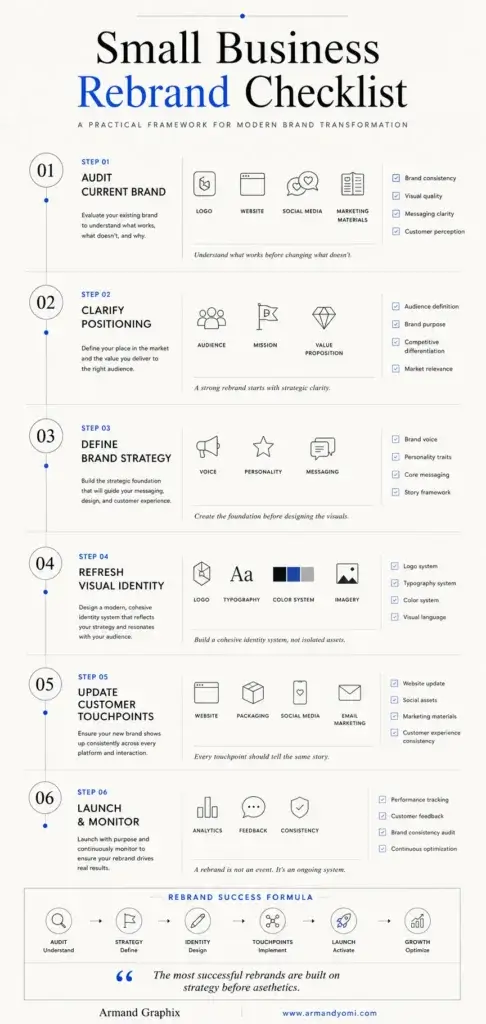
The small business rebrand checklist begins with strategy
A visual identity should express strategy, not replace it. That is why the most useful part of any small business rebrand checklist sits upstream from design.
Reconfirm your positioning
Get clear on what market space you want to own. This means defining who you serve, what problem you solve, how you are different, and why that difference matters now. Small businesses often skip this because they feel close enough to the answer already. But proximity can blur clarity.
Positioning should be concise enough to guide decisions. If your current brand speaks to everyone, your new brand will likely land nowhere. Precision creates stronger messaging, stronger visuals, and better marketing performance.
Audit customer perception
What your brand says about itself and what customers actually believe are often two different things. Review testimonials, sales calls, inquiry emails, customer reviews, and social comments. Look for repeated language. What do people already trust you for? What do they misunderstand? Where are expectations too low or too vague?
This is where rebrands become powerful. You are not inventing a brand from thin air. You are identifying the strongest truths in the business and expressing them more clearly.
Define your brand story and voice
A polished identity without a compelling narrative feels empty. Your story does not need to be dramatic, but it does need to be intentional. Why does this business exist? What values shape your decisions? What emotional impression should customers leave with after interacting with you?
For founder-led businesses especially, voice matters. The way you write, present, and sell should feel coherent across your website, packaging, presentations, and social media. If your visual brand says premium but your copy sounds generic, the gap shows.
Audit what you already have
A rebrand is easier when you know what deserves to stay. Review every brand touchpoint you currently use. That includes your logo, color palette, typography, photography style, business cards, packaging, signage, website, social profiles, ads, email templates, proposals, and presentation decks.
Look at them as a system, not as isolated assets. Are they consistent? Do they reflect your current level of quality? Do they support the kind of client or customer you want next?
Some assets may still have value. A recognizable shape, a strong brand color, or a memorable tagline can carry equity worth preserving. Rebranding does not always mean starting over. Sometimes it means editing with discipline.
Build the right visual direction
Once strategy is clear, design can do its real job. Your identity should communicate who you are before you explain yourself.
Prioritize recognition over novelty
Many small businesses chase a look that feels new but forget to ask whether it will stay recognizable. A trend-driven identity may earn quick compliments and age badly. A thoughtful system lasts longer and works harder.
Strong brand design is not just about a logo. It includes type hierarchy, spacing, image treatment, icon style, packaging behavior, and digital consistency. These choices create memory. They also shape trust.
Design for real-world use
A brand has to perform in motion, in print, on mobile, in social graphics, on signage, and sometimes on very small packaging labels. Test the identity in realistic scenarios early. A logo that looks elegant in a presentation may fail on a storefront or social avatar.
This is where strategic design earns its value. The goal is not simply to look better. The goal is to communicate clearly across every place your audience encounters you.
Align your messaging with the new identity
A rebrand fails when the visuals change but the words stay stuck in the past. Your messaging should evolve alongside your design.
Rework your core brand messages first: your headline, value proposition, elevator pitch, service descriptions, about section, and calls to action. Make sure they match your new market position. If the brand now looks more refined, the language should sound more precise and confident too.
This is also the moment to simplify. Small businesses often overexplain because they are trying to prove value. Clear messaging usually performs better than dense messaging. Say less, but make it sharper.
Prepare your internal rollout before the public one
One of the most overlooked parts of a small business rebrand checklist is internal readiness. Even a small team needs alignment before launch. If employees, contractors, or partners use old files, outdated language, or inconsistent logos, the rebrand weakens immediately.
Create a practical set of brand rules. It does not need to be a massive document. It does need to define logo usage, colors, fonts, voice principles, and where approved assets live. Everyone involved in the brand should know what changed and why.
If you are a solo founder, internal rollout still matters. Update your templates, invoices, proposals, email signature, social bios, and any saved materials before announcing the rebrand. The market notices details.
Time the launch carefully
The best rebrand launches feel deliberate, not rushed. That does not mean you need a dramatic campaign. It means your rollout should be coordinated.
Start by deciding whether you will switch everything at once or phase changes in. A full switch creates a cleaner impression. A phased rollout may be more realistic if you have packaging inventory, printed materials, or a large content library to work through. The right choice depends on your resources and how visible your brand is.
At minimum, update the high-traffic touchpoints first: website homepage, social profiles, Google Business profile, email signature, proposals, and key sales materials. If customers encounter old and new branding side by side for too long, confidence can slip.
When you announce the change, explain it in plain language. Customers do not need a design lecture. They need to understand what is new, what remains true, and how the rebrand supports a better experience.
Measure what changed after launch
A rebrand should produce outcomes, not just approval. Once the new brand is live, track what happens next. Watch branded search behavior, website engagement, inquiry quality, conversion rates, average order value, social engagement, and customer feedback.
Not every gain shows up immediately. Brand recognition and trust build over time. But you should still look for early signals. Are better-fit leads coming in? Are people understanding your offer faster? Are sales conversations getting easier? Those are meaningful indicators.
This is where design and marketing should meet. At Armand Graphix, that overlap matters because a brand is not finished when it looks polished. It needs to perform in the market.
What to avoid during a rebrand
The most common mistake is treating a rebrand like a logo project. The second is changing too much without preserving what customers already recognize. The third is launching before your messaging, assets, and digital presence are aligned.
There is also a budget trade-off to respect. If resources are tight, focus first on strategy, core identity, website essentials, and the materials closest to revenue. You do not need to redesign everything on day one. You do need to make the most visible parts of the brand feel consistent and intentional.
A good rebrand creates clarity. It helps people understand your value faster, trust your presentation more, and remember your business longer. If your current brand no longer reflects where you are headed, that is not a cosmetic issue. It is a growth issue. The right checklist does more than keep the project organized – it keeps your brand honest about who it is becoming.
“Don’t Rebrand Until You’ve Checked These Essentials.”
Discover the strategic steps successful small businesses take before changing their identity.
Start Your Rebrand Plan →- WordPress Versus Custom Websites for Growing Brands
 WordPress versus custom websites: compare cost, speed, control, SEO, and growth to choose a site that supports your brand and business goals clearly.
 - What Does Brand Strategy Include for Growth?
 What does brand strategy include? Learn the research, positioning, identity, messaging, and marketing choices that turn a business into a distinct brand.
 - Packaging Design Guide for Retail Brands
 A packaging design guide for retail brands: build shelf impact, meet production realities, and turn a first glance into a confident purchase decision.
 - Multicultural Branding Trends 2026 for Modern Brands
 Multicultural branding trends 2026 will reward brands that pair cultural intelligence, inclusive design, and local relevance with measurable, real growth.
 - Custom Logo vs Template: What Fits Your Brand?
 Custom logo vs template: compare cost, speed, ownership, and brand impact to choose an identity that builds your launch, growth, and reputation today.
 - What Is a Visual Identity? Design That Builds Trust
 What is a visual identity? Learn how logos, color, typography, and systems create recognition, trust, and stronger brand growth for ambitious businesses.