A founder approves a beautiful logo, updates the website header, prints business cards, and expects the brand to feel complete. A few weeks later, the real problem shows up – the visuals look polished, but the message is still blurry, the audience connection is weak, and marketing feels inconsistent. That is the gap in brand strategy vs logo design, and it is where many businesses spend money on aesthetics without building direction.
A logo matters. It gives your business a recognizable mark and creates a first impression. But a logo alone cannot define your positioning, shape your voice, clarify your offer, or tell people why they should trust you over the next option. Strategy does that work. Design makes it visible.
“Brand Strategy or Logo Design? You’ve Been Confusing Both”
Understand how strategy defines meaning before design gives it form.
Discover the Difference →Brand strategy vs logo design: what is the difference?
Brand strategy is the thinking behind the brand. It defines who you serve, what you stand for, how you want to be perceived, what makes you different, and how your brand should communicate across channels. It is the internal compass that guides decisions.
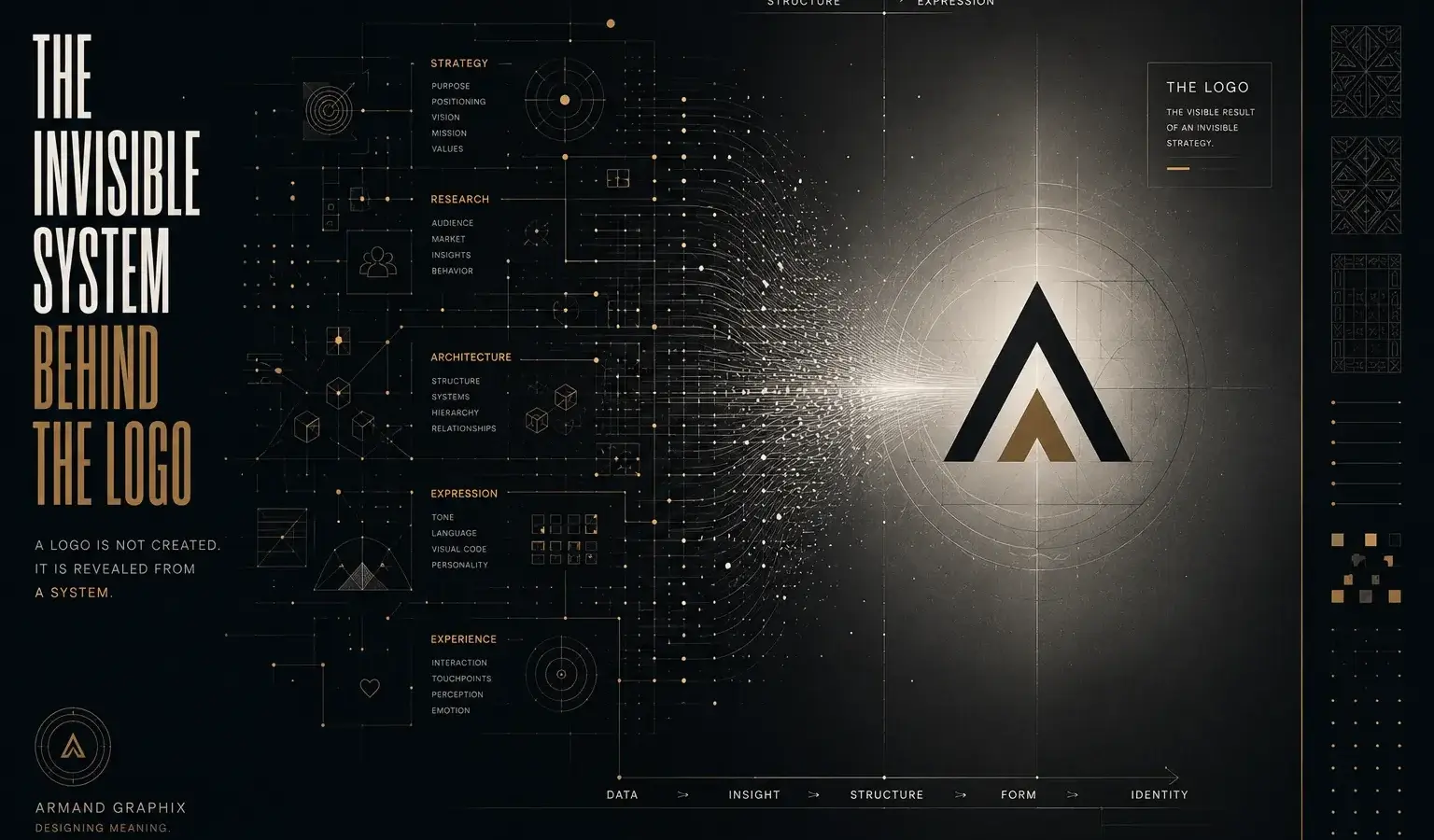
Logo design is one part of brand identity. It translates some of that strategic thinking into a visual symbol. A strong logo can communicate tone, category, confidence, and memorability, but it is still one asset inside a larger system.
If you strip it down, brand strategy answers why, who, and how. Logo design answers what people will see first.
That distinction matters because businesses often hire for a logo when what they really need is clarity. If your audience is unclear, your message is generic, or your positioning sounds like everyone else in the market, a new mark will not fix the foundation.
Why businesses confuse brand strategy and logo design
The confusion is understandable. A logo is visible, immediate, and easy to evaluate. You can react to it in seconds. Strategy feels less tangible because it lives in language, decisions, priorities, and systems before it ever appears as design.
There is also a market problem. Many services are sold as branding when they are really only visual identity packages. That does not make them useless. It just means the scope is different. A business can walk away with a refined logo, colors, typography, and templates, yet still have no clear positioning or brand message.
For startups and small businesses, budget plays a role too. Founders often want the asset they can launch quickly. That is reasonable. If you are moving fast, a logo feels like progress. But if the business is still evolving, skipping strategy can create expensive rework later.
You redesign the logo. Then you rewrite the website. Then packaging changes. Then social content no longer matches the new direction. The cost is not only visual inconsistency. It is lost momentum.
What brand strategy actually covers
Brand strategy is not abstract theory for large corporations. It is practical decision-making. It helps a business become coherent.
A useful brand strategy usually clarifies your audience, market position, value proposition, personality, tone of voice, messaging themes, and long-term brand perception. It can also shape naming, product structure, campaign direction, and customer experience.
This is where the business side and creative side meet. If your strategy says your brand should feel premium, modern, and culturally fluent, your visuals, words, and marketing should all reinforce that. If your strategy says you are the approachable expert for first-time buyers, your design should not look distant or overly corporate.
Good strategy gives design criteria. Without that, logo choices become subjective. You are left debating whether something “looks nice” instead of asking whether it aligns with the brand you are building.
What logo design actually does well
Logo design has a specific job, and it is an important one. A logo helps people recognize you, remember you, and distinguish you from competitors. It can signal professionalism, personality, and category fit in a very compact form.
A strong logo is simple enough to be memorable and flexible enough to work across real-world applications. It should hold up on a website, social profile, packaging label, event signage, and mobile screen. It should also fit the tone of the business rather than chase trends.
But a logo is not a business plan, a message platform, or a marketing engine. It cannot carry the full weight of your brand on its own. When people expect it to do that, they usually end up disappointed.
The better view is this: a logo is a signature, not the whole story.
Brand strategy vs logo design in real business scenarios
The right priority depends on where your business is.
When strategy should come first
If you are launching a new business, entering a crowded market, repositioning after growth, or trying to reach a more specific audience, strategy should lead. At that stage, clarity is more valuable than decoration.
Let us say you run a product-based business and want retail-ready packaging. Before designing the logo or label system, you need to know what shelf position you are claiming. Are you premium, playful, sustainable, minimalist, family-focused, or culture-driven? That decision affects naming, messaging, packaging hierarchy, and the visual identity itself.
The same applies to service businesses. A consultant, agency, coach, or creative studio often needs a strategic point of view before visual development. Otherwise the brand can look polished while saying very little.
When logo design may be enough for now
If your strategy is already clear and your business simply lacks a professional visual mark, a logo project can make sense on its own. This is common for established businesses with a stable offer, known audience, and consistent message.
For example, if your positioning is already working, your referrals are strong, and your voice is defined, a visual refresh may be the missing piece. In that case, logo design is not replacing strategy. It is expressing it more effectively.
When both should happen together
This is often the smartest route for growing brands. Strategy defines the narrative. Design turns that narrative into a system people can recognize and trust.
That combination is where branding becomes powerful. You are not choosing between insight and aesthetics. You are aligning them.
The hidden cost of starting with only a logo
A logo-first approach can work if your business is simple and your direction is already settled. But there are trade-offs.
First, you risk designing for your personal taste instead of your audience. Founders naturally gravitate toward visuals they like, but effective branding is not self-portraiture. It is communication.
Second, your marketing may become fragmented. If there is no strategic foundation, your website copy, social media tone, ad creative, and packaging can all pull in different directions. The result is a brand that feels inconsistent even if the logo itself looks strong.
Third, you may outgrow the design quickly. When the business gains clarity later, the original logo can feel disconnected from the more mature brand. Then you are paying twice.
This is one reason strategy-led branding tends to create stronger long-term value. It reduces guesswork and gives every creative decision a purpose.
How to decide what your business needs right now
Ask a simple question: is the main problem visibility, or is it clarity?
If people already understand your offer, trust your positioning, and respond to your messaging, but your brand looks outdated or unprofessional, logo design may solve the immediate issue.
If people are confused about what you do, who you help, or why you are different, strategy should come first. No visual upgrade can fully compensate for weak positioning.
Another useful test is internal alignment. If you cannot describe your brand clearly in a few confident sentences, design will have little to anchor to. If your team, partners, or stakeholders all describe the business differently, that is a strategy problem.
For founders who want both beauty and business performance, the strongest path is rarely logo alone. It is a brand built from clear intent outward. That is where story, identity, and growth begin to support each other rather than compete.
At Armand Graphix, that intersection matters because design should not only look distinctive. It should carry meaning, support recognition, and make marketing work harder.
What a better branding process looks like
A better process usually starts with questions before sketches. Who is the audience? What are they choosing between? What should they feel when they encounter the brand? What proof supports the promise? What tone fits the market and the story?
From there, visual identity becomes sharper. The logo is not created in isolation. It is developed alongside typography, color direction, messaging cues, and brand applications that reflect the intended perception.
That process takes more discipline than picking a symbol from mood boards. It also tends to produce brands that last longer, scale more easily, and show up with more confidence across web, print, packaging, and campaigns.
If you are weighing brand strategy vs logo design, do not ask which one sounds more impressive. Ask which one solves the real problem in front of your business. A logo can make you visible. Strategy gives people a reason to remember you.
“Your Logo Is Not Your Brand.”
Learn how strategy builds identity systems that logos alone cannot express.
Explore Brand Strategy →- WordPress Versus Custom Websites for Growing Brands
 WordPress versus custom websites: compare cost, speed, control, SEO, and growth to choose a site that supports your brand and business goals clearly.
 - What Does Brand Strategy Include for Growth?
 What does brand strategy include? Learn the research, positioning, identity, messaging, and marketing choices that turn a business into a distinct brand.
 - Packaging Design Guide for Retail Brands
 A packaging design guide for retail brands: build shelf impact, meet production realities, and turn a first glance into a confident purchase decision.
 - Multicultural Branding Trends 2026 for Modern Brands
 Multicultural branding trends 2026 will reward brands that pair cultural intelligence, inclusive design, and local relevance with measurable, real growth.
 - Custom Logo vs Template: What Fits Your Brand?
 Custom logo vs template: compare cost, speed, ownership, and brand impact to choose an identity that builds your launch, growth, and reputation today.
 - What Is a Visual Identity? Design That Builds Trust
 What is a visual identity? Learn how logos, color, typography, and systems create recognition, trust, and stronger brand growth for ambitious businesses.