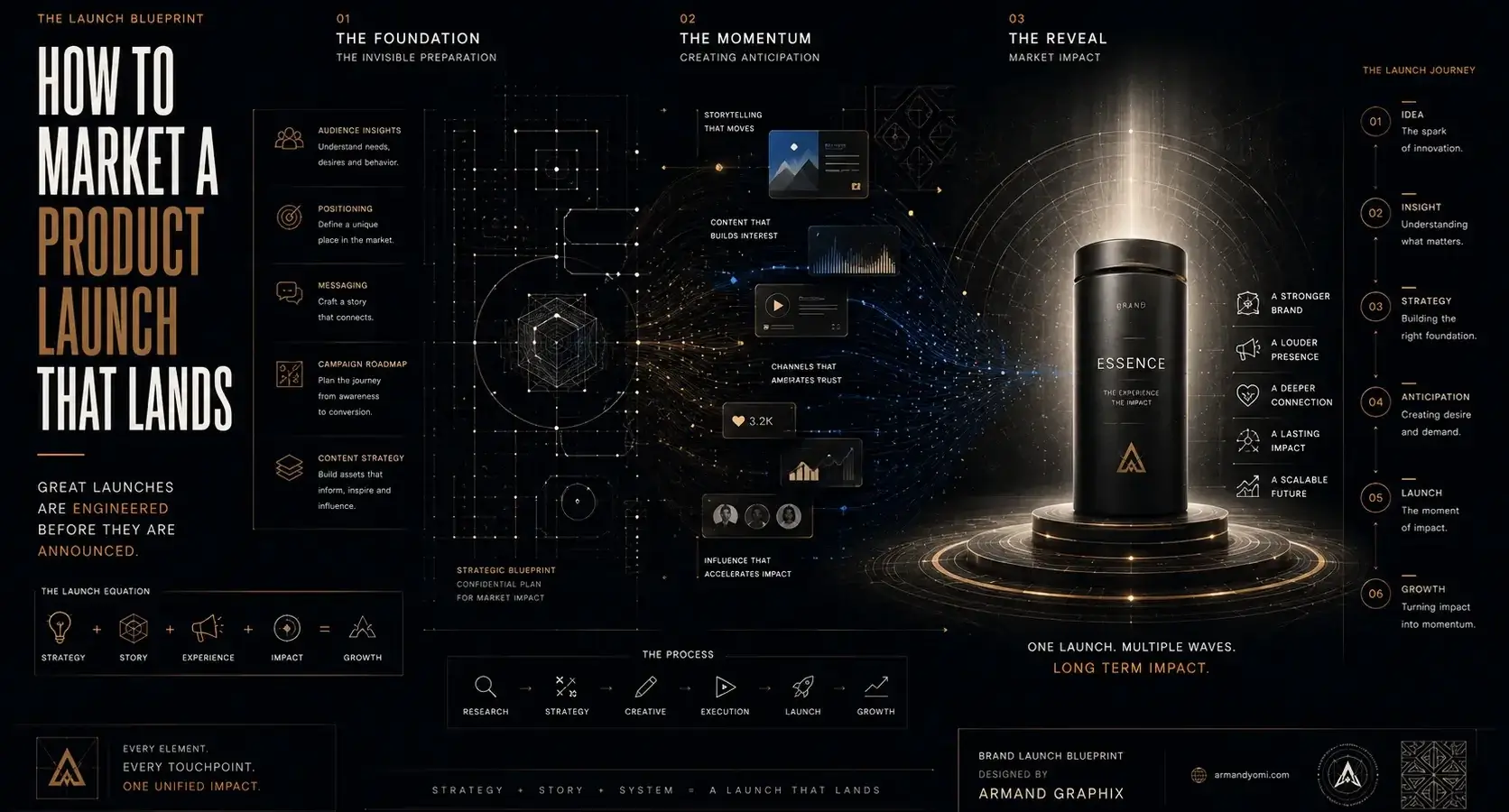
A product can be beautifully designed, expertly built, and still miss the market if the launch feels vague, rushed, or forgettable. That is the real challenge behind how to market a product launch – not just getting attention, but shaping a release people understand, remember, and act on.
The brands that launch well rarely start with promotion. They start with clarity. If your audience cannot tell what the product is, who it is for, and why it matters right now, no ad budget or social push will save it. Marketing is not the decoration added at the end. It is the structure that gives your launch momentum.
“Launch Your Product With Strategy, Not Guesswork”
Discover the essential steps to build anticipation, connect with your audience, and create a launch that delivers results.
Build Your Launch Strategy →How to market a product launch starts with positioning
Before you design a campaign, define the story. Every strong launch sits on a sharp positioning statement. What problem does the product solve? What makes your approach different? Why should someone care today instead of three months from now?
This is where many founders get too close to the work. They describe features when buyers need outcomes. They talk about process when the market wants payoff. Positioning should be simple enough to repeat across your landing page, social assets, email sequence, sales deck, and ads without changing meaning every time.
A useful test is this: if someone saw your launch graphic without context, would the headline make immediate sense? If not, the issue is not the audience. It is the message.
Good positioning also creates discipline. It helps you decide what to emphasize and what to leave out. That matters because early launches often fail from excess. Too many claims. Too many offers. Too many visual directions. Strong launches reduce noise.
Build the launch around a distinct brand experience
People do not experience a launch in pieces. They experience it as a whole. Your product page, visuals, email design, packaging, social content, and ad creative should feel connected. If each touchpoint looks and sounds like it came from a different brand, trust drops.
This is where design does serious commercial work. A launch identity does more than make things look polished. It signals quality, creates recognition, and gives your audience something to remember. The right typography, color system, image direction, and messaging rhythm can turn a simple announcement into a credible market entry.
For brand-led businesses, this matters even more. If you are selling a lifestyle product, consumer goods, a service-based offer, or anything visually competitive, your audience will judge the product partly through presentation. That is not superficial. It is how buyers read value when they do not yet have experience with your product.
A launch campaign should feel intentional at every level. The copy should match the visual tone. The visual tone should match the price point. The price point should match the promise. When those pieces align, the launch feels believable.
Create anticipation before you ask for the sale
One of the most common mistakes in how to market a product launch is waiting until launch day to start talking. By then, you are already late.
Good launches use a pre-launch phase to warm the audience. That does not mean vague teaser content for the sake of mystery. It means releasing the right information in the right sequence. Start by introducing the problem or desire your product addresses. Then reveal the product context. Then show proof, details, and reasons to care.
This pre-launch period helps in three ways. It builds familiarity, gives your content time to circulate, and lets you test what messaging gets the strongest response. You may discover that your audience cares more about convenience than innovation, or more about design than price. That insight can sharpen the full campaign.
If you already have an email list, this is where it becomes valuable. Email remains one of the strongest launch channels because it reaches people who have already chosen to hear from you. Social platforms are useful for visibility, but email is stronger for conversion. If you have both, use social to attract attention and email to move people closer to action.
Choose channels based on behavior, not trend
Not every launch needs every platform. A focused strategy usually performs better than a scattered one.
Start with where your audience already pays attention. If you are launching a design-forward consumer product, Instagram and short-form video may carry the visual narrative well. If your buyers need more education or trust-building, email, search, and a conversion-focused landing page may do more heavy lifting. If your market is local or niche, community partnerships, event-based promotion, or targeted paid search can outperform broad awareness campaigns.
This is where strategy matters more than volume. It is better to have three coordinated channels than seven neglected ones. Your launch should have a clear path from awareness to consideration to purchase. If a channel does not serve that path, it may not belong in the campaign.
Paid media can accelerate reach, but only if the fundamentals are ready. Do not put budget behind weak messaging or an unfinished page. Ads amplify what is already there. If the offer is unclear, you will simply pay to spread confusion faster.
Content should answer the buyer’s next question
A launch campaign needs more than one hero announcement. People rarely buy the first time they hear about something. They move through questions.
What is it? Who is it for? Why is it different? How does it work? Is it worth the price? Can I trust this brand?
Your content should answer those questions in sequence. That might mean a landing page with sharp copy, a product demo, short social videos, behind-the-scenes content, founder messaging, customer previews, or visual storytelling that shows the product in context. The format can vary. The job stays the same.
This is also where proof becomes powerful. Proof may come from early reviews, waitlist demand, test user feedback, before-and-after examples, or case-based storytelling. For new brands without a long track record, credibility has to be built through presentation and evidence. Even small proof points can reduce hesitation.
If your product has a cultural, aesthetic, or emotional dimension, do not strip that out in pursuit of performance language. Buyers respond to logic, but they remember meaning. The strongest campaigns combine clarity with feeling.
Launch day is a peak, not the whole campaign
Treating launch day like the finish line is another costly mistake. It is only the moment when your preparation becomes visible.
On launch day, your assets should already be aligned. Your landing page should be live and tested. Your email sequence should be timed. Your social posts should reinforce the same message, not improvise around it. Your paid traffic, if you are using it, should send people to a destination built to convert.
The best launch-day marketing feels coordinated, not frantic. You want momentum, but you also want control. That often means resisting the urge to say everything at once. Keep the main message consistent. Then let supporting content carry the deeper detail.
It also helps to prepare for response. If the campaign works, people will have questions. Make sure your inbox, DMs, and order process are ready. Marketing creates demand, but the experience after the click shapes reputation.
What to do after the launch goes live
If you want to know how to market a product launch well, study what happens after the first wave. This is where many brands disappear too quickly.
Post-launch marketing is where you extend interest into traction. Share customer reactions. Highlight use cases. Answer objections you noticed in comments or sales calls. Repackage launch content into ongoing assets. A strong campaign can keep generating value long after the official release.
This is also the right time to review performance honestly. Which message got the highest engagement? Which channel drove the strongest conversions? Where did people drop off? Marketing should not only create excitement. It should generate insight you can use for the next campaign.
Sometimes the product is solid but the framing missed the mark. Sometimes the creative is strong but the offer needs work. Sometimes the audience was right, but the timing was off. A launch is not just a sales event. It is a live test of how your brand meets the market.
For creative businesses and growing brands, that is where design and strategy should stay connected. Visual identity gets attention. Messaging builds belief. Channel planning creates reach. Performance analysis tells you what to refine. That combination is where launches stop feeling improvised and start feeling engineered.
Armand Graphix approaches brand growth from that exact intersection – design that tells your story, and strategy that grows your brand.
A strong launch does not need to be loud. It needs to be clear, cohesive, and well-timed. When people can see the value, feel the brand, and trust the experience, the market responds.
“A Great Product Deserves a Powerful Launch Story”
Learn how branding, storytelling, and marketing design turn product launches into memorable experiences.
Create Your Launch Plan →- WordPress Versus Custom Websites for Growing Brands
 WordPress versus custom websites: compare cost, speed, control, SEO, and growth to choose a site that supports your brand and business goals clearly.
 - What Does Brand Strategy Include for Growth?
 What does brand strategy include? Learn the research, positioning, identity, messaging, and marketing choices that turn a business into a distinct brand.
 - Packaging Design Guide for Retail Brands
 A packaging design guide for retail brands: build shelf impact, meet production realities, and turn a first glance into a confident purchase decision.
 - Multicultural Branding Trends 2026 for Modern Brands
 Multicultural branding trends 2026 will reward brands that pair cultural intelligence, inclusive design, and local relevance with measurable, real growth.
 - Custom Logo vs Template: What Fits Your Brand?
 Custom logo vs template: compare cost, speed, ownership, and brand impact to choose an identity that builds your launch, growth, and reputation today.
 - What Is a Visual Identity? Design That Builds Trust
 What is a visual identity? Learn how logos, color, typography, and systems create recognition, trust, and stronger brand growth for ambitious businesses.