A brand can look polished and still miss the mark. That usually happens when the hiring decision is based on surface assumptions – lower cost, bigger team, faster turnaround – instead of what the business actually needs. The real question behind freelance designer vs design agency is not who is better in general. It is who is better for your stage, your ambitions, and the kind of brand experience you want to build.
If you are launching, rebranding, packaging a product, or trying to improve your digital visibility, the wrong creative partner can slow momentum. The right one can shape not just how your brand looks, but how it is understood, remembered, and chosen.
The best decision is rarely about freelancer versus agency as a fixed rule. It is about fit, trust, and whether the person or team in front of you can turn your vision into a brand people remember and a business people choose.
“Freelancer or Design Agency? Choose the Right Creative Partner”
Understand the strengths, limitations, and opportunities of each option before investing in your next design project.
Find Your Best Fit →Freelance designer vs design agency: what is the real difference?
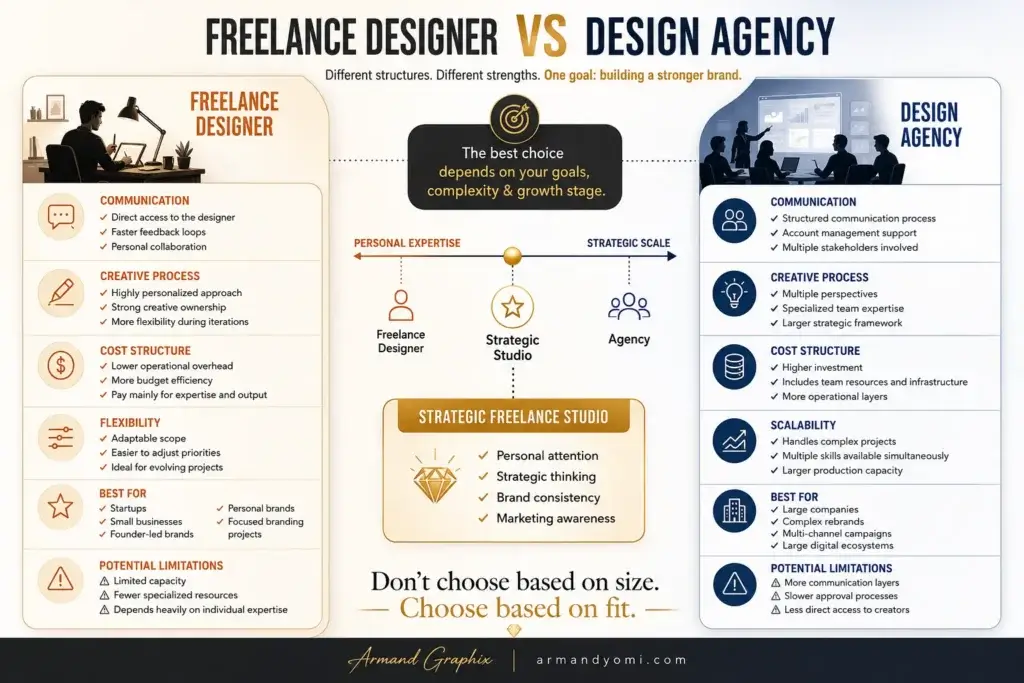
At a basic level, a freelance designer is an independent creative professional. A design agency is a team-based business with multiple roles under one structure. That sounds simple, but the practical difference runs deeper.
When you hire a freelancer, you are usually buying direct access to the person doing the work. Communication is often tighter. Decisions move faster. The relationship can become highly collaborative because there are fewer layers between concept and execution.
With an agency, you are often hiring a system. That can include account managers, strategists, designers, developers, media buyers, and production specialists. For some brands, that structure is a major advantage. For others, it adds cost and distance without adding real value.
The best choice depends on the complexity of the project and the level of strategic integration required. A logo-only job, a full rebrand, a website rebuild, and a multi-channel growth campaign are not the same assignment. They should not be bought the same way.
When a freelance designer is the stronger choice
A strong freelance designer can be the smartest option when you want quality, clarity, and a more personal creative process. This is especially true for startups, founder-led businesses, and small brands that need thoughtful work without the overhead of a large team.
One of the biggest advantages is continuity. You are speaking directly with the person interpreting your vision. That reduces the gap between what you mean and what gets delivered. It also makes nuance easier to preserve. If your brand has a personal story, cultural context, or a very specific market position, direct collaboration matters.
Freelancers also tend to be more adaptable. They can tailor scope, adjust pacing, and build around your priorities instead of forcing your project into a fixed agency process. If you need branding first, then packaging, then a landing page, then support with SEO or paid campaigns, a flexible freelance partnership can feel more aligned with how growing businesses actually work.
Cost is another factor, but it should be framed correctly. A freelancer is not always cheaper because they are less capable. Often, they are more efficient because there is less operational overhead to fund. You are paying for expertise and output, not layers of management.
That said, not every freelancer is strategic. Some are highly skilled visually but weak in positioning, messaging, or business thinking. Others are excellent at one deliverable and less confident across a wider brand ecosystem. The right freelancer should be able to connect design decisions to audience perception and commercial outcomes, not just aesthetics.
When a design agency makes more sense
An agency becomes more attractive when your project needs many specialized hands at once. If you are managing a complex launch with brand strategy, web development, ad creative, motion graphics, copywriting, and campaign execution happening in parallel, a strong agency can provide useful infrastructure.
Agencies can also be a better fit for organizations that need capacity more than intimacy. Larger companies often want process, documentation, backup resources, and formal reporting. If one team member is unavailable, another can step in. That reduces dependency on any single person.
There is also a perception advantage in some corporate environments. Stakeholders may feel more comfortable approving a larger budget with an established agency because the structure looks safer. Whether that is always true is another matter, but perception does influence decisions.
Still, agencies come with trade-offs. The person who sells the project may not be the person shaping the work. Feedback can pass through multiple layers before it reaches the designer. That can flatten originality or create disconnect between strategy and execution. Bigger teams can produce bigger thinking, but they can also produce slower decisions and less creative cohesion.
Cost, speed, and communication
This is where many comparisons become too simplistic. People assume freelancers are always faster and agencies are always more expensive. Often that is true, but not automatically.
A focused freelancer can move quickly because approval chains are short. If the brief is clear and the scope is realistic, progress can feel efficient and sharp. You may get more responsiveness and more thoughtful iteration because the project is not being handed across departments.
An agency may take longer because there are more checkpoints. Sometimes that improves quality control. Sometimes it creates drag. The difference comes down to how the team is managed and whether the process serves the project or just the organization.
On cost, agencies usually price higher because they carry more overhead and more roles. That does not mean the spend is unjustified. If your project truly needs research, strategy, design, development, content, and media execution all coordinated together, agency pricing can reflect real operational value.
But for many small and midsize brands, the agency model is oversized for the actual need. If what you need is a brand identity, a high-converting website, and strategic marketing guidance, a senior freelance partner can often deliver more directly and with greater accountability.
Strategy matters more than team size
The strongest brands are not built by volume. They are built by clarity. That is why the freelance designer vs design agency decision should not center only on headcount.
A smaller creative partner with strategic depth can outperform a larger team that treats your business like a workflow. This is especially relevant for founder-led brands, where the business story, audience psychology, and visual identity need to align from the start.
Design should do more than decorate. It should position. It should signal value. It should help the right audience feel trust before a sales conversation even begins. And if your creative partner also understands search visibility, ad performance, and customer acquisition, design becomes part of a larger growth system instead of an isolated deliverable.
That combination is where many businesses find real traction. Not because they hired the biggest team, but because they hired the right mind.
Which option fits your stage of business?
Early-stage businesses often benefit from a freelance partnership because they need agility. Priorities change quickly. Messaging evolves. Offers get refined. In that environment, direct collaboration is an advantage.
Established businesses with internal teams may benefit from an agency if they need scale, production support, or a broader bench of specialists. But even then, it depends on whether the agency can maintain strategic consistency across touchpoints.
If you are rebranding after growth, launching a premium offer, or entering a more competitive market, look beyond deliverables. Ask who can help shape perception. Ask who understands your audience. Ask who can create design that tells your story while supporting measurable visibility.
For many brands, especially those that need branding and marketing to work together, the best solution sits between the old categories. Not a solo designer who only makes assets. Not a large agency with too many layers. A strategic freelance studio model can offer the creative intimacy of a freelancer and the business thinking of a brand partner.
That is why businesses working with studios like Armand Graphix are often looking for more than design production. They want narrative-led branding, polished execution, and strategy that grows the brand after launch.
How to choose well
Start with the scope. If your project is broad, map the moving parts. If it is focused, be honest about what success actually requires. Then assess the partner, not just the business model.
Review their thinking, not only their visuals. Ask how they approach positioning. Ask how they handle revision cycles, timelines, and growth strategy. Ask who will actually do the work. A beautiful portfolio matters, but so does the ability to translate brand ambition into market response.
Most of all, choose the partner who understands the space between emotion and performance. Your brand has to look right, feel right, and work right. That is where strong creative partnerships earn their value.
The best decision is rarely about freelancer versus agency as a fixed rule. It is about fit, trust, and whether the person or team in front of you can turn your vision into a brand people remember and a business people choose.
“Great Design Starts With the Right Creative Relationship”
Discover how the right designer partnership can transform your ideas into a powerful brand experience.
Start Your Brand Journey →- WordPress Versus Custom Websites for Growing Brands
 WordPress versus custom websites: compare cost, speed, control, SEO, and growth to choose a site that supports your brand and business goals clearly.
 - What Does Brand Strategy Include for Growth?
 What does brand strategy include? Learn the research, positioning, identity, messaging, and marketing choices that turn a business into a distinct brand.
 - Packaging Design Guide for Retail Brands
 A packaging design guide for retail brands: build shelf impact, meet production realities, and turn a first glance into a confident purchase decision.
 - Multicultural Branding Trends 2026 for Modern Brands
 Multicultural branding trends 2026 will reward brands that pair cultural intelligence, inclusive design, and local relevance with measurable, real growth.
 - Custom Logo vs Template: What Fits Your Brand?
 Custom logo vs template: compare cost, speed, ownership, and brand impact to choose an identity that builds your launch, growth, and reputation today.
 - What Is a Visual Identity? Design That Builds Trust
 What is a visual identity? Learn how logos, color, typography, and systems create recognition, trust, and stronger brand growth for ambitious businesses.