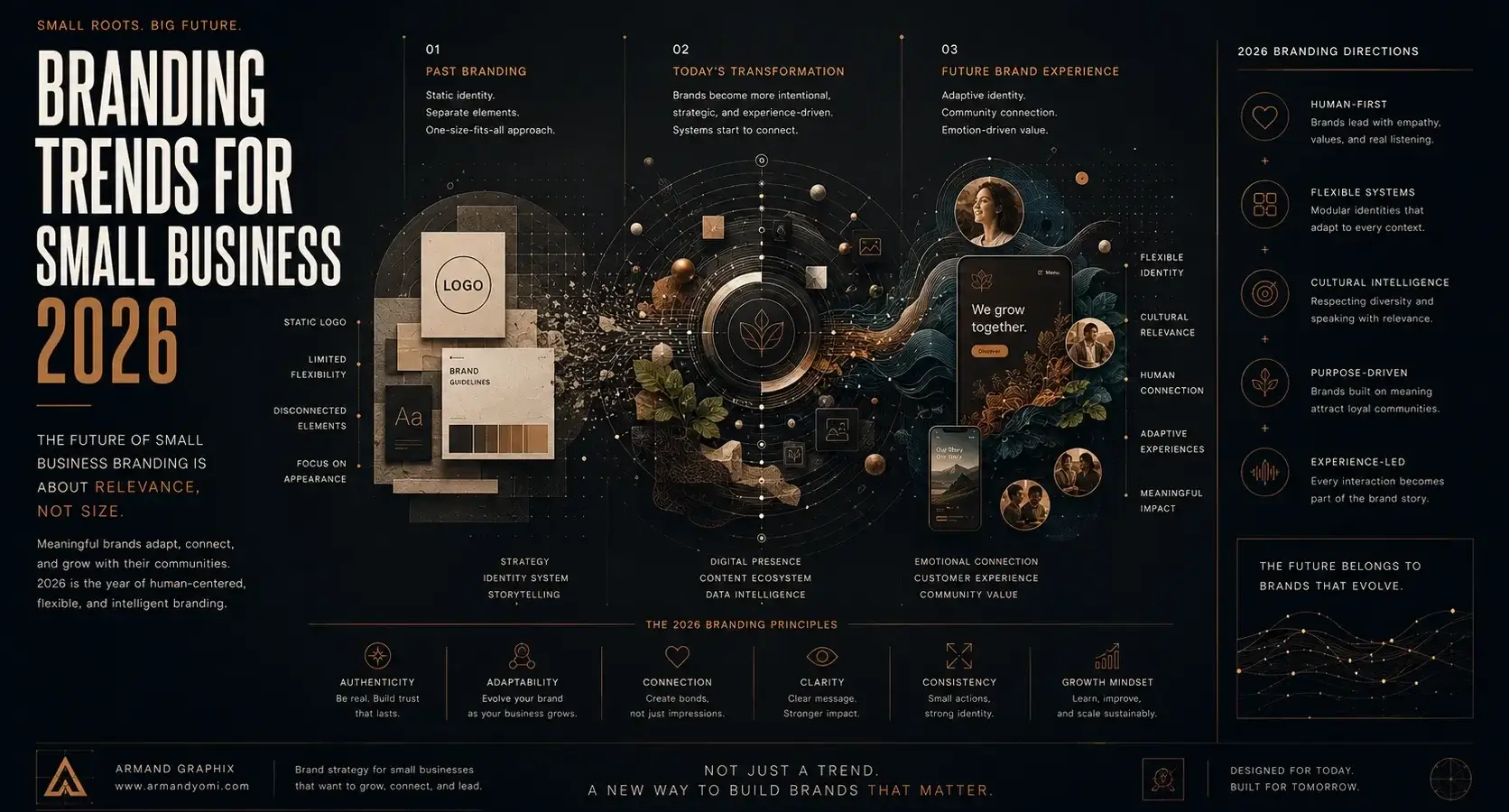
A polished logo is no longer enough. Small brands are being judged in seconds – on Instagram, on packaging, in search results, and on a phone screen before a customer ever speaks to a human. That is why branding trends for small business matter right now. The strongest brands are not simply looking better. They are becoming clearer, more memorable, and easier to trust.
For founders, this shift creates both pressure and opportunity. You do not need the budget of a national brand to look credible. You do need a sharper point of view, a more disciplined visual system, and a brand experience that feels consistent wherever people meet you. The trends shaping small business branding this year are less about decoration and more about direction.
“Prepare Your Brand for What’s Next”
Discover the branding trends shaping 2026 and learn how small businesses can build identities that stay relevant in a changing market.
Explore 2026 Branding Trends →Branding trends for small business are getting more strategic
A few years ago, many small businesses treated branding as a launch task. Get a logo, pick a few colors, build a website, move on. That approach is fading. Brand identity is now expected to work across content, ads, packaging, email, social media, and search. It has to carry emotional meaning and commercial intent at the same time.
The businesses gaining traction are using branding as a growth tool. They are asking smarter questions. Does our visual identity match our price point? Does our messaging sound like us or like everyone else in the category? Can a customer recognize us instantly in a crowded feed? Those are strategic brand questions, not surface-level design choices.
1. Story-led branding is replacing generic polish
Small businesses used to chase a clean, modern look and stop there. Clean still matters, but generic no longer performs. Audiences remember brands that feel specific. They want to know what shaped the business, what it stands for, and why its point of view deserves attention.
This does not mean every founder needs to turn their about page into a memoir. It means the brand should carry a narrative thread. A bakery might emphasize heritage and craft. A wellness brand might center ritual and care. A consulting firm might build its identity around clarity and transformation. The best stories are focused, not dramatic.
For small businesses, this trend is especially powerful because specificity creates distinction. You may not outspend bigger competitors, but you can out-position them.
2. Flexible identity systems matter more than one perfect logo
A single logo file cannot do all the work anymore. Brands now live across profile pictures, website headers, product labels, paid ads, presentation decks, and event signage. A rigid identity tends to break under that pressure.
That is why more small businesses are investing in flexible brand systems. Think logo variations, responsive typography, icon sets, motion cues, and clear rules for image treatment. The goal is not to create more assets for the sake of it. The goal is to make the brand usable in real situations.
This is one of the most practical branding trends for small business because it affects day-to-day execution. A beautiful identity that only works in one format becomes expensive fast. A flexible system saves time, protects consistency, and gives your brand room to grow.
3. Typography is becoming a bigger brand differentiator
Color palettes still matter, but typography is doing more of the heavy lifting. As more industries start to look visually similar, type choices are helping brands create a stronger signature.
For small businesses, typography can signal confidence, personality, and positioning without saying a word. A refined serif can feel editorial and premium. A geometric sans serif can suggest clarity and innovation. A custom or carefully paired type system can make a brand feel far more considered than a template-driven competitor.
There is a trade-off here. Distinctive typography should never come at the expense of readability. If your audience struggles to read your website, menu, packaging, or social posts, the brand loses momentum. Expression works best when it stays functional.
4. Imperfect, human visuals are earning more trust
Highly polished design still has a place, especially in luxury, hospitality, and premium retail. But across many small business categories, overly artificial visuals can feel distant. People are responding to brands that feel crafted by humans rather than assembled by algorithms.
That shift shows up in candid photography, textured layouts, handwritten accents, editorial crops, and more natural motion design. It also appears in messaging that sounds direct instead of overproduced. The point is not to look messy. The point is to feel real.
This matters even more as AI-generated content becomes common. When everyone can produce smooth visuals quickly, human judgment becomes a stronger signal of quality. Taste, restraint, and authenticity start to stand out.
5. Brand voice is finally getting the attention it deserves
Many small businesses invest in visual identity and leave messaging until later. That creates a gap customers can feel. The brand may look premium but sound vague, inconsistent, or interchangeable.
A stronger brand voice closes that gap. It gives shape to your homepage copy, social captions, email campaigns, packaging language, and ad messaging. More importantly, it helps people recognize your brand even when the logo is not present.
This trend is not about being louder or more clever. It is about being more intentional. A founder-led service brand may benefit from a confident, conversational tone. A product-based business may need language that feels sensory, concise, and lifestyle-aware. The right voice depends on the audience, the offer, and the buying context.
6. Micro-branding moments are shaping perception
Customers do not experience your brand in one dramatic reveal. They experience it in fragments. A favicon in a browser tab. A product insert. A confirmation email. A social story template. A thank-you card. A search snippet.
These small touchpoints are getting more attention because they influence trust in subtle ways. When those moments feel aligned, the brand feels established. When they feel random, the brand feels unfinished.
Small businesses have an advantage here. You can build thoughtful details into the customer journey faster than a large organization can. A clear packaging label, a consistent call to action, or a well-designed onboarding email can elevate perception without requiring a major rebrand.
7. Cultural awareness is becoming part of better design
As small businesses reach broader audiences online, cultural context matters more. Colors, symbols, phrasing, imagery, and even layout choices can carry different meanings across communities and markets.
The brands navigating this well are not flattening their identity to appeal to everyone. They are designing with awareness. They understand who they are speaking to, what references resonate, and what signals might alienate or confuse. That kind of sensitivity creates stronger connection and better market fit.
For businesses serving diverse customer bases, this is not just a social consideration. It is a strategic one. Cross-cultural clarity can improve response, relevance, and long-term loyalty.
8. AI is accelerating production, but not replacing brand judgment
AI is already changing how small businesses approach content, visuals, and brand experimentation. It can speed up ideation, support copy drafts, and help teams test creative directions. Used well, it improves efficiency.
But branding is still a discipline of judgment. AI can generate options. It cannot decide which story feels true, which visual language fits your audience, or which brand system will hold up over time. That is where strategy and design craft still matter.
The smartest small businesses are treating AI as a tool, not a substitute. They use it to move faster, then apply human direction to refine what actually represents the brand. This balance will matter more as audiences become better at spotting generic output.
9. Performance and branding are moving closer together
One of the biggest changes in recent years is that branding and marketing are no longer operating in separate lanes. A strong identity now affects click-through rates, conversion, retention, and referral. Brand clarity improves ad creative. Better messaging strengthens SEO pages. Consistency across channels reduces friction.
This is where many small businesses either gain momentum or stall. If your brand looks one way on your website, another way on social media, and another way in paid campaigns, performance suffers. People hesitate when signals do not align.
The opportunity is to build a brand that does both jobs. Design that tells your story. Strategy that grows your brand. When identity and visibility support each other, small businesses can compete with far larger players in a way that feels focused and credible.
What to prioritize if you cannot do everything at once
Not every trend deserves equal attention. If your budget or timeline is tight, start with the areas that shape perception fastest: positioning, brand voice, typography, and consistency across your main customer touchpoints. Those choices tend to create the biggest visible shift.
If you sell physical products, packaging may need to come sooner. If your business depends on lead generation, your website and search presence may matter more than social polish. If you are founder-led, messaging and personal brand alignment might carry extra weight. It depends on how customers find you and what convinces them to act.
A small business does not need to chase every design movement to stay relevant. It needs a brand system with enough clarity to be remembered, enough flexibility to scale, and enough substance to earn trust. Trends are useful when they sharpen your identity, not when they distract from it.
The best move is rarely to look newer. It is to look more like yourself – with greater precision, stronger storytelling, and a clearer path between first impression and real growth.
“Build a Brand That Evolves With Your Audience.”
Learn how modern branding strategies help small businesses create stronger connections, improve recognition, and grow with confidence.
Upgrade Your Brand Strategy →- WordPress Versus Custom Websites for Growing Brands
 WordPress versus custom websites: compare cost, speed, control, SEO, and growth to choose a site that supports your brand and business goals clearly.
 - What Does Brand Strategy Include for Growth?
 What does brand strategy include? Learn the research, positioning, identity, messaging, and marketing choices that turn a business into a distinct brand.
 - Packaging Design Guide for Retail Brands
 A packaging design guide for retail brands: build shelf impact, meet production realities, and turn a first glance into a confident purchase decision.
 - Multicultural Branding Trends 2026 for Modern Brands
 Multicultural branding trends 2026 will reward brands that pair cultural intelligence, inclusive design, and local relevance with measurable, real growth.
 - Custom Logo vs Template: What Fits Your Brand?
 Custom logo vs template: compare cost, speed, ownership, and brand impact to choose an identity that builds your launch, growth, and reputation today.
 - What Is a Visual Identity? Design That Builds Trust
 What is a visual identity? Learn how logos, color, typography, and systems create recognition, trust, and stronger brand growth for ambitious businesses.