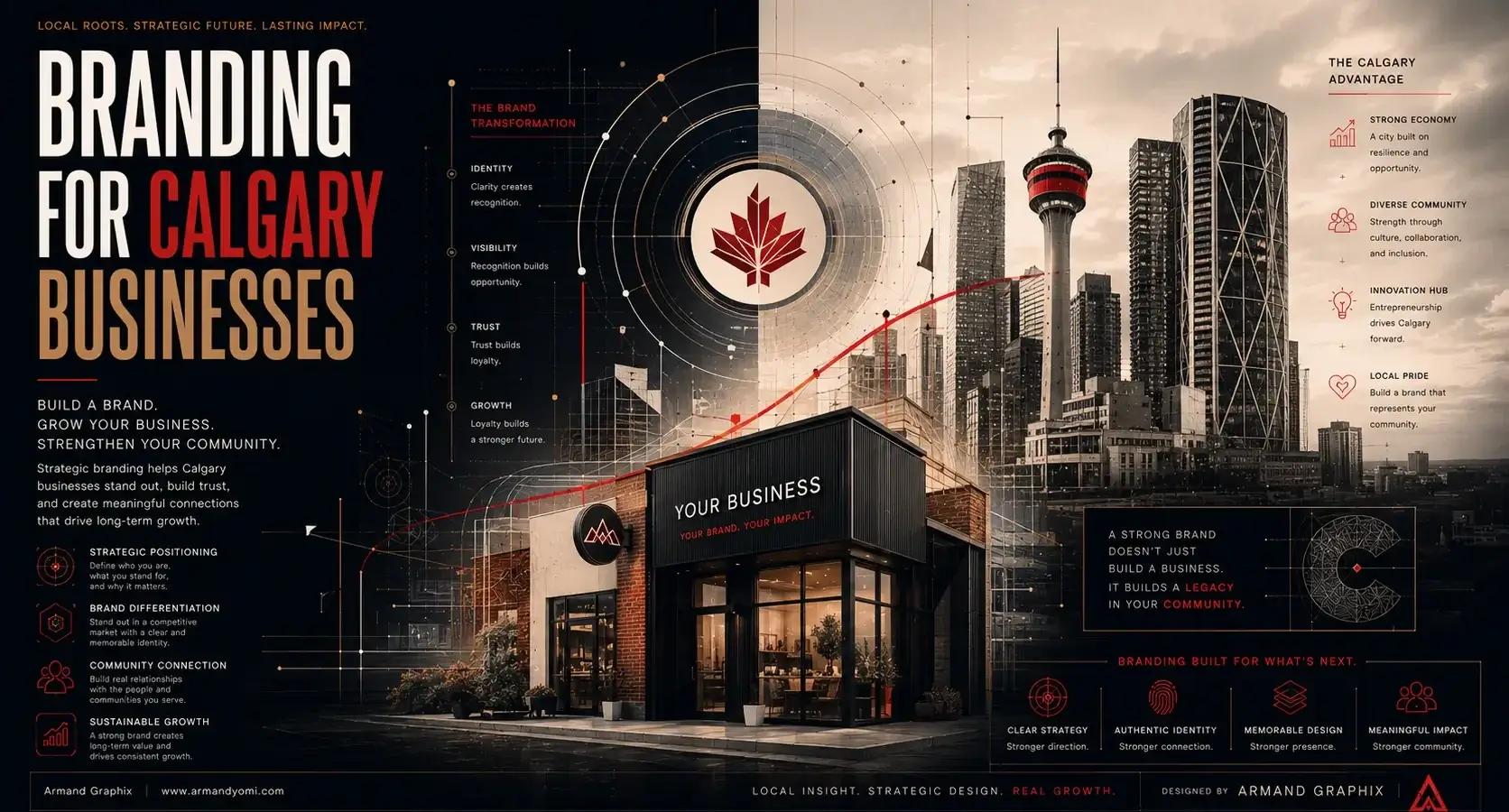
A lot of businesses wait too long to fix their brand. They launch with a logo, a few social graphics, maybe a website, then wonder why the market feels cold. That is usually where branding Calgary businesses need starts to become clear – not as decoration, but as a business tool that shapes trust, recognition, and growth.
In a city full of ambitious startups, established local companies, and fast-moving service brands, good branding has to do more than look polished. It has to communicate who you are, what you stand for, and why someone should choose you over the next option. If it only looks attractive but says nothing meaningful, it will not carry the weight your business needs it to carry.
“Turn Your Calgary Business Into a Recognizable Brand”
Discover how strategic branding helps local businesses build trust, stand out from competitors, and create stronger customer connections.
Grow Your Brand →What branding Calgary really means
Branding is often reduced to visual identity alone. That is part of it, but only part. Your brand lives in the gap between what you say and what people feel when they encounter your business.
That includes your name, logo, typography, website, packaging, tone of voice, messaging, campaign visuals, and even how consistently you show up across channels. More importantly, it includes the story tying those pieces together. The strongest brands do not just look unified. They feel intentional.
For Calgary businesses, that matters because competition is not limited to your immediate neighborhood anymore. A local company may be compared against national players with sharper websites, stronger messaging, and more memorable identities. If your brand feels generic, dated, or disconnected, people notice fast.
Why some brands blend in while others build traction
Most weak brands are not weak because the owner lacks vision. They are weak because the process started in the wrong place. Too often, businesses begin with personal taste instead of market position.
A founder might say they want a modern logo, a luxury feel, or a bold color palette. Those preferences can be useful, but they are not strategy. The real questions come first. Who are you speaking to? What do they need to believe before they buy? What emotional tone fits your offer? What visual cues will help you stand apart without confusing your audience?
That is where branding starts to affect results. A clear brand reduces friction. It helps people understand your value faster. It makes your business easier to remember. It also gives your marketing a stronger foundation, because paid ads, search visibility, social content, and website design all perform better when the brand underneath them is coherent.
Branding Calgary companies need at different stages
Not every business needs the same branding work. A startup has different pressures than a mature company going through a repositioning.
If you are just launching, branding helps you define your market entry. You need a clear identity, a compelling brand story, and assets that make you look credible from day one. This is especially critical if you are entering a crowded category where buyers make quick judgments.
If your business is established, the need is often different. Maybe your visuals no longer reflect your quality. Maybe your website looks disconnected from your packaging or social presence. Maybe your messaging has not evolved with your audience. In that case, branding is less about invention and more about alignment.
For product-based brands, packaging can become one of the most powerful brand touchpoints. For service businesses, the website and sales materials often carry more weight. For event-driven organizations, campaign identity and environmental visuals can shape the entire audience experience. It depends on how people encounter your brand in real life.
The real components of a strong brand system
A strong brand system is built in layers. At the center is strategy. That includes positioning, audience understanding, brand personality, messaging direction, and market context. Without that layer, design choices become arbitrary.
The next layer is identity. This is where logo design, typography, color, imagery, layout principles, and visual language come together. Good identity design is not just aesthetically strong. It creates recognition across formats, from social graphics to presentations to packaging.
Then comes application. A brand only becomes real when it is used consistently. That means websites, printed materials, ad creatives, pitch decks, signage, packaging, and digital campaigns should all feel like they belong to the same business. If every touchpoint tells a different story, people trust the brand less.
This is also where many businesses underestimate the value of working with someone who understands both design and marketing. A beautiful identity that fails in search, performs poorly in ads, or does not translate well to digital environments leaves opportunity on the table.
Story is not a soft extra
Some business owners still treat storytelling as optional, as if it belongs only to lifestyle brands or personal brands. That misses the point.
Story is how people make sense of value. It is how a business moves from being technically competent to emotionally relevant. Even in practical industries, buyers respond to clarity, meaning, and confidence. They want to know what drives your business, what standards you hold, and what experience they can expect.
The best branding work captures that story without becoming vague or theatrical. It turns your purpose into language, visuals, and experiences people can recognize. It gives your brand a point of view.
For diverse markets, intercultural awareness adds another layer. Visual communication does not land the same way for every audience. Tone, symbolism, typography, and color associations can shift based on cultural context. Brands that understand this communicate with more precision and more respect.
Where branding and marketing should meet
One of the biggest mistakes businesses make is treating branding and marketing as separate worlds. Branding shapes perception. Marketing drives visibility. You need both.
If your SEO brings traffic to a weak website, the traffic does not convert as well as it should. If your paid campaigns attract attention but your brand feels inconsistent, that attention does not build confidence. If your social content is active but visually fragmented, growth becomes harder to sustain.
This is why the best brand development is not isolated from performance thinking. Your identity should support discoverability, your messaging should support conversion, and your visual system should make campaigns more effective. Design that tells your story and strategy that grows your brand should not compete with each other. They should reinforce each other.
That integrated thinking is where many businesses gain an edge. Instead of hiring one partner for visuals and another for traffic, they build a brand that is designed to perform from the start.
How to know when your brand is holding you back
Sometimes the signs are obvious. Your materials look outdated. Your website does not reflect your level of work. Your social presence feels uneven. People misunderstand what you offer.
Sometimes the signs are quieter. Leads come in, but not the right ones. Pricing conversations feel harder than they should. Your business is growing, but your presentation still feels like an early version of you. Those gaps matter because branding influences perception before your sales process ever begins.
A rebrand is not always the answer. Sometimes a strategic refresh is enough. Sometimes the issue is messaging, not visuals. Sometimes your logo is fine, but your brand architecture, typography, or website hierarchy need work. The right solution depends on what is actually causing friction.
What to look for in a branding partner
If you are investing in branding Calgary businesses can compete with, look beyond surface style. You want someone who can ask strong questions, translate strategy into visuals, and build assets that work across real business use cases.
A good branding partner should be able to explain why a direction makes sense, not just present something attractive. They should understand how identity extends into digital marketing, content, and customer experience. They should also know when to push creatively and when to simplify.
This is where a portfolio matters. Not because every project should look the same, but because the work should show range, clarity, and intention. Strong branding is not about imposing one aesthetic on every client. It is about finding the visual and verbal system that fits each business best.
Armand Graphix approaches branding from that intersection of story, design craft, and market performance, helping businesses build brands that feel distinctive and work hard in the real world.
A brand should make growth easier
The right brand does not solve every business problem. It will not replace a weak offer or fix poor customer service. But it can remove hesitation, sharpen your market presence, and make every touchpoint work harder.
When your brand is clear, people understand you faster. When it is distinctive, they remember you longer. When it is aligned with your marketing, it helps create momentum instead of draining it.
If your business has evolved but your brand has not, that tension is worth paying attention to. Often, the next level of growth does not start with more noise. It starts with a brand that finally looks, sounds, and performs like the business you are building.
“Your Business Needs More Than Visibility, It Needs Identity”
Learn how a strong brand strategy can help Calgary businesses communicate their value and build long-term market recognition.
Build Your Brand Strategy →- WordPress Versus Custom Websites for Growing Brands
 WordPress versus custom websites: compare cost, speed, control, SEO, and growth to choose a site that supports your brand and business goals clearly.
 - What Does Brand Strategy Include for Growth?
 What does brand strategy include? Learn the research, positioning, identity, messaging, and marketing choices that turn a business into a distinct brand.
 - Packaging Design Guide for Retail Brands
 A packaging design guide for retail brands: build shelf impact, meet production realities, and turn a first glance into a confident purchase decision.
 - Multicultural Branding Trends 2026 for Modern Brands
 Multicultural branding trends 2026 will reward brands that pair cultural intelligence, inclusive design, and local relevance with measurable, real growth.
 - Custom Logo vs Template: What Fits Your Brand?
 Custom logo vs template: compare cost, speed, ownership, and brand impact to choose an identity that builds your launch, growth, and reputation today.
 - What Is a Visual Identity? Design That Builds Trust
 What is a visual identity? Learn how logos, color, typography, and systems create recognition, trust, and stronger brand growth for ambitious businesses.