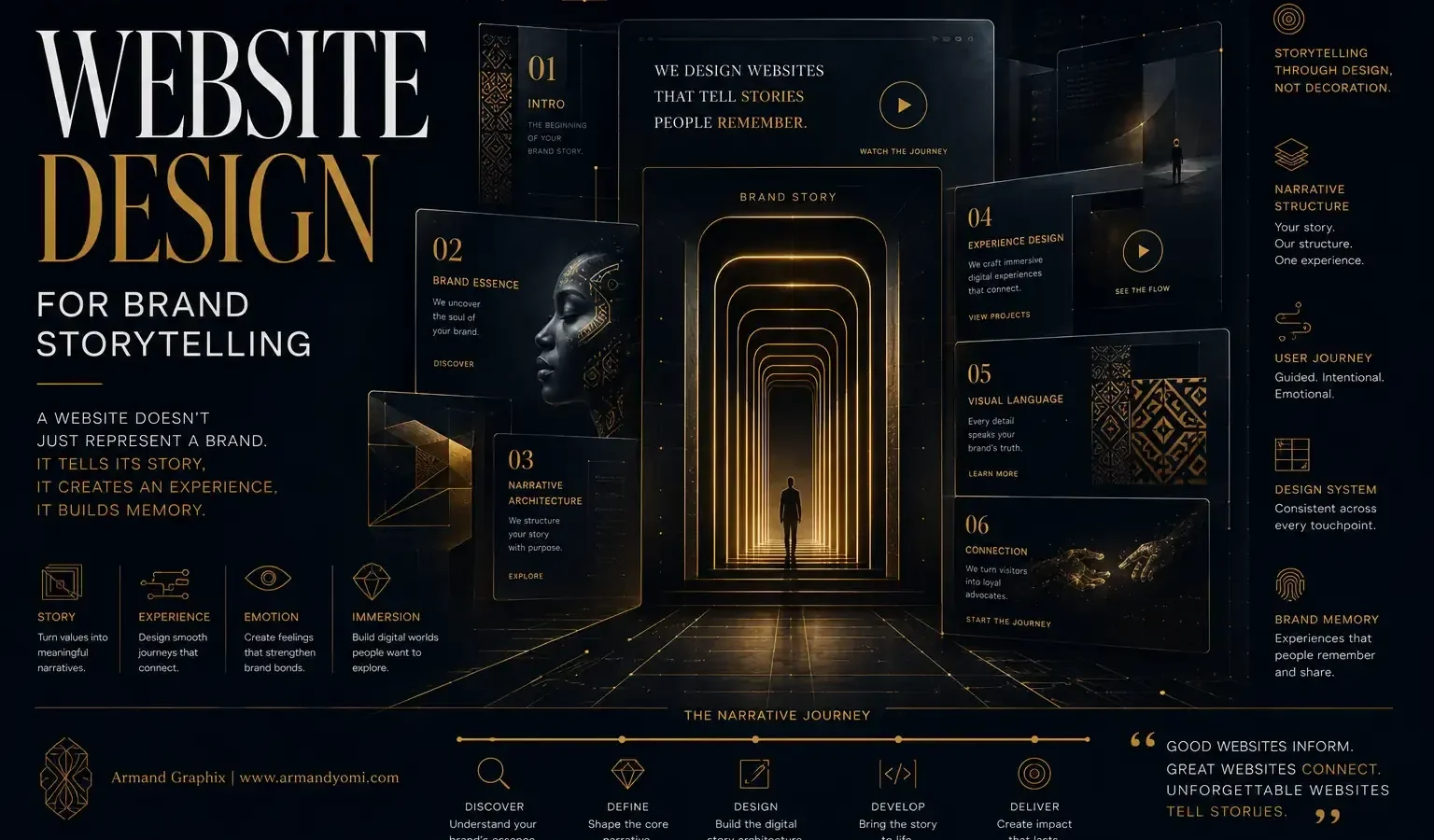
A visitor lands on your site and makes a judgment before they read a full sentence. They feel whether your brand is sharp, thoughtful, premium, playful, grounded, or forgettable. That is why website design for brand storytelling is not a decorative layer added after strategy. It is the strategy made visible.
A strong website does more than present information. It stages an experience. Every section, type choice, image treatment, color decision, and call to action tells people what kind of brand they are dealing with and what kind of relationship they can expect. If your website looks polished but says nothing meaningful, it may attract attention without building trust. If it tells a compelling story but feels clumsy to use, people may leave before the story has a chance to work.
“Your website should do more than look modern.”
Build a digital experience that communicates your brand story with clarity and emotion.
Start Your Brand Website Project →What website design for brand storytelling actually means
Brand storytelling on the web is not about writing a dramatic About page and hoping for the best. It is the deliberate alignment of message, visuals, structure, and interaction so the brand feels coherent from the first scroll to the final click.
That story can be bold and minimal. It can be warm and editorial. It can be product-focused, founder-led, or mission-driven. The point is not to make every brand sound poetic. The point is to make the website express a clear identity that people can recognize, remember, and trust.
For a startup, this often means translating a new idea into credibility. For a small business, it might mean moving beyond a generic template into a site that reflects real expertise. For a brand-led company, it means turning visual identity into a working digital experience that supports visibility and conversion.
The best brand stories are built into the structure
Many businesses think storytelling lives in the copy alone. In reality, site structure does just as much narrative work.
What appears first on the homepage tells people what matters most. A founder portrait says one thing. A product benefit says another. A case study-led layout signals proven outcomes. A gallery-first approach suggests visual authority. None of these choices are neutral.
Good structure creates momentum. It introduces the brand, frames the value, answers doubt, and guides the next step. That journey is storytelling. It is also user experience.
This is where a lot of websites lose power. They try to say everything at once. Services, credentials, mission, testimonials, offers, and long blocks of copy all compete for attention. The result is not richness. It is noise.
A story needs sequence. Your website does too.
Start with the brand promise, not the brand biography
Most visitors are not asking, Who are you really? at the top of the page. They are asking, Is this for me? Can you solve my problem? Can I trust your taste, your process, or your product?
That is why the opening section matters so much. It should frame your brand promise in a way that feels immediate and specific. Once people understand the value, they are more willing to learn the deeper story behind it.
Use progression, not repetition
If every section on the page repeats the same claim in different words, the story stalls. Strong websites move from one layer of meaning to the next. They might start with positioning, then show proof, then explain the process, then address objections, then invite contact.
That progression gives the visitor confidence. It also makes the brand feel intentional.
Visual design is where emotion becomes credible
A brand story without visual discipline feels thin. A beautiful site without narrative clarity feels empty. The strongest work combines both.
Typography plays a major role here. Clean, assertive type can communicate authority. More expressive typography can signal personality, culture, or creative range. But it has to fit the brand. A luxury skincare line, a local consultant, and a streetwear label should not all sound the same visually.
Color also carries meaning quickly. Warm neutrals can suggest calm and refinement. High contrast can feel confident and modern. Rich saturation can signal energy or cultural vibrancy. Still, color is not just emotional. It has practical consequences for readability, hierarchy, and accessibility. A strong palette should support the story without making the site harder to use.
Photography and graphics matter for the same reason. Stock images often flatten brand identity because they describe a category rather than a point of view. Original photography, custom graphics, thoughtful layouts, and branded motion can make a site feel owned rather than assembled.
This is especially important for businesses that want to differentiate in crowded markets. Distinctive design is not vanity. It is positioning.
Website design for brand storytelling should still convert
There is a common mistake in creative circles and a different one in performance marketing. One side sometimes treats storytelling as enough, as if emotional resonance will automatically create action. The other reduces the website to a conversion machine, stripping away brand depth in favor of blunt efficiency.
The truth sits between them.
A site that tells a strong story but hides the next step is underperforming. A site that pushes hard for clicks without building trust often turns premium brands into commodities. The best websites support both brand perception and business movement.
That means calls to action should feel like part of the story, not interruptions inside it. A service brand might invite visitors to book a consultation after showing a clear process and selected work. An e-commerce brand might present product benefits, social proof, and brand values before asking for the sale. A founder-led business may need more personality and more reassurance before conversion happens.
It depends on the audience, the price point, and how much trust the decision requires.
Storytelling changes by business stage
A new business often needs a website that establishes legitimacy fast. The design should feel polished, but the message must also reduce uncertainty. Clear offers, sharp positioning, and a focused narrative usually matter more than elaborate features.
An established business with an outdated site has a different challenge. It may already have credibility, but the website no longer reflects the quality of the work. In that case, storytelling is often about alignment – bringing the digital presence up to the level of the real brand.
For brands entering new markets or speaking to diverse audiences, the story may need another layer. Cultural references, imagery, tone, and design choices should feel intentional, not imported without context. Intercultural design thinking becomes especially valuable here because what feels premium, trustworthy, or relatable can shift across audiences.
What to fix if your website looks good but feels flat
This happens often. The site is clean. The colors are fine. The layout is modern. Yet nothing stays with the visitor.
Usually, the issue is not a lack of style. It is a lack of narrative tension and specificity. The brand is presented as competent, but not memorable. The copy names services, but not perspective. The visuals are attractive, but not distinct enough to express character.
If that sounds familiar, look at whether your website answers these questions clearly: what do you stand for, who is this for, why should someone trust your approach, and what emotional impression should they leave with? If those answers are weak, the design has nothing meaningful to amplify.
Another issue is inconsistency. The homepage says one thing, the portfolio says another, the About page introduces a different tone, and the contact page feels transactional. That disconnect weakens the story, even when each page looks good on its own.
Consistency does not mean sameness. It means the brand feels coherent at every touchpoint.
Why the strongest websites feel edited
Brand storytelling is often improved by subtraction. Not every credential belongs on the homepage. Not every service needs equal visual weight. Not every paragraph deserves to survive the final draft.
Editing is what gives a site confidence. It shows that the brand knows what matters and is not afraid to lead with it.
This is one reason portfolio-led creative businesses often perform well when their websites are carefully curated. Selected work, framed with the right context, tells a sharper story than a crowded archive ever could. The same principle applies to testimonials, service descriptions, and homepage sections. Better to say the right thing clearly than say everything loosely.
For businesses investing in both branding and growth, this balance matters. Design that tells your story should also support search visibility, page clarity, and lead quality. Strategy that grows your brand needs a website capable of carrying both emotion and intent. That combination is where strong creative direction becomes commercial advantage.
A website should not feel like a brochure pasted onto a screen. It should feel like your brand has entered the room, knows exactly what it wants to say, and knows how to move people closer.
“Great brands are remembered through experiences.”
Create a website that people feel, remember, and trust.
Create an Immersive Brand Experience →- WordPress Versus Custom Websites for Growing Brands
 WordPress versus custom websites: compare cost, speed, control, SEO, and growth to choose a site that supports your brand and business goals clearly.
 - What Does Brand Strategy Include for Growth?
 What does brand strategy include? Learn the research, positioning, identity, messaging, and marketing choices that turn a business into a distinct brand.
 - Packaging Design Guide for Retail Brands
 A packaging design guide for retail brands: build shelf impact, meet production realities, and turn a first glance into a confident purchase decision.
 - Multicultural Branding Trends 2026 for Modern Brands
 Multicultural branding trends 2026 will reward brands that pair cultural intelligence, inclusive design, and local relevance with measurable, real growth.
 - Custom Logo vs Template: What Fits Your Brand?
 Custom logo vs template: compare cost, speed, ownership, and brand impact to choose an identity that builds your launch, growth, and reputation today.
 - What Is a Visual Identity? Design That Builds Trust
 What is a visual identity? Learn how logos, color, typography, and systems create recognition, trust, and stronger brand growth for ambitious businesses.