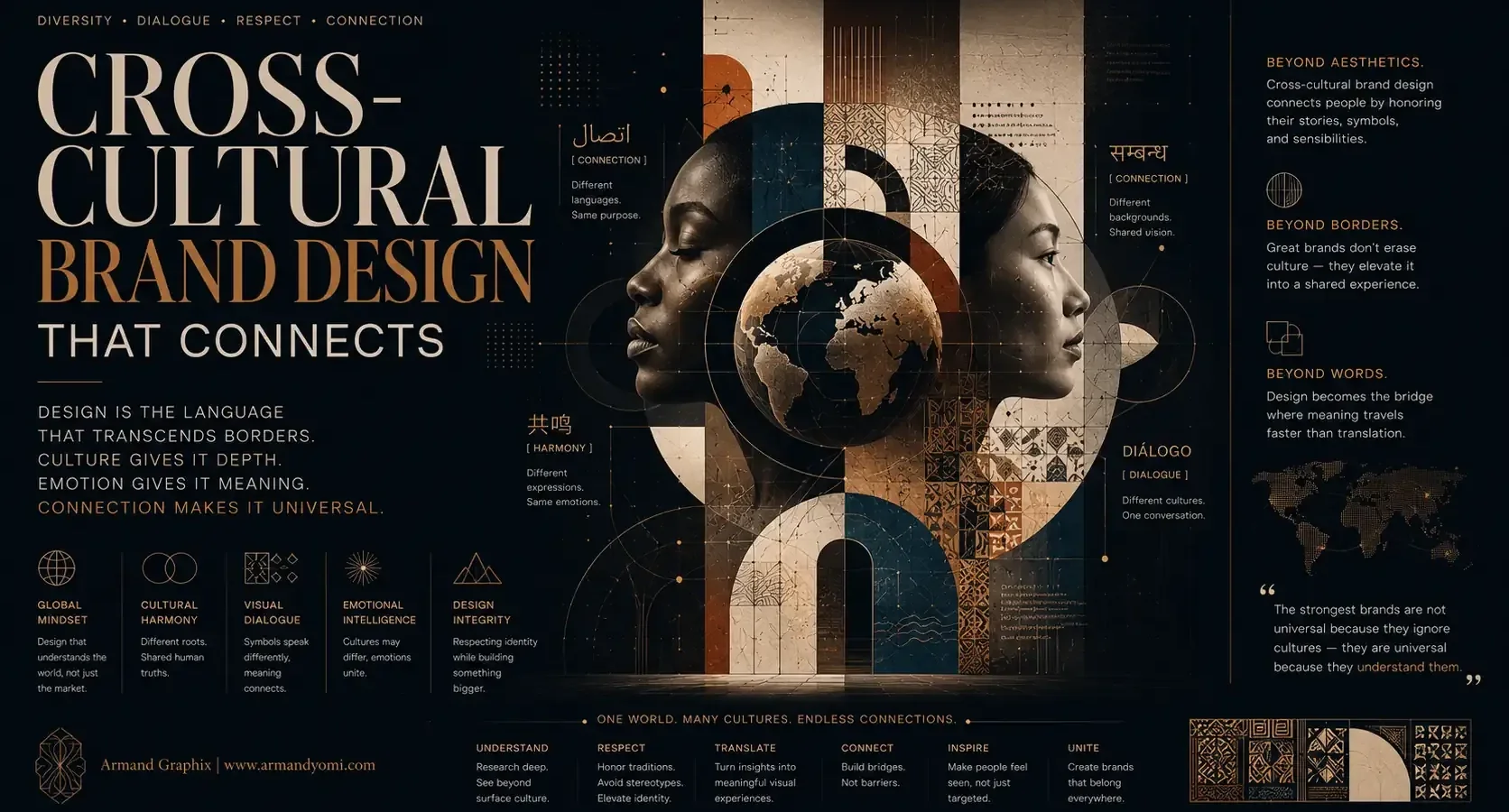
A brand can look polished, expensive, and technically well made – and still miss the audience completely. That usually happens when visual decisions are based on internal taste rather than cultural understanding. Cross cultural brand design solves that problem by helping brands communicate with people who do not all read symbols, color, language, status, and emotion in the same way.
For founders planning to grow across regions, speak to diverse communities, or launch in more than one market, this is not a cosmetic layer. It is a strategic design discipline. The goal is not to make a brand feel generic enough for everyone. The goal is to make it recognizable, respectful, and persuasive in context.
“Great Brands Connect Across Cultures.”
Learn how strategic cross-cultural design creates emotional connections with diverse audiences without losing brand authenticity.
Build Global Connection →What cross cultural brand design actually means
Cross cultural brand design is the practice of shaping a brand identity so it can resonate across different cultural settings without losing its core story. That includes the obvious design elements such as logo systems, typography, packaging, imagery, and color. It also includes less visible decisions – tone of voice, hierarchy of information, symbolism, naming, user expectations, and what trust looks like in a given audience.
A brand does not enter every market with the same cultural baggage. In one place, minimal design may signal premium confidence. In another, it may feel empty or unfinished. A bright red package can suggest celebration, appetite, urgency, danger, luck, or discount pricing depending on who is looking at it and where.
That is where many businesses get caught. They assume consistency means repeating the same execution everywhere. In reality, consistency is about protecting the brand idea while adapting the way it is expressed.
Why cross cultural brand design matters for growth
If your audience is multicultural, your brand already operates in a cross-cultural environment whether you planned for it or not. This is especially true for e-commerce brands, service businesses with immigrant or international customer bases, and startups trying to scale beyond one city or country.
Good cross cultural brand design improves three things that matter commercially.
First, it increases clarity. People understand what you offer faster when the visual language aligns with their expectations. Second, it builds trust. Audiences notice when a brand feels informed rather than performative. Third, it protects your positioning. A brand that reads as premium in one market should not accidentally read as cheap, childish, or culturally unaware in another.
There is also a practical marketing benefit. Better cultural alignment improves performance across touchpoints. Ads feel more relevant. Landing pages feel more intuitive. Packaging stands out for the right reasons. Your brand story travels further because it is not fighting avoidable friction.
The biggest mistake brands make
The most common mistake is treating culture as decoration.
That usually looks like surface-level localization – swapping stock photos, adding translated copy, or inserting a pattern that feels vaguely regional. The brand remains built from one cultural point of view, then dressed up for another. Audiences can feel that gap quickly.
A stronger approach starts deeper. It asks what the audience values, how they interpret authority, what feels aspirational, what feels familiar, and what creates emotional distance. In some markets, brands win with friendliness and warmth. In others, precision and restraint signal credibility. Neither is universally right.
This is why design decisions should not begin with trends. They should begin with people.
The layers that shape cultural perception
Color is never just color
Color carries emotional and cultural associations, but those associations are rarely stable across borders. White can suggest simplicity and purity, but it can also carry mourning associations in some contexts. Gold can feel luxurious, spiritual, traditional, or overly ornate depending on the category and audience.
That does not mean brands should avoid strong color. It means color strategy needs context. The question is not “Is this beautiful?” It is “What does this communicate here?”
Typography speaks before copy does
Typography often gets treated as a purely stylistic choice, but it signals personality, authority, heritage, and accessibility before anyone reads a word. A highly editorial serif might communicate sophistication to one audience and distance to another. A geometric sans serif can feel modern and efficient, or cold and generic.
Multilingual considerations matter too. A type system that works beautifully in English may collapse when paired with other scripts or translated content. Good brand systems anticipate expansion instead of forcing awkward fixes later.
Imagery and symbolism need scrutiny
Photography style, illustration systems, icons, gestures, and symbols all carry assumptions. An image that feels empowering in one context may feel overly individualistic in another. Hand gestures, animals, religious cues, and even spatial composition can shift meaning across audiences.
This does not mean a brand should become visually timid. It means visual confidence should be informed, not accidental.
How to approach cross cultural brand design strategically
The strongest brand systems start with a clear center. Before adapting anything, define what cannot change. That may be your core story, your mission, your brand promise, or the emotional outcome you want customers to associate with you. If everything is flexible, the brand loses coherence.
From there, identify what can and should adapt. In some cases, it is messaging hierarchy. In others, it is packaging visuals, photography direction, content tone, or digital user flows. A brand does not need a completely different identity for every audience. It needs a design system that knows the difference between essence and execution.
Research matters here, but not all research is equal. Demographics alone will not tell you how design is received. You need cultural insight, category awareness, and market-specific observation. Look at what signals trust in that space. Study competitors, but also study adjacent brands, retail environments, and how audiences interact with visual information.
When possible, test with real people in the intended audience. What feels premium to your internal team may feel confusing or emotionally flat to the people you want to reach.
Cross cultural brand design is not about pleasing everyone
There is a real trade-off in this work. If you adapt too little, the brand feels imported without sensitivity. If you adapt too much, it starts losing its identity. The answer is not endless compromise. It is disciplined translation.
A strong brand should still feel like itself across markets. The voice may shift in tone. The visuals may flex. The messaging may prioritize different benefits. But the brand promise should remain intact.
This is where strategy protects creativity. Without a clear brand foundation, adaptation becomes guesswork. With a clear foundation, adaptation becomes intelligent design.
What this looks like in practice
A food brand entering a multicultural retail environment may need packaging that balances familiarity with aspiration. If the design only reflects one cultural norm for premium presentation, it may miss the emotional triggers that actually drive shelf appeal in another audience.
A professional service brand expanding internationally may need to rethink how authority is expressed. In one market, bold personal storytelling may create connection. In another, a more structured and formal presentation may build greater confidence.
A digital-first startup may discover that its sleek interface works visually but fails in communication because icons, form labels, or content hierarchy assume a user behavior pattern that is not universal.
These are not edge cases. They are common brand growth issues disguised as design preferences.
Where design and marketing need to work together
Cross-cultural thinking should not stop at the logo or brand guide. It should extend into SEO messaging, paid creative, social content, landing pages, and campaign visuals. A brand identity may be well adapted, but if ad language and imagery ignore cultural nuance, performance suffers anyway.
That is why design and marketing work best when they are developed together. Brand expression creates the first impression, but campaign execution proves whether that expression actually connects. Strategy that grows your brand needs both visual intelligence and audience insight.
For many founders, that integrated view is the missing piece. They invest in branding on one side and audience acquisition on the other, but the two are not speaking the same language. The result is a brand that looks good yet underperforms, or marketing that drives traffic to an identity that does not convert trust.
Building a brand that travels well
Brands with long-term strength are not the ones that flatten themselves into neutrality. They are the ones that know who they are, understand who they are speaking to, and design with both conviction and awareness.
Cross cultural brand design asks better questions. Not just whether the identity is attractive, but whether it is legible across cultures. Not just whether it is consistent, but whether it is relevant. Not just whether it tells your story, but whether that story can be received the way you intend.
If your brand is meant to grow across audiences, your design system needs more than style. It needs cultural intelligence. That is where connection starts – and where stronger brand growth becomes much more realistic.
“Design That Speaks Beyond Language.”
Discover how culturally intelligent branding helps modern businesses communicate, resonate, and grow across international audiences.
Explore Cross-Cultural Branding →- WordPress Versus Custom Websites for Growing Brands
 WordPress versus custom websites: compare cost, speed, control, SEO, and growth to choose a site that supports your brand and business goals clearly.
 - What Does Brand Strategy Include for Growth?
 What does brand strategy include? Learn the research, positioning, identity, messaging, and marketing choices that turn a business into a distinct brand.
 - Packaging Design Guide for Retail Brands
 A packaging design guide for retail brands: build shelf impact, meet production realities, and turn a first glance into a confident purchase decision.
 - Multicultural Branding Trends 2026 for Modern Brands
 Multicultural branding trends 2026 will reward brands that pair cultural intelligence, inclusive design, and local relevance with measurable, real growth.
 - Custom Logo vs Template: What Fits Your Brand?
 Custom logo vs template: compare cost, speed, ownership, and brand impact to choose an identity that builds your launch, growth, and reputation today.
 - What Is a Visual Identity? Design That Builds Trust
 What is a visual identity? Learn how logos, color, typography, and systems create recognition, trust, and stronger brand growth for ambitious businesses.