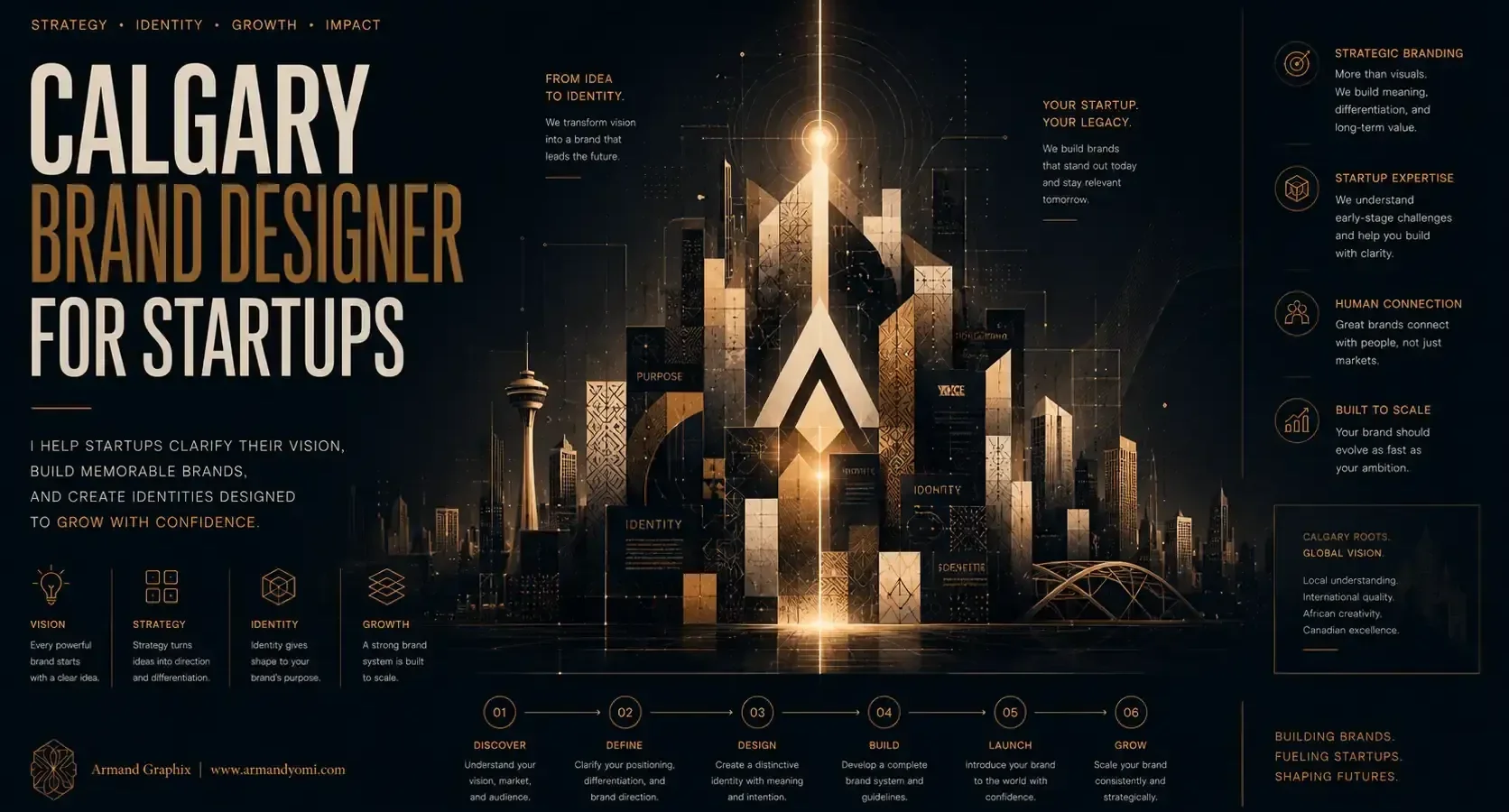
A startup rarely gets a second chance to explain itself. In the first few seconds, people decide whether your brand feels credible, relevant, and worth their attention. That is why choosing a Calgary brand designer for startups is not just a creative decision. It is a business decision that shapes how your company enters the market.
Early-stage founders often think branding starts with a logo and ends with a website. That view is too narrow. Brand design is how your company becomes legible to the people you want to reach. It turns an idea into a presence. It gives your offer structure, tone, and visual consistency so customers can recognize you, remember you, and trust you.
“A great product gets attention.”
A strong brand earns trust, recognition, and long-term growth.
Build a Startup Brand That Scales →What a Calgary brand designer for startups should actually do
A strong startup brand designer does more than make things look polished. The real work begins before the visuals. Your positioning, audience, value proposition, and personality all influence the identity system that follows.
That means the designer should be asking sharper questions than What colors do you like? They should want to know who you serve, what market you are entering, what alternatives customers are comparing you against, and what story your brand needs to tell. If those questions never come up, the work may end up attractive but strategically thin.
For startups, this matters even more because you are often building from ambiguity. You may still be refining your offer. You may be testing pricing, channels, and messaging. A capable designer helps create clarity inside that uncertainty. The goal is not to pretend your business is fully mature. The goal is to build an identity that feels focused enough to launch and flexible enough to evolve.
Why startups need brand strategy, not just design files
Startups live under pressure. You need traction, investor confidence, customer trust, and a market presence that does not feel improvised. Brand strategy supports all of that.
When your identity is aligned with your business model, your materials start working harder. Your pitch deck feels more cohesive. Your website becomes easier to navigate. Your social content sounds like it comes from one brand, not five different moods. Packaging, presentations, and digital campaigns begin to reinforce each other instead of competing for attention.
This is where many founders underestimate the cost of fragmented branding. You can launch with a cheap logo, a generic template, and a rushed website. Sometimes that is necessary. But if every customer touchpoint tells a different story, you spend more time correcting perception later. Rebrands are not always a sign of growth. Often, they are repairs.
A thoughtful brand system saves time because it creates repeatable decisions. Typography, color, tone, hierarchy, layout style, and messaging direction all become usable tools. That consistency is not cosmetic. It builds familiarity, and familiarity supports trust.
The difference between a freelancer, a studio, and a strategic partner
Not every brand designer works the same way, and the right fit depends on your stage.
A production-focused freelancer may be ideal if you already have clarity and simply need execution. A larger studio may make sense if you need a broad team and have the budget to support it. But many startups need something more specific – a partner who can think strategically, design at a high level, and understand how brand decisions affect marketing performance.
That middle ground is valuable. It gives founders direct collaboration without losing strategic depth. If your designer understands identity, storytelling, web presentation, and digital visibility, the brand is more likely to launch as a coherent system rather than a collection of separate deliverables.
This is especially relevant for startups trying to move fast without looking rushed. The brand needs emotional clarity and commercial purpose at the same time. Design that tells your story is stronger when it is paired with strategy that grows your brand.
What to look for in a startup brand designer
The portfolio should show range, but not randomness. You want to see that the designer can adapt to different industries while still creating work with logic, personality, and structure. Strong visuals matter, but so does the thinking behind them.
Look for signs of strategic discipline. Can they build identities that feel distinct without relying on trends? Do their projects carry a clear tone? Does the work translate across packaging, digital platforms, print, and campaign assets? Startups need brands that can live in multiple environments from day one.
You should also pay attention to how the designer communicates. A good process is often visible in the way they talk about the work. If they can explain why a direction fits a market, why a type system supports credibility, or why a visual language helps customer recall, that is a strong sign. Branding is not decoration. It is decision-making made visible.
For founders in Calgary, there is also value in local context when it helps. A designer familiar with the regional business landscape may better understand the competitive tone of the market, the expectations of local audiences, and how a startup needs to present itself to stand out. That said, local presence alone is not enough. Strategic fit matters more than geography.
Red flags founders should not ignore
The first red flag is a process that starts with aesthetics and skips positioning. If the conversation begins and ends with mood boards, your brand may lack the strategic foundation it needs.
The second is a portfolio built entirely on style sameness. If every project looks like the same brand wearing different names, your startup will struggle to feel original. Distinctive branding should reflect your story, not the designer’s personal template.
The third is the absence of system thinking. A logo by itself is not a brand. If there is no discussion of typography, color behavior, layout rules, messaging tone, social application, or web consistency, the identity may not hold up once you start using it in the real world.
Another common issue is treating marketing as an afterthought. Startups do not just need assets. They need momentum. If your brand looks refined but your website does not convert, your search presence is weak, and your messaging lacks focus, the business impact will be limited.
Why cross-cultural design thinking can be an advantage
Many startups are speaking to audiences that are more diverse, more global, and more visually literate than ever. A brand that works in one cultural context may not carry the same meaning in another. This does not only apply to international companies. Even local markets contain multiple cultural perspectives and expectations.
That is why cross-cultural design thinking adds real value. It helps a brand communicate with more awareness. It sharpens choices around symbolism, tone, image direction, and verbal identity. It can also help startups avoid visual clichés that flatten their story instead of strengthening it.
The most memorable brands feel intentional. They are emotionally clear without becoming generic. They understand who they are speaking to and what signals matter. For founders building modern brands, that awareness is part of the strategy, not an extra layer.
Branding and growth should not live in separate rooms
One of the biggest advantages a startup can gain is alignment between brand design and digital marketing. Too often, a company invests in identity first and only later asks how that identity performs online. By then, the gap becomes obvious.
A well-designed brand should support discoverability, engagement, and conversion. That means your visual identity needs to work with your website structure, your messaging should support search intent, and your campaign creative should feel connected to the brand rather than improvised around it.
This integrated approach is where a strategic creative partner can make a meaningful difference. When branding and marketing inform each other, the result is stronger than either discipline working alone. You do not just look established. You communicate with more precision and grow with more consistency.
That balance of artistic depth and measurable thinking is what many startups need most. Not branding for branding’s sake. Not marketing without personality. A brand presence that feels emotionally distinct and commercially ready.
Making the right decision for your stage
The best choice is not always the biggest package or the most elaborate process. It depends on what stage your startup is in, how clear your business model is, and how soon you need the brand to perform across channels.
If you are pre-launch, focus on clarity and flexibility. If you are already live but inconsistent, focus on building a stronger system. If you are preparing for growth, investor conversations, or a more competitive market position, invest in branding that can support that next step instead of patching the current one.
A startup brand should not feel inflated. It should feel true, intentional, and ready. That is the standard worth holding when you choose a designer.
Armand Graphix approaches this work with that balance in mind – narrative-led design, strategic clarity, and marketing awareness built to help brands connect and scale.
The right brand designer will not simply make your startup look better. They will help your business make sense faster, speak more clearly, and show up with the kind of confidence people notice before you ever say a word.
“Your startup deserves more than a logo.”
Create a brand identity designed to attract the right customers from day one.
Book Your Brand Strategy Session →- WordPress Versus Custom Websites for Growing Brands
 WordPress versus custom websites: compare cost, speed, control, SEO, and growth to choose a site that supports your brand and business goals clearly.
 - What Does Brand Strategy Include for Growth?
 What does brand strategy include? Learn the research, positioning, identity, messaging, and marketing choices that turn a business into a distinct brand.
 - Packaging Design Guide for Retail Brands
 A packaging design guide for retail brands: build shelf impact, meet production realities, and turn a first glance into a confident purchase decision.
 - Multicultural Branding Trends 2026 for Modern Brands
 Multicultural branding trends 2026 will reward brands that pair cultural intelligence, inclusive design, and local relevance with measurable, real growth.
 - Custom Logo vs Template: What Fits Your Brand?
 Custom logo vs template: compare cost, speed, ownership, and brand impact to choose an identity that builds your launch, growth, and reputation today.
 - What Is a Visual Identity? Design That Builds Trust
 What is a visual identity? Learn how logos, color, typography, and systems create recognition, trust, and stronger brand growth for ambitious businesses.