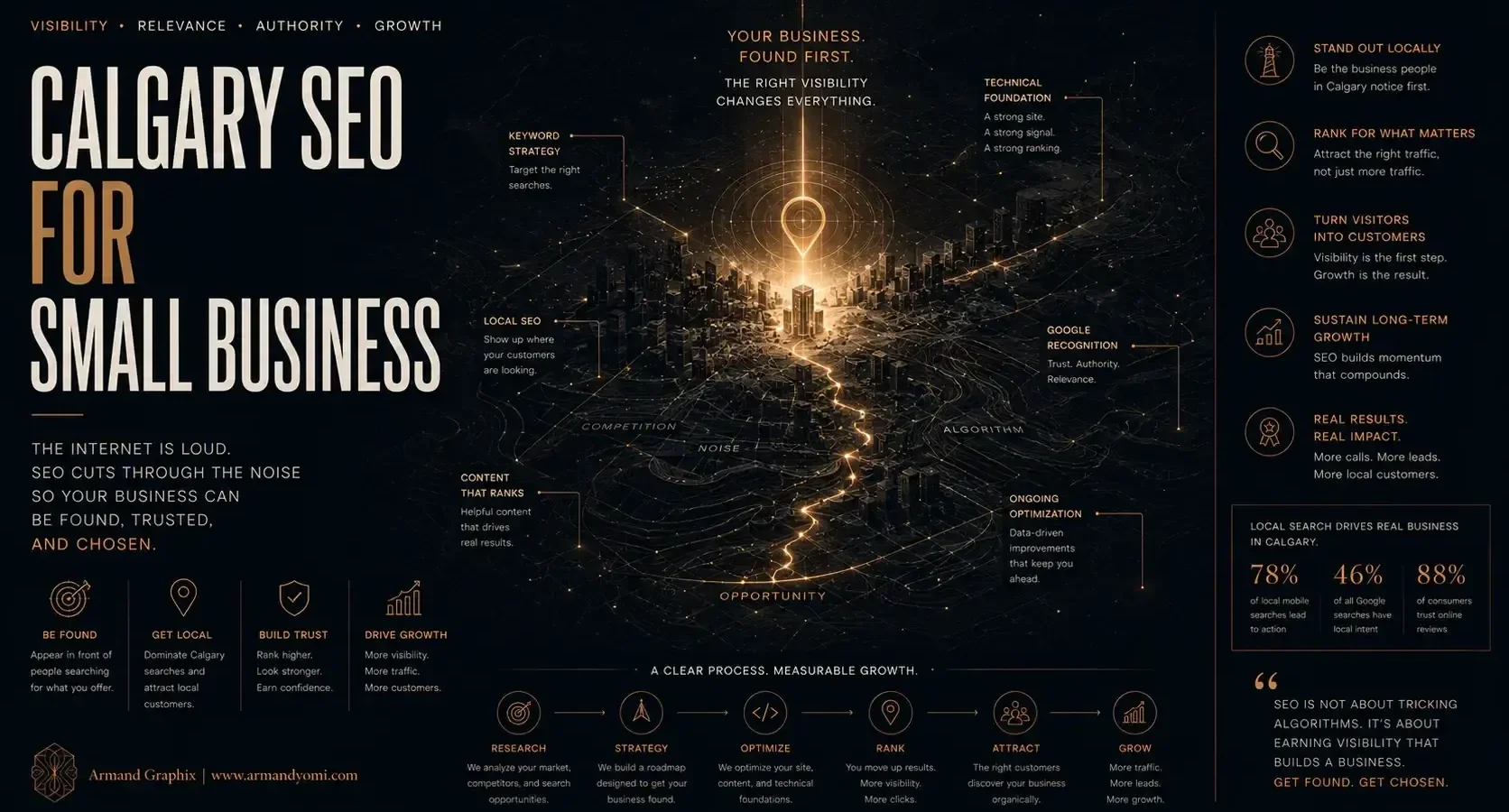
A beautiful brand that no one can find has a visibility problem, not a design problem. That is why calgary seo for small business matters so much. For local founders, service providers, and growing teams, search is often the first place trust is built, long before a form is filled out or a call is booked.
Small businesses do not need more random traffic. They need the right visibility. They need to appear when a customer is actively looking for what they sell, in the moment intent is strongest. Done well, SEO brings in people who are already searching for answers, options, and providers. That makes it one of the few marketing channels where strategy and timing can work in your favor at the same time.
“Turn Search Visibility Into Business Growth”
Build a stronger local presence, attract qualified leads, and compete more effectively in Calgary’s market.
Improve My Local Rankings →What Calgary SEO for Small Business Actually Means
SEO is often framed as rankings alone, but that is too narrow for a small business. Rankings matter, yes. What matters more is whether search helps your brand get discovered by the right audience, sends them to the right page, and gives them enough confidence to take the next step.
For a local business, that usually means showing up for service-based searches, branded searches, and problem-aware searches. A contractor might want visibility for kitchen renovation queries. A product-based brand may need category pages that attract shoppers who are comparing options. A consultant may benefit from educational content that captures interest early, before a buyer is ready to commit.
This is where many businesses lose momentum. They treat SEO as a technical add-on when it is actually part positioning, part content strategy, part user experience, and part market credibility. Search performance improves when your brand message is clear, your pages are structured properly, and your site makes sense to both people and search engines.
Why Small Businesses Struggle With SEO
Most small businesses are not failing because they lack effort. They are failing because the effort is scattered. One month they publish a blog post. The next month they tweak a headline. Then they pay for ads because organic traffic feels too slow. None of those choices are wrong on their own. The problem is the absence of a connected system.
There is also a deeper issue. Many websites are designed to look polished but not to guide search traffic into action. A homepage may be visually strong yet vague about services. A service page may mention everything at once and rank for nothing clearly. A blog may attract visitors outside the buying market. Traffic rises, but leads do not.
Small business SEO has to be selective. You do not need to rank for every high-volume term in your industry. You need to rank for the terms that fit your offer, geography, and buyer intent. That narrower focus is often what creates better results.
The Three Layers of SEO That Drive Results
The first layer is technical clarity. If your website loads slowly, breaks on mobile, or confuses search engines with weak structure, your content has a harder time performing. Technical SEO is not glamorous, but it protects everything else. Clean page titles, strong internal hierarchy, crawlable pages, and a fast user experience are not extras. They are foundational.
The second layer is content relevance. Your website needs pages built around real search behavior, not internal business language. Customers rarely search using the exact phrases a business uses to describe itself. They search by need, urgency, location, and outcome. Good SEO content reflects that reality while still sounding like your brand.
The third layer is conversion readiness. This is where design and marketing need to speak to each other. If your site attracts the right person but feels generic, cluttered, or uncertain, SEO has done its job only halfway. The page has to support belief. That includes strong messaging, visual consistency, clear calls to action, and proof that your business understands the customer problem.
How Local Intent Changes the Strategy
Calgary SEO for small business is not the same as national SEO. Local search has its own logic. Searchers often want reassurance that a business serves their area, understands the local market, and is close enough to respond quickly. That does not mean stuffing city names into every paragraph. It means using location naturally where it helps decision-making.
A local service business should usually have dedicated pages for its core offers, written with clear local relevance. A business with a physical presence also needs consistency across its local listings, contact details, and business information. Reviews, map visibility, and localized content can all strengthen trust signals.
Still, local SEO is not just about geography. It is about context. A Calgary-based wedding planner, for example, competes on style, price point, seasonality, and service model. A local search strategy needs to reflect those distinctions. If every competitor sounds the same, the one with the clearest message often wins.
Content That Pulls Its Weight
Not every business needs a high-volume publishing schedule. That approach can create noise without returns. For many small businesses, a tighter content strategy works better. Start with your core service pages. Make them specific, persuasive, and aligned with what customers actually search. Then build supporting content that answers common questions, explains your process, and addresses objections before they become barriers.
This is especially effective for founder-led and brand-conscious businesses. Search content should not flatten your voice into generic copy. It should translate your expertise into language that searchers understand. That balance matters. A brand can be expressive and optimized at the same time.
For creative businesses, this is where many opportunities are missed. Strong visuals attract attention, but search needs language. The right content gives your work context. It explains the value behind the design, the thinking behind the strategy, and the outcome behind the service. That is how a portfolio starts supporting discovery, not just validation.
What to Expect From SEO and What Not to Expect
SEO is a strong long-term growth channel, but it is not instant. Small businesses that expect page-one rankings in a few weeks usually end up disappointed or pushed toward low-quality tactics. Search performance depends on competition, site history, content quality, and how clear your offer is from the start.
That said, slow does not mean passive. A smart strategy can create early signs of progress before major rankings arrive. Better page structure can improve engagement. Clearer service pages can increase inquiries from existing traffic. A stronger keyword focus can help the right pages gain traction over time.
It also depends on your category. Some industries are highly competitive, and broad terms may take time to move. In those cases, targeting more specific search intent can be the smarter path. Sometimes the best SEO win is not chasing the biggest keyword. It is owning the most relevant one.
SEO Works Better When Brand and Strategy Align
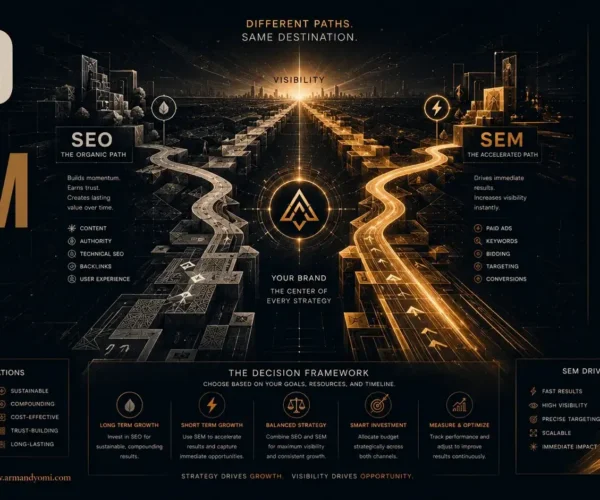
This is where the conversation gets more interesting. The best SEO is not detached from branding. It is strengthened by it. A business with a clear point of view, a distinctive visual identity, and confident messaging tends to convert better once search traffic arrives. Visibility gets people in the door. Brand gets them to stay.
That is why businesses that treat design, messaging, and search as separate projects often create friction for themselves. The website says one thing visually and another thing strategically. The content ranks but does not persuade. The ads bring attention, but the brand lacks cohesion. Growth becomes harder than it needs to be.
For small businesses that want both presence and performance, integration matters. A thoughtful SEO strategy should reflect how your brand speaks, what your audience values, and how your offer stands apart. That intersection is where traffic starts becoming trust.
If you are building a business that wants to be found and remembered, search should not feel like a technical chore sitting outside your brand. It should be part of the story your business tells in the market. At its best, SEO is not only about being seen. It is about being chosen.
“Turn Search Visibility Into Business Growth”
Build a stronger local presence, attract qualified leads, and compete more effectively in Calgary’s market.
Improve My Local Rankings →- WordPress Versus Custom Websites for Growing Brands
 WordPress versus custom websites: compare cost, speed, control, SEO, and growth to choose a site that supports your brand and business goals clearly.
 - What Does Brand Strategy Include for Growth?
 What does brand strategy include? Learn the research, positioning, identity, messaging, and marketing choices that turn a business into a distinct brand.
 - Packaging Design Guide for Retail Brands
 A packaging design guide for retail brands: build shelf impact, meet production realities, and turn a first glance into a confident purchase decision.
 - Multicultural Branding Trends 2026 for Modern Brands
 Multicultural branding trends 2026 will reward brands that pair cultural intelligence, inclusive design, and local relevance with measurable, real growth.
 - Custom Logo vs Template: What Fits Your Brand?
 Custom logo vs template: compare cost, speed, ownership, and brand impact to choose an identity that builds your launch, growth, and reputation today.
 - What Is a Visual Identity? Design That Builds Trust
 What is a visual identity? Learn how logos, color, typography, and systems create recognition, trust, and stronger brand growth for ambitious businesses.