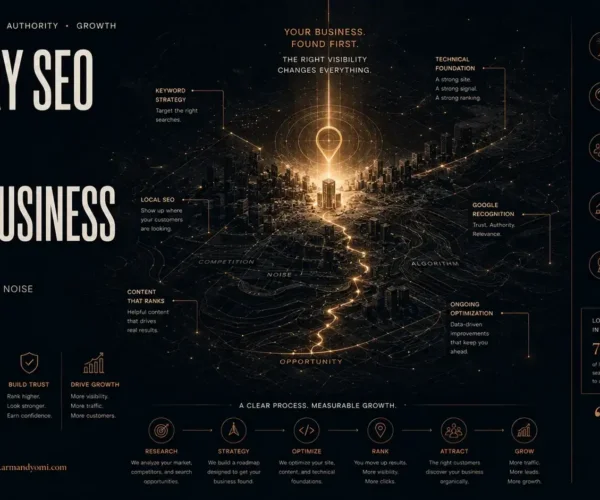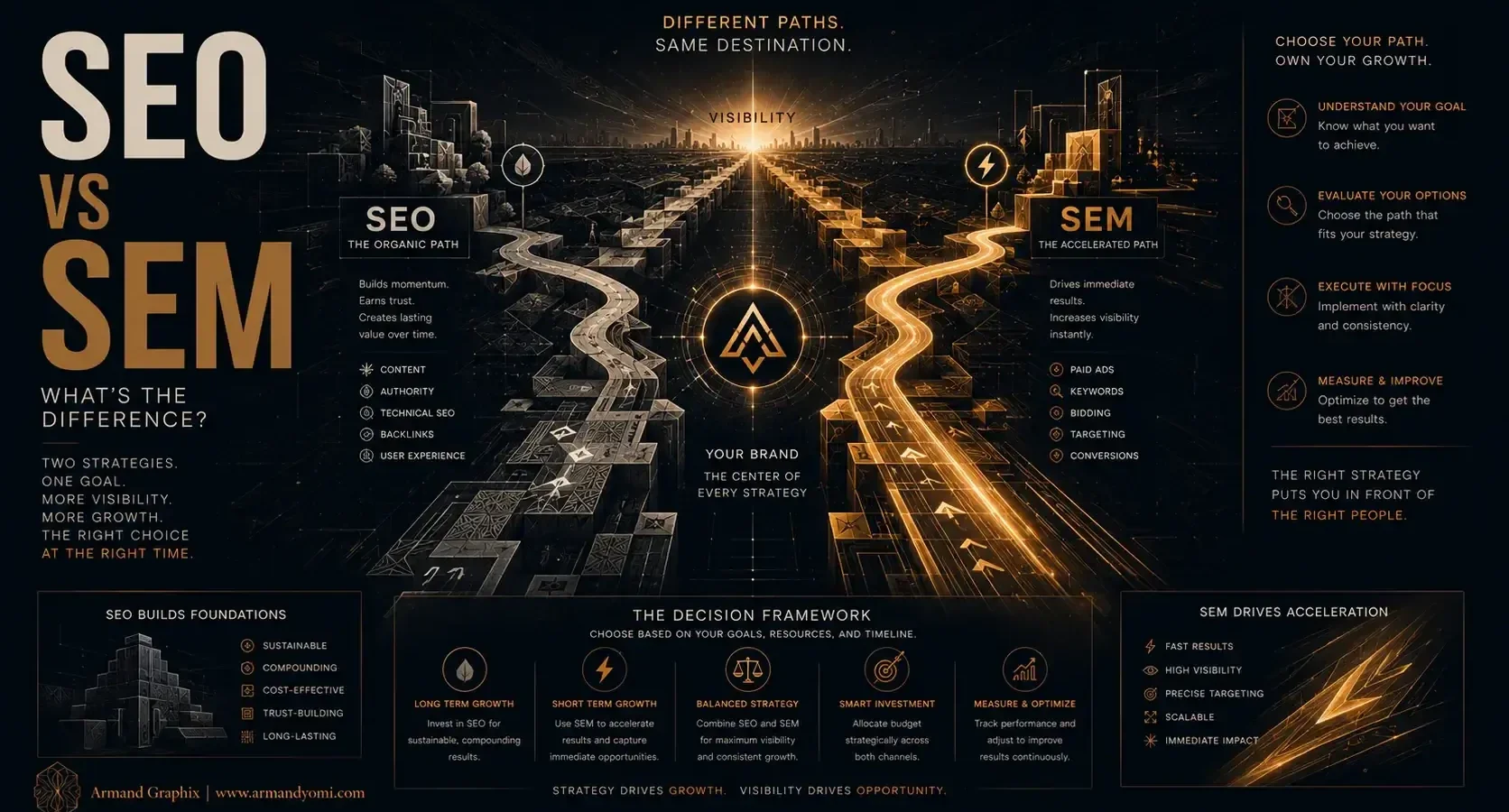
When a business says, “We need more traffic,” the real question is usually this: do you need visibility that compounds over time, or visibility you can buy right now? That is the core of the seo vs sem difference, and getting it wrong can waste budget, time, or both.
For founders, small business owners, and brand-led teams, this is not just a technical marketing choice. It affects how your brand is discovered, how fast you can test demand, and how efficiently you turn attention into revenue. SEO and SEM both help people find you in search, but they work in very different ways and support different stages of growth.
“Choose the right visibility strategy for your business”
Understand when SEO delivers long-term growth, when SEM drives immediate results, and how to use both strategically.
Get Expert Marketing Advice →SEO vs SEM difference in plain terms
SEO stands for search engine optimization. It is the work of improving your website so it can earn visibility in organic search results. That includes technical performance, content quality, page structure, keyword relevance, and overall site authority.
SEM stands for search engine marketing. In common usage, it usually refers to paid search advertising. You bid on keywords, create ads, and pay when someone clicks. Your visibility comes from budget, targeting, and ad performance rather than from organic rankings.
So the simplest seo vs sem difference is this: SEO earns placement, while SEM buys placement.
That simple distinction matters because each channel behaves differently. SEO builds momentum slowly and can keep paying off after the work is done. SEM works quickly, but the visibility typically stops when the spend stops.
How SEO works when you want long-term brand growth
SEO is often the better fit for brands that want to build durable visibility. If someone searches for your services, products, or expertise, strong SEO helps your site appear naturally in those results without paying for every click.
The challenge is timing. SEO is rarely immediate. It takes consistent work to create useful pages, improve technical health, align content with search intent, and earn trust in a competitive space. For a newer business, that can feel slow. For an established brand, it can become one of the most efficient acquisition channels over time.
There is also a branding advantage that people sometimes overlook. Organic visibility can increase perceived credibility. Users often trust strong organic results because they feel earned. If your site appears with well-written service pages, thoughtful content, and a clear visual identity, search becomes more than a traffic source. It becomes a proof point.
That is especially true for businesses selling expertise, design, consulting, or professional services. The click matters, but what the search result says about your brand matters too.
What SEO usually involves
SEO is not one task. It is a system. It typically includes keyword research, content planning, on-page optimization, site speed improvements, mobile usability, internal structure, metadata, and ongoing performance tracking.
For a creative or service-based business, good SEO also means translating what makes your brand distinctive into language people actually search for. That is where many businesses stall. They know their value, but their website speaks in internal brand language instead of search language.
How SEM works when speed matters
SEM is built for immediacy. You choose the keywords you want to appear for, set a budget, write ad copy, and launch campaigns. If your targeting is sharp and your landing page is strong, you can start attracting qualified traffic quickly.
That makes SEM useful in scenarios where timing matters. A new product launch, a seasonal campaign, a local promotion, or a service category that needs leads this month rather than next quarter can all be strong cases for paid search.
SEM is also valuable for testing. Before investing months into SEO for a keyword theme, you can run ads and see whether that audience converts. If it does, you gain both leads and market insight. If it does not, you avoid building long-form content around a weak opportunity.
Still, speed comes with a price. Competitive keywords can be expensive, and weak campaigns burn money fast. Paid search is not just about getting clicks. It is about paying for the right clicks and leading people to pages designed to convert.
What SEM usually involves
SEM includes keyword targeting, bid strategy, audience refinement, ad copywriting, landing page optimization, conversion tracking, and ongoing campaign management. It also requires discipline. Launching ads is easy. Running them profitably is not.
A campaign can look busy while underperforming. Plenty of impressions and clicks mean very little if they do not produce sales, inquiries, or qualified leads.
The biggest trade-offs between SEO and SEM
If you are weighing the seo vs sem difference, the real answer is not about which one is better in general. It is about which trade-off fits your business right now.
SEO usually offers lower long-term cost per acquisition, but it demands patience. SEM gives you speed and control, but usually at a higher direct cost. SEO is stronger for compounding visibility. SEM is stronger for immediate demand capture. SEO can support authority and education. SEM can support testing and fast lead generation.
There is also a creative trade-off. SEO often rewards depth, clarity, and relevance across your whole site. SEM is more concentrated. The message has to work fast, the offer has to be clear, and the landing page has to remove friction quickly.
If your site experience is weak, SEM may expose that weakness faster because you are paying to send visitors there. If your site experience is strong, SEM can amplify it.
When SEO makes more sense
SEO is often the better choice when you have a longer time horizon, a clear service offering, and the ability to invest in content and site quality consistently. It fits businesses that want to build search equity rather than rent attention.
It is also well suited to brands with complex buying journeys. If customers need time to compare, research, and understand your value, organic content can meet them at different stages. A thoughtful site architecture can answer early questions, support mid-funnel consideration, and capture high-intent searches later.
For example, a design studio, consultant, agency, or professional service provider often benefits from SEO because trust is built gradually. People want to understand your process, your point of view, and the quality of your work before they reach out.
When SEM makes more sense
SEM makes more sense when you need results on a shorter timeline, when you are entering a competitive market, or when you are promoting a specific offer with clear conversion intent. It is often the right move for launches, limited campaigns, and high-value services where one conversion can justify the ad spend.
It can also make sense when organic rankings are not yet realistic. A new website with little authority may struggle to rank for competitive terms. Paid search gives you a way to show up while your SEO foundation is still taking shape.
That is often the practical path for smaller brands. Build the long-term asset, but use paid search to create near-term momentum.
Why the smartest strategy is often both
For many businesses, SEO and SEM are not opposing choices. They are complementary tools.
SEO creates the infrastructure. It strengthens your website, clarifies your messaging, and improves discoverability over time. SEM creates acceleration. It puts your offer in front of people quickly, generates data, and helps you test what resonates.
Used together, they can sharpen each other. Paid search data can reveal which keywords convert best, which headlines get clicks, and which offers move people to act. That insight can improve your SEO content strategy. At the same time, a well-optimized site can improve paid performance by raising landing page relevance and conversion rates.
This is where strategy matters more than channel loyalty. A business that treats SEO and SEM as separate silos usually leaves value on the table. A business that aligns both around brand story, audience intent, and conversion goals tends to get stronger results.
How to choose the right mix for your business
Start with three questions. How fast do you need results? How much budget can you sustain? What happens after the click?
If speed is your priority and you have budget for testing, SEM can create immediate visibility. If your budget is tighter and your focus is long-term efficiency, SEO may deserve more attention. If your website, messaging, or offer still need refinement, either channel can underperform until that foundation improves.
This is why search strategy should not be isolated from brand strategy. The strongest campaigns are not just technically optimized. They are clearly positioned. They speak to the right audience, reflect a credible visual identity, and make the next step feel obvious.
That is also where creative and marketing need to work together. Search does not happen in a vacuum. People search, click, scan, judge, and decide. The message, the design, the structure, and the offer all shape the outcome.
For brands that care about both presence and performance, the goal is not simply more traffic. It is the right visibility, delivered in the right way, at the right stage of growth.
A good rule is simple: use SEO to build your foundation, use SEM to create momentum, and let your brand experience make both work harder.
“Turn Search Traffic Into Qualified Leads”
Build a smarter search strategy that increases visibility, attracts customers, and supports sustainable business growth.
Book a Strategy Consultation →- WordPress Versus Custom Websites for Growing Brands
 WordPress versus custom websites: compare cost, speed, control, SEO, and growth to choose a site that supports your brand and business goals clearly.
 - What Does Brand Strategy Include for Growth?
 What does brand strategy include? Learn the research, positioning, identity, messaging, and marketing choices that turn a business into a distinct brand.
 - Packaging Design Guide for Retail Brands
 A packaging design guide for retail brands: build shelf impact, meet production realities, and turn a first glance into a confident purchase decision.
 - Multicultural Branding Trends 2026 for Modern Brands
 Multicultural branding trends 2026 will reward brands that pair cultural intelligence, inclusive design, and local relevance with measurable, real growth.
 - Custom Logo vs Template: What Fits Your Brand?
 Custom logo vs template: compare cost, speed, ownership, and brand impact to choose an identity that builds your launch, growth, and reputation today.
 - What Is a Visual Identity? Design That Builds Trust
 What is a visual identity? Learn how logos, color, typography, and systems create recognition, trust, and stronger brand growth for ambitious businesses.