If you have invested in a new website, refined your brand, and started publishing content, the next question usually arrives fast: how long does SEO take? It is a fair question, especially for founders and small business owners who need visibility to turn into leads, not just nice-looking analytics.
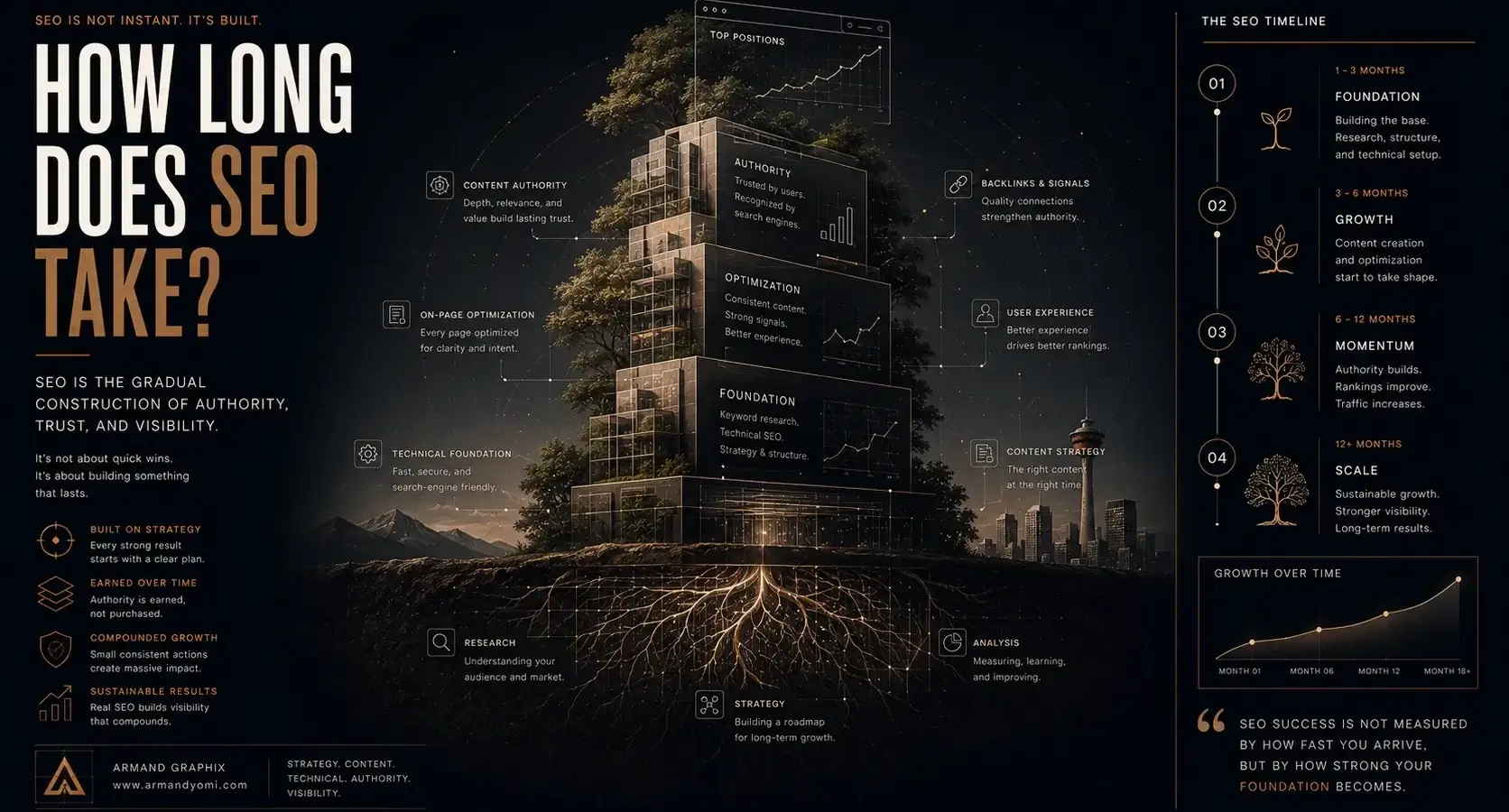
The honest answer is that SEO rarely works on a fixed clock. Most businesses start seeing meaningful movement in 3 to 6 months, while stronger, compounding results often take 6 to 12 months or longer. That range is not vague for the sake of it. It reflects how search engines evaluate trust, relevance, competition, and consistency over time.
SEO is less like flipping on paid traffic and more like building a brand reputation in public. The stronger your foundation, the faster momentum can build. The weaker the foundation, the longer it takes to earn trust.
“Understand What Really Drives SEO Growth”
Learn why SEO takes time, what factors influence results, and how a strategic approach creates sustainable visibility.
Understand SEO Timeline →How long does SEO take for most businesses?
For most small to mid-sized businesses, early signals can appear within the first few months. You may notice more pages getting indexed, small ranking gains, and impressions increasing in search results. These are encouraging signs, but they are not the same as strong business outcomes yet.
Around months 3 to 6, a well-executed strategy often starts producing more visible traction. Some target keywords move onto page one. Organic traffic becomes more consistent. A few inquiries or sales may begin to come directly from search.
The 6 to 12 month window is where SEO often starts proving its real value. At that stage, content has had time to mature, technical fixes have been processed, internal relevance is clearer, and backlinks may begin reinforcing authority. This is when many brands shift from asking whether SEO works to asking how to scale it.
That said, timelines change dramatically depending on your market. A local service business with a focused niche may move faster than an ecommerce brand competing nationally. A new domain usually takes longer than an established site with existing authority.
Why SEO takes time in the first place
Search engines are cautious by design. Their job is to rank the most trustworthy and useful results, not the newest pages or the brands with the biggest expectations.
When you publish a new page, Google still has to discover it, crawl it, understand its context, compare it with competing pages, and evaluate whether users find it valuable. That process is not instant. Even when your content is strong, search engines need enough signals over time to justify ranking it above established competitors.
There is also a compounding effect at work. One optimized page helps, but a connected system of relevant pages helps more. Technical performance supports content. Content supports authority. Authority supports rankings. Good SEO works because each part reinforces the others.
This is why rushed SEO often disappoints. If the strategy focuses only on keywords without considering user intent, site structure, or brand credibility, results stall. Design that tells your story is powerful, but strategy that grows your brand has to support discoverability too.
The biggest factors that affect how long SEO takes
Your website’s starting point
An established website with healthy technical structure, clear service pages, and some domain history has a head start. A brand-new site has to build trust from scratch.
If your site is slow, confusing, poorly structured, or missing core pages, SEO takes longer because basic issues need to be fixed before performance can improve. Search visibility is hard to build on a weak foundation.
The level of competition
Keyword difficulty matters. Trying to rank for broad, high-competition terms in law, finance, software, or ecommerce can take much longer than targeting a narrower service niche or a local audience.
Competition is not only about who ranks now. It is about how strong those brands are, how much content they publish, how many backlinks they have, and how clearly they match search intent.
Content quality and relevance
Thin pages rarely win. Search engines reward pages that answer real questions clearly, completely, and with enough depth to satisfy the searcher.
This does not mean every page should be long. It means every page should be useful. A focused service page, a thoughtful article, and a strong location page all serve different purposes. The common thread is relevance.
Technical SEO health
If search engines cannot crawl your site properly, understand your structure, or load your pages efficiently, rankings suffer. Technical SEO includes site speed, mobile usability, indexing, internal linking, metadata, page hierarchy, and more.
Technical work is not glamorous, but it shapes how easily your content can compete.
Backlinks and authority
Backlinks still matter because they act as trust signals. If credible websites mention or reference your brand, that can strengthen your authority. But quality matters more than volume.
A handful of relevant, trustworthy links can outperform dozens of weak ones. Building authority takes time, especially in competitive spaces.
Consistency
This is one of the most underestimated factors. SEO rewards sustained effort. Publishing strong content for two months and then disappearing usually does not create momentum.
Consistent optimization, content updates, and strategic refinement are what turn SEO from a cost into an asset.
What happens in each stage of an SEO campaign?
Month 1: Research, fixes, and foundation
The first month is usually less visible from the outside. This is where strategy is set. Keyword research is refined. technical issues are identified. Core pages are reviewed. Tracking is configured. Content gaps become clear.
This stage may not feel exciting, but it is where strong campaigns are built. Without it, later progress is often uneven.
Months 2 to 3: Implementation begins
This is where on-page optimization, technical improvements, internal linking, and early content production start taking effect. Search engines may begin reprocessing key pages.
You might see small ranking gains, especially for lower-competition terms. Traffic can begin rising, but often modestly.
Months 4 to 6: Early traction
At this point, a good strategy often starts becoming visible. More keywords rank. Better pages rise. Organic traffic gets steadier. Lead generation may begin improving.
If you are targeting local intent or niche service terms, this period can produce meaningful wins.
Months 6 to 12: Compounding growth
This is where the benefits of consistency show up. More indexed content creates more entry points. Authority grows. Existing pages can be refreshed based on real performance data.
Strong SEO campaigns often become significantly more efficient in this stage because you are no longer starting from zero.
How to speed up SEO results without cutting corners
You cannot force search engines to trust your site overnight, but you can remove delays.
Start by making sure your website is structurally sound. That means clear navigation, focused service pages, strong internal linking, fast loading, and mobile-friendly design. If your site looks polished but confuses users or crawlers, rankings will lag.
Then narrow your targeting. Many businesses slow themselves down by chasing broad keywords that are too competitive. A sharper strategy focuses on intent-rich phrases that match actual buying behavior.
Content should also be built around decision-making, not just traffic. A founder searching for pricing, process, comparisons, or service fit is often closer to converting than someone reading a generic top-of-funnel article.
Finally, align branding and SEO. This is where many businesses miss an advantage. A clear visual identity, persuasive messaging, and well-structured pages improve trust once visitors arrive. SEO gets people to the door. Brand presentation helps them step inside.
How long does SEO take if you’re a local business?
Local SEO can move faster than broader national campaigns, especially when the business has a clear service area, a complete business profile, strong reviews, and location-relevant content.
In some cases, local businesses can see meaningful gains in 2 to 4 months for lower-competition terms. In more competitive markets, it may still take 6 months or more. If multiple established businesses already dominate local search results, patience is still required.
For service businesses, the goal is not only rankings. It is qualified visibility. Ranking for the right local searches matters more than showing up for a large volume of irrelevant traffic.
The mistake that makes SEO feel slower than it is
The most common mistake is measuring SEO only by final rankings. Rankings matter, but they are not the whole story.
Sometimes SEO is already working before the headline metrics catch up. Impressions increase. More pages get indexed. Click-through rates improve. Branded search grows. Time on site improves. These signals suggest that your visibility and relevance are moving in the right direction.
A creative, strategic business should look at SEO the same way it looks at brand building. Momentum is often visible before dominance is obvious.
That is why the strongest SEO approach is rarely isolated. It works best when your site design, messaging, content, and search strategy are all telling the same story with clarity and confidence.
If you are asking how long SEO takes, the better question may be this: are you building something worth ranking? When the answer is yes, time stops feeling like a delay and starts acting like leverage.
“Build SEO Results That Last”
Discover the essential steps behind long-term search growth and create a strategy designed for consistent improvement.
Start Your SEO Strategy →- WordPress Versus Custom Websites for Growing Brands
 WordPress versus custom websites: compare cost, speed, control, SEO, and growth to choose a site that supports your brand and business goals clearly.
 - What Does Brand Strategy Include for Growth?
 What does brand strategy include? Learn the research, positioning, identity, messaging, and marketing choices that turn a business into a distinct brand.
 - Packaging Design Guide for Retail Brands
 A packaging design guide for retail brands: build shelf impact, meet production realities, and turn a first glance into a confident purchase decision.
 - Multicultural Branding Trends 2026 for Modern Brands
 Multicultural branding trends 2026 will reward brands that pair cultural intelligence, inclusive design, and local relevance with measurable, real growth.
 - Custom Logo vs Template: What Fits Your Brand?
 Custom logo vs template: compare cost, speed, ownership, and brand impact to choose an identity that builds your launch, growth, and reputation today.
 - What Is a Visual Identity? Design That Builds Trust
 What is a visual identity? Learn how logos, color, typography, and systems create recognition, trust, and stronger brand growth for ambitious businesses.