A polished logo can create a strong first impression. It cannot, on its own, tell people why they should choose you, what they should remember, or why your offer matters. So, what does brand strategy include? It includes the decisions beneath the design: the research, story, position, voice, visual direction, and market plan that give every customer touchpoint a clear purpose.
For founders, this work is often the difference between a business that looks professional and a brand people can recognize, trust, and recommend. Design that tells your story needs a strategy that gives that story focus.
What Does Brand Strategy Include?
Brand strategy is a practical system for shaping perception. It defines what your business stands for, who it serves, how it differs from alternatives, and how it should show up across design, messaging, and marketing.
The exact scope depends on your stage. A startup may need a clear foundation before launch. An established company may need to correct an outdated perception, enter a new market, or organize a growing collection of services. In either case, the strategy should make creative decisions easier and commercial decisions sharper.
Audience research and insight
A brand cannot speak clearly to everyone. Audience research identifies the people most likely to value your offer and the context around their decisions. That means looking beyond broad labels such as “women 25-45” or “small business owners.”
Useful insight asks what customers are trying to accomplish, what creates hesitation, what language they use, and what they expect from a business like yours. A premium skincare brand, for example, may be selling reassurance and ritual as much as ingredients. A Calgary construction company may be selling reliability, clarity, and reduced project risk as much as building services.
Research can include customer interviews, sales conversations, reviews, competitive analysis, search behavior, and internal knowledge from the people closest to clients. The goal is not to create a thick report that sits unread. It is to identify patterns that can guide positioning, messaging, and design.
Purpose, vision, and brand values
Purpose explains the contribution your brand wants to make beyond completing a transaction. Vision describes the future you are working toward. Values establish the principles that shape how you behave while getting there.
These ideas should not sound like generic wall art. “Quality,” “integrity,” and “innovation” are common claims, but they mean little unless they influence real choices. If accessibility is a value, does your website use readable type, clear navigation, and inclusive imagery? If craftsmanship is a value, does your packaging, customer service, and product presentation support that promise?
A strong foundation gives a business a consistent center. It is especially useful when a founder is making fast decisions, adding team members, or expanding into new channels.
Positioning and differentiation
Positioning answers a direct market question: why this brand instead of another option? It is not a slogan. It is the strategic space a business can credibly own in the customer’s mind.
Good positioning sits at the intersection of audience need, business strength, and market opportunity. It should be specific enough to create distinction, but believable enough to deliver consistently. A restaurant cannot simply declare itself “the best.” It may, however, own a more focused position such as contemporary West African dining built around communal experiences, refined presentation, and cultural storytelling.
Differentiation does not always mean inventing a category. It can come from a distinctive process, a clearer audience focus, a better service experience, a more compelling point of view, or a recognizable visual world. The trade-off is that sharper positioning may make you less relevant to people who were never a strong fit. That is usually a strength, not a problem.
Brand story and core messaging
People remember a clear point of view more easily than a list of features. Brand storytelling organizes your purpose, customer insight, and positioning into language that feels human and useful.
This usually includes a core brand narrative, a value proposition, key messages, service descriptions, and proof points. It can also define how to talk about your origin, your process, your results, or the change you help clients create.
The best messaging does not force every sentence to sound poetic. It balances emotion with clarity. A creative studio might lead with the belief that design can make a business feel more credible before the first conversation. A financial advisor may lead with confidence and practical guidance during major life decisions. Different industries require different levels of warmth, authority, detail, and restraint.
Messaging should also account for the buyer journey. A new visitor needs a quick explanation of what you do and why it matters. A buyer comparing options needs evidence, process details, and a reason to trust your expertise. A returning customer needs reinforcement that they made the right choice.
Brand personality and voice
Your brand voice is the character of your communication. It affects headlines, sales decks, social captions, email campaigns, proposals, and customer support. Without a defined voice, a brand can sound polished on its website and entirely different on social media.
A voice framework often sets a few traits and their boundaries. For example, a brand can be confident without becoming arrogant, creative without becoming vague, or friendly without sounding overly casual. The point is not to make every piece of writing identical. It is to make it recognizable.
Tone can shift by context. A campaign may be energetic. A service issue should be calm and direct. A product launch can carry more personality than a legal policy page. Strategy establishes the consistent character beneath those shifts.
Visual identity and design direction
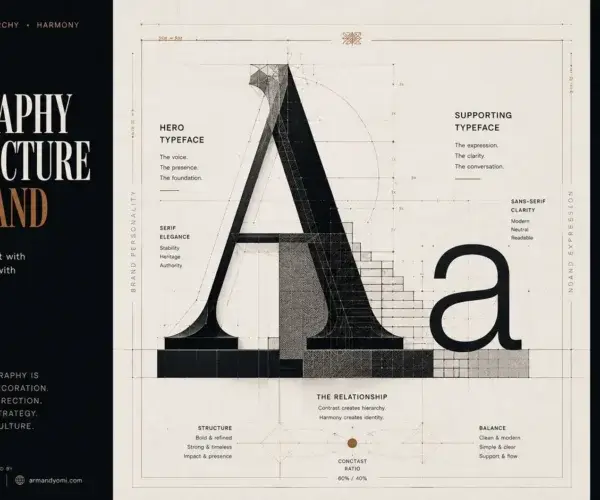
Visual identity is the most visible part of brand strategy, but it should be informed by the work that comes before it. The logo, color palette, typography, photography, illustration style, layout system, packaging, and motion principles should communicate a deliberate position.
If your business is positioned as precise, premium, and considered, every visual choice needs to support that feeling. If it is built around community, cultural energy, and accessibility, the system may need a warmer and more expressive direction. Neither approach is automatically better. The right answer depends on your audience, category, offer, and goals.
A complete identity system also considers application. A mark that looks impressive in a presentation but fails on social media, storefront signage, mobile screens, or a product label is not doing enough work. Strategic design anticipates the places customers will actually encounter the brand.
Brand experience across touchpoints
Your brand is not limited to what people see. It is what they experience at every point of contact: the website, inquiry process, proposal, onboarding, product, packaging, follow-up, and social presence.
This is where strategy becomes operational. If your message promises a thoughtful, high-end experience, an unclear quote or slow follow-up creates a disconnect. If you position your business around simplicity, customers should not have to work hard to understand your offer or book your service.
Mapping touchpoints helps identify gaps between promise and reality. It also reveals opportunities to create memorable details, whether that is more helpful product education, a stronger unboxing moment, or a clearer post-purchase communication flow.
Marketing alignment and measurement
A brand strategy should support growth, not sit apart from it. SEO, paid search, social media, email, content, and partnerships work better when they share a consistent position and message.
For example, search campaigns can capture people actively looking for a service, while social content can build recognition before a need becomes urgent. The visual system and voice should make those efforts feel connected, even when the format changes. Strategy gives performance marketing something more valuable than attractive assets: a clear idea to repeat and reinforce.
Measurement depends on the goal. A rebrand may aim to improve lead quality, sales conversion, customer retention, search visibility, or perceived value. Not every result appears immediately, and not every valuable outcome fits neatly into a dashboard. Still, defining success early makes it easier to judge whether the work is moving the business forward.
The Difference Between Brand Strategy and Brand Identity
Brand strategy is the thinking. Brand identity is the expression of that thinking. Strategy determines the role your brand should play in the market; identity gives that role a visual and verbal presence.
You can create an attractive identity without strategy, but it often becomes subjective. Decisions turn into personal preferences about colors and logos rather than choices tied to customers and business goals. You can also write a smart strategy without giving it a strong identity, but it may never earn attention or emotional recall.
The strongest brands connect both disciplines. They pair insight with craft, story with structure, and creative expression with measurable market intent.
When to Revisit Your Brand Strategy
A strategy is not permanent. It should evolve when the business changes in a meaningful way. That may happen when you launch a new offer, target a different audience, raise your prices, enter a new region, merge services, or discover that customers describe your value differently than you do.
A visual refresh alone may be enough if the business direction is still clear and relevant. But if the core offer, audience, or competitive landscape has shifted, it is worth revisiting the foundation before investing in new design. Reworking a logo without addressing unclear positioning can leave the real problem untouched.
The most useful brand strategy creates momentum. It gives founders language for their value, designers a rationale for their choices, and marketers a direction for attracting the right people. When every element works from the same idea, your brand becomes easier to recognize and far easier to grow.