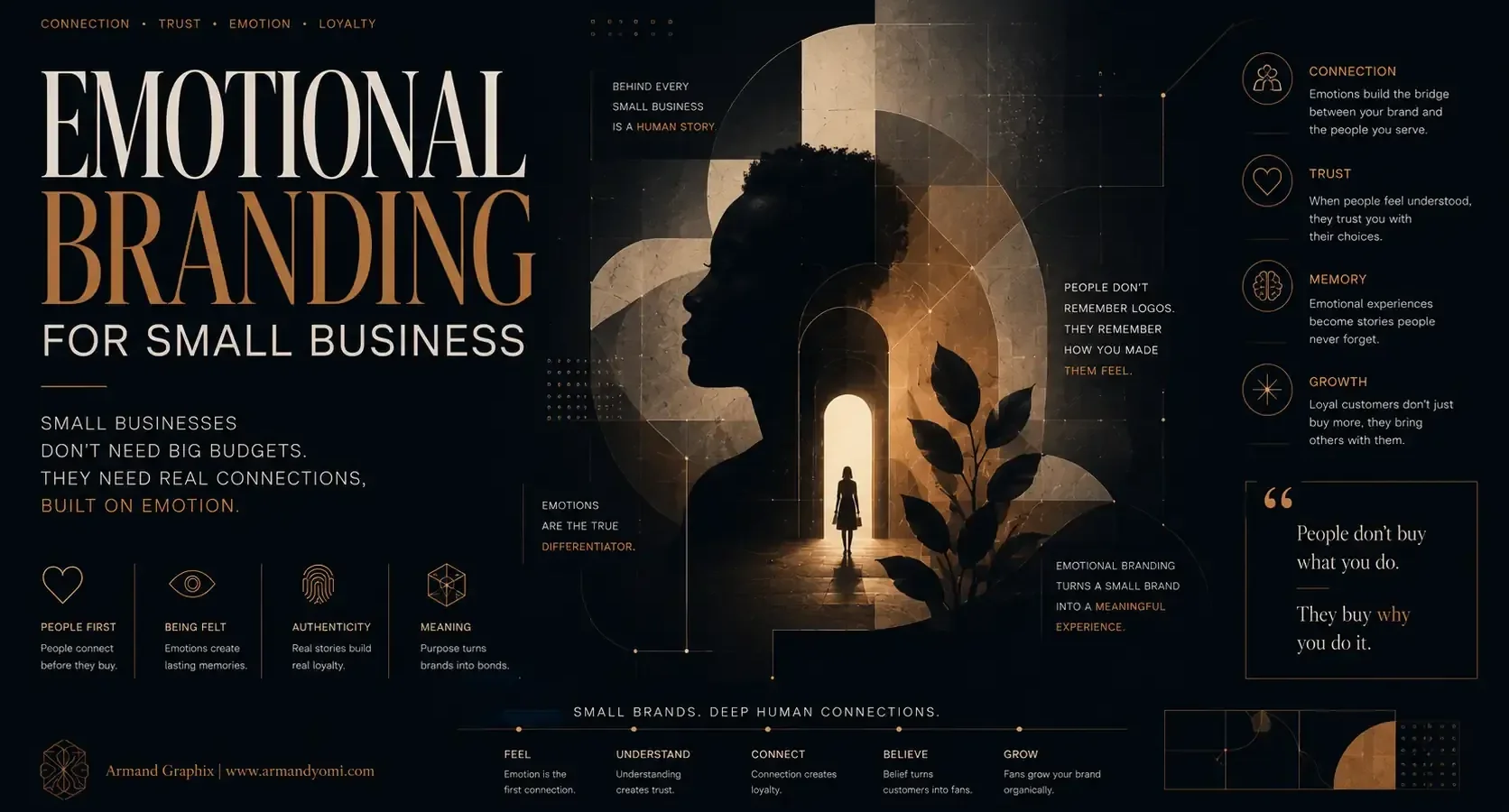
A customer rarely remembers every feature you listed. They remember how your brand made them feel when they first saw your packaging, landed on your website, or read your message. That is why emotional branding for small business matters so much. It is not decoration. It is the layer of meaning that turns a business into something people recognize, trust, and return to.
Small businesses often assume emotional branding belongs to global brands with giant budgets and polished campaigns. In practice, smaller brands may have a stronger advantage. They are closer to their audience, closer to their story, and often built around a founder’s real point of view. That kind of proximity can create a level of connection that large companies spend years trying to manufacture.
What emotional branding for small business really means
Emotional branding for small business is the practice of shaping how people feel about your company, not just what they know about it. It brings together visual identity, messaging, customer experience, and brand story to create a response that goes beyond awareness.
That response might be trust. It might be excitement. It might be relief, ambition, pride, or belonging. The point is not to force emotion for the sake of marketing. The point is to understand which feeling supports your value and helps the right audience see themselves in your brand.
A bookkeeping firm, for example, does not need to be dramatic. It may need to create calm and confidence. A skincare startup may need to create self-assurance and ritual. A local coffee brand may need to create warmth and community. Different businesses need different emotional outcomes.
This is where many small brands go off track. They copy the visual trends of bigger competitors without asking what emotional position they actually want to own. Looking modern is not a strategy. Looking expensive is not always right either. If your audience needs clarity and honesty, a luxury aesthetic can work against you.
Why small businesses benefit more than they think
Price is easy to compare. Features are easy to copy. Emotional connection is harder to replace.
For a small business, that matters. You may not have the ad budget of a major competitor. You may not have national recognition or a large sales team. What you can build is a brand people remember for the right reasons. That memory creates stronger referrals, better retention, and more patience from customers who believe in what you offer.
Emotional branding also sharpens decision-making inside the business. When you know the feeling your brand should leave behind, your choices become more consistent. Your website design, social presence, typography, photography, packaging, and campaign language start pulling in the same direction.
Consistency is not just a visual issue. It is a trust issue. Customers notice when a business claims to be premium but looks rushed, or claims to be human but sounds automated. Strong brands reduce that friction.
The foundation is not emotion alone
There is a trade-off worth being clear about. Emotional branding works best when the business behind it is credible.
A compelling identity can attract attention, but it cannot fix a weak offer, poor service, or confusing customer journey. If your brand promises care and your checkout process feels frustrating, the emotional message collapses. If your visuals communicate quality but your product disappoints, the gap becomes obvious.
So the goal is not to make people feel something in isolation. The goal is alignment. Design that tells your story has to be supported by strategy that grows your brand.
That alignment is often what separates attractive branding from effective branding.
Start with your emotional position
Before choosing colors or writing taglines, define the emotional position your brand should hold in the customer’s mind. This is more specific than deciding to be inspiring or friendly.
Ask a sharper question: when the right customer interacts with your brand, what should they feel that makes choosing you easier?
For one business, the answer may be confidence. For another, it may be creative energy. For another, reassurance during a stressful purchase. The right answer depends on your market, your offer, and the emotional tension your audience already feels.
A founder selling premium handmade products may need buyers to feel they are purchasing something thoughtful and personal, not mass-produced. A consultant may need prospects to feel they are finally speaking to someone who understands the complexity of their challenge. A restaurant brand may need guests to feel both curiosity and comfort.
That emotional position becomes a strategic filter. If an idea does not reinforce it, it probably does not belong in the brand.
Story gives the brand emotional weight
People connect to story because story provides context. It tells them why your business exists, what shaped it, and what it stands for beyond transactions.
For small businesses, this does not mean writing a dramatic founder biography and placing it on an About page. It means identifying the narrative threads that make your brand meaningful and relevant.
Maybe your business was built to solve a frustration you lived through yourself. Maybe your product reflects a cultural perspective missing in your category. Maybe your service approach exists because clients in your industry are used to being confused, ignored, or oversold. These are not side notes. They are strategic assets.
The strongest brand stories are grounded, not inflated. They make a business feel real. They also help customers remember you in language they can repeat to others.
Design is where emotion becomes visible
Your visual identity is often the first emotional signal people receive. Before anyone reads your service list or product details, they are already forming an impression from your logo, layout, typography, imagery, motion, and color decisions.
This is why design should not be treated as surface polish. It is communication.
Typography can create authority, softness, edge, or clarity. Color can suggest energy, calm, trust, warmth, or exclusivity. Photography can make a brand feel intimate or distant, editorial or approachable. Even spacing and composition affect how premium or chaotic a business appears.
The best visual systems do not simply look good in isolation. They reflect the emotional position behind the brand. A wellness brand built around calm should not feel visually noisy. A bold fashion label should not feel timid. A family-focused service should not feel cold and overly corporate unless that contrast serves a very specific purpose.
It depends, of course, on your audience. A minimalist system can feel elegant to one market and empty to another. A vibrant identity can feel expressive in one context and unrefined in another. Emotional branding is never one-size-fits-all.
Customer experience either proves or weakens the brand
Many businesses stop at logo and messaging, then wonder why the brand does not create loyalty. Emotion is reinforced through experience.
How quickly do you respond to inquiries? How clear is your proposal? Does your website guide people smoothly or make them work too hard? Does your packaging feel intentional? Does your tone stay consistent from Instagram caption to invoice?
Each touchpoint either supports the brand feeling or interrupts it.
If your brand promises ease, the process should feel easy. If your brand promises thoughtful service, small details should show care. If your brand promises expertise, your communication should feel precise and confident. Emotional branding becomes credible when the operational experience matches the creative presentation.
How to apply emotional branding without forcing it
The smartest approach is focused, not theatrical. You do not need exaggerated copy or sentimental campaigns to create emotional connection. Often the strongest signals are subtle.
Start by identifying the emotional gap in your category. What are customers tired of feeling when they deal with businesses like yours? Confused, rushed, ignored, intimidated, overwhelmed? Your brand can position itself as the alternative.
Then build from there. Clarify your story. Refine your visual identity around one clear emotional direction. Audit your messaging for tone and consistency. Review your customer journey from first impression to follow-up.
This is also where outside perspective helps. Founders are often too close to their own business to see what the brand is actually communicating. A strategic creative partner can translate instincts into a brand system that feels distinct and market-ready.
The brands people remember make people feel seen
At its best, emotional branding is not manipulation. It is recognition. It tells your audience, we understand what matters to you, and we built this brand with intention.
That is why some businesses feel immediately magnetic while others feel interchangeable. The difference is rarely volume. It is resonance.
If you are building a small business with serious ambitions, do not treat branding as the final layer you add once everything else is done. Build the emotional meaning early, shape it carefully, and let every design and marketing decision support it. People may forget your pitch faster than you expect. They will remember the feeling if you get it right.
A strong brand does more than get noticed. It gives people a reason to care.