A logo usually gets judged in under a second. Before anyone reads your copy, clicks your site, or tries your product, they see the mark. That is why understanding what makes a strong logo is not a matter of taste alone. It is a business decision. The right logo can sharpen recognition, build trust, and give your brand a visual center of gravity. The wrong one can make even a strong offer feel uncertain.
For founders, startups, and growing brands, this matters more than many realize. A logo is not your whole brand, but it is often the first signal people use to decide whether your brand feels established, premium, playful, disruptive, or forgettable. Strong logos work because they carry meaning with control. They do not try to say everything. They say the right thing, clearly.
What makes a strong logo in practice
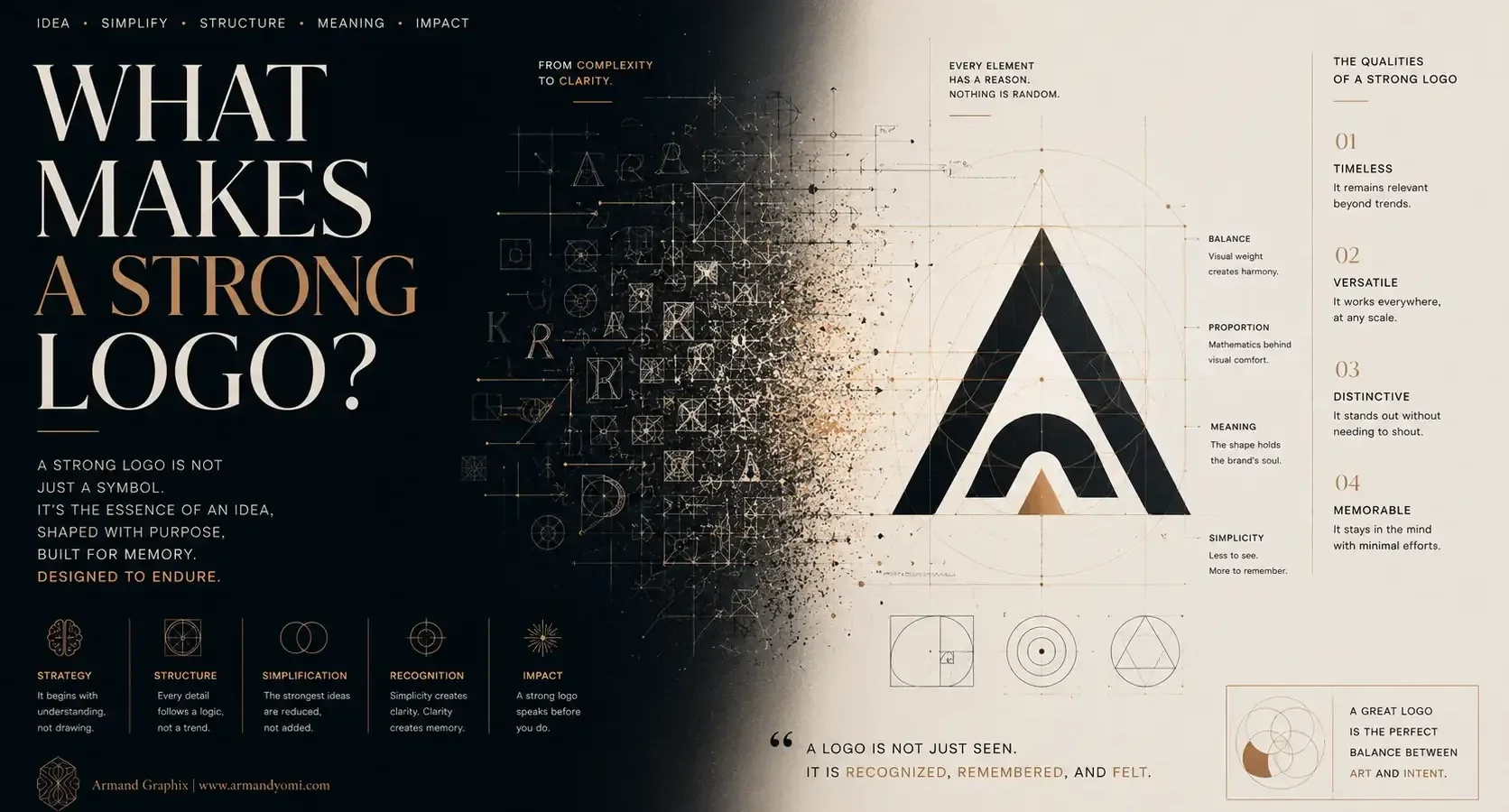
A strong logo is clear, distinctive, relevant, and usable across real-world brand touchpoints. That sounds simple, but each part carries weight.
Clarity means people can recognize the mark quickly. If a logo is too detailed, too abstract without purpose, or too dependent on effects, it starts losing power the moment it shrinks. Distinctiveness means it avoids looking like every other business in the category. Relevance means it fits the brand’s positioning, audience, and personality. Usability means it still works on a website header, a social profile, packaging, signage, business cards, and paid ads.
The strongest logos are usually disciplined. They are built with restraint. They know what to emphasize and what to leave out.
A strong logo is simple, not empty
Simplicity is often misunderstood. It does not mean plain. It means focused.
When a logo is simple, the eye understands it faster. That speed matters because brand recognition is built through repetition, and repetition only works when the visual is easy to recall. Think about how many places a logo has to live now – app icons, mobile screens, video intros, favicons, storefronts, product labels. Complexity tends to fall apart across those environments.
That said, simple does not mean generic. A circle with a random sans serif wordmark is not automatically strong. Simplicity needs tension, character, and intention. The best marks often have one memorable move – a proportion, a shape relationship, a custom letterform, or a subtle twist that gives the logo its signature.
This is where many DIY logos miss the mark. They remove detail but never build identity.
Memorability comes from difference
If your logo could be swapped with a competitor’s and nobody would notice, it is not doing enough work.
Memorability is one of the clearest answers to the question of what makes a strong logo. People do not remember logos because they are crowded with ideas. They remember them because one idea comes through cleanly. That could be a strong silhouette, an unexpected geometry, a confident use of negative space, or a wordmark with unmistakable rhythm.
The trade-off is that memorability rarely comes from following trends too closely. Gradient overload, lookalike minimalist tech branding, or overused startup symbols can make a logo feel current for a moment but forgettable over time. A trend can be a reference point, but it should not become the whole design strategy.
Distinctiveness also needs market awareness. If you are branding a law firm, a kids’ product, and a luxury skincare line the same way, something is off. Strong logos understand category codes, then choose where to align and where to stand apart.
Relevance matters more than decoration
A logo should feel like it belongs to the brand it represents. That is relevance.
This is why strategy has to come before sketching. You need to know the brand story, the customer, the positioning, the emotional tone, and the business goal. Is the brand trying to feel premium or accessible? Heritage-driven or future-facing? Local and personal or global and scalable? Bold and cultural or minimal and technical?
A strong logo translates those decisions into form. Typography, spacing, symbol style, and color direction should all support the same message. If the business sells handcrafted products with a warm human story, an ultra-corporate mark may create distance. If the company is a serious B2B service provider, a playful logo might undermine trust.
Relevance is also cultural. Symbols, colors, and visual references do not communicate the same way in every audience or market. Good logo design pays attention to that. It avoids visual shortcuts that flatten the brand or send mixed signals.
Typography often does the heavy lifting
When people think about logos, they often focus on symbols. In reality, typography is often what gives a logo its voice.
A strong wordmark can be more powerful than an unnecessary icon. Letterforms carry personality with precision. They can feel editorial, luxurious, technical, athletic, refined, rebellious, or grounded depending on how they are built. The spacing, weight, curves, and proportions all shape perception.
This is especially important for newer brands that need name recognition first. If your audience does not know your name yet, a smart typographic logo can be more useful than a symbol that requires explanation.
Custom typography tends to create stronger long-term value than default type choices. Not because everything must be dramatically bespoke, but because even subtle refinements can turn a decent logo into an ownable one. A small adjustment in the terminals, a unique ligature, or a more intentional structure can make the identity feel designed rather than assembled.
What makes a strong logo across platforms
A logo is not strong if it only looks good in a presentation file.
It has to perform in use. That means it should work in black and white, in small sizes, in horizontal and stacked formats, and on different backgrounds. It should remain recognizable on mobile and still feel polished at large scale. If a logo depends on shadows, fine lines, or intricate gradients to make sense, it is carrying too much fragility into the market.
Versatility is not glamorous, but it is part of what makes a strong logo commercially effective. A brand identity needs range. A primary logo, a secondary lockup, a symbol, and clear rules for spacing and color use can make the system more resilient.
This is where strategic design pays off. You are not just creating a nice mark. You are creating an asset the business can use consistently while it grows.
Good logos support brand systems
A logo should not be expected to tell the whole story alone.
Some businesses overload the logo because they want it to communicate every value, every product category, and every emotional cue at once. That almost always weakens the result. A strong logo works best inside a broader identity system that includes typography, color, imagery, layout behavior, messaging, and digital presence.
That system is where the deeper storytelling happens. The logo sets the tone. The rest of the brand builds the world around it.
For businesses that care about visibility and growth, this connection matters. Your logo may create first recognition, but your website, packaging, social media, ad creative, and content are what reinforce meaning over time. Design that tells your story works best when every touchpoint carries the same visual logic.
The strongest logos age well
A logo does not need to be timeless in a mythical sense, but it should have enough design integrity to last.
That means avoiding choices that are based purely on what is fashionable this year. It also means building with a clear concept instead of surface effects. When the core idea is strong, a logo can evolve gracefully without losing its identity.
Rebrands often happen not because a company outgrew its audience, but because the original logo was built on weak foundations. Maybe it was too trendy, too generic, too hard to apply, or too disconnected from the brand’s actual position. A stronger logo from the start reduces that friction.
At the same time, longevity does not mean rigidity. Brands grow. Markets shift. Audiences change. A good logo leaves room for the brand to expand without becoming visually trapped.
So what actually makes a strong logo?
It comes down to alignment. A strong logo aligns design craft with brand strategy. It is simple enough to remember, distinctive enough to own, relevant enough to feel right, and flexible enough to work everywhere the brand shows up.
It also respects a basic truth many businesses learn late: the best logos are not the ones that say the most. They are the ones that create confidence fastest.
If you are evaluating your own logo, ask a harder question than whether you personally like it. Ask whether it reflects your position in the market, whether it is recognizable without effort, and whether it can carry your brand consistently as you scale. That is the standard worth designing for.
A strong logo does not just look professional. It gives your brand a sharper voice before you say a word.